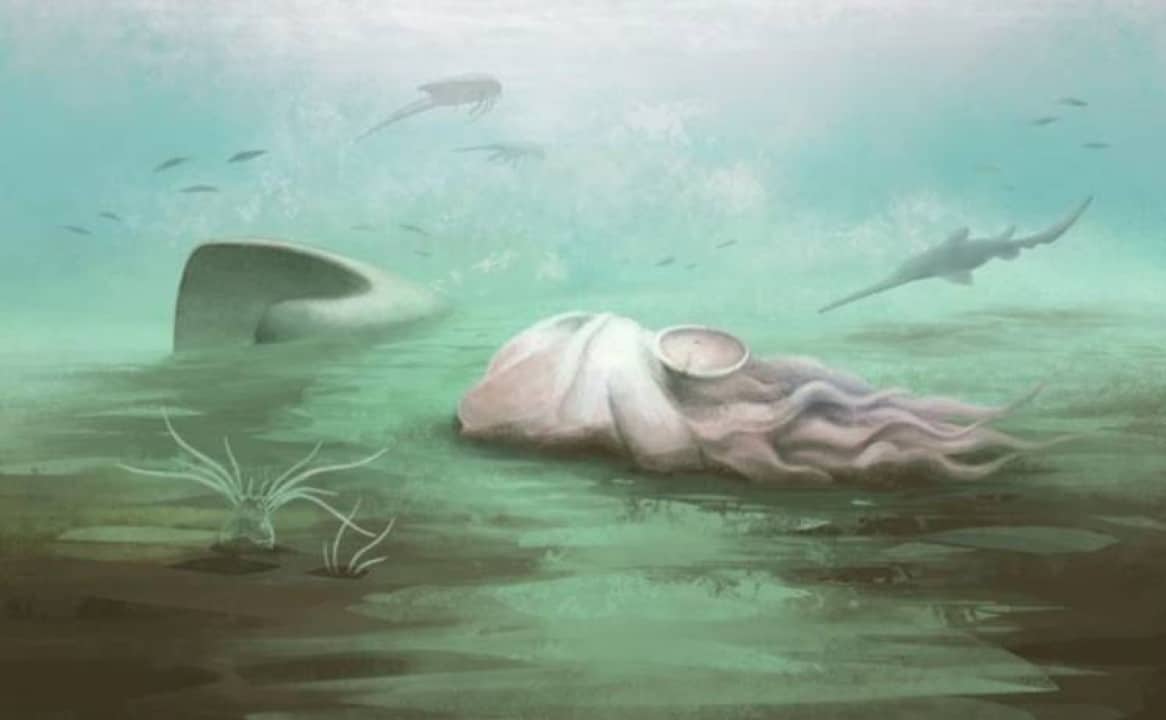
An approximately 300 million year old marine fossil, discovered in the southern region of Chicago, nos Estados Unidos, has undergone taxonomic reclassification after more than two decades of incorrect identification. The specimen, which has been listed in scientific records as the world’s oldest octopus since 2000, actually belongs to an extinct lineage of relatives of modern nautiluses. The correction took place through high-precision imaging tests that detected previously invisible internal structures in the rock. The study on the animal’s new identity was published on April 8, 2026 in the magazine Proceedings of the Royal Society B. Pesquisadores of Universidade of Reading, no Reino Unido, led the investigation that changed the understanding of the piece. The discovery adjusts data on the presence of primitive cephalopods in ancient oceans.
The role of synchrotron technology in structural research
The change in the classification of marine organisms depended directly on the application of images generated by synchrotron. Esse equipment works as a particle accelerator capable of producing powerful x-ray beams, with brightness greater than that of sunlight. The technique allows scientists to perform three-dimensional scans of the interior of dense rocks without needing to break down the fossilized material. The method reveals microscopic details of the internal anatomy that remain hidden during conventional superficial analyses.
During the first evaluations of the fossil, carried out in the early 2000s, experts used scanning electron microscopes. Esses instruments were limited to mapping the external topography of the piece, resulting in an interpretation based only on the visible shape of the contour. The light generated by the synchrotron was able to penetrate the mineral layers and map the fossilized organs with unprecedented resolution. Technological advances provided definitive data to resolve the morphological doubts that some paleontologists had already raised about the specimen.
The main element revealed by the new scan was the radula, a mouth structure used by molluscs to scrape and ingest food. The X-ray equipment identified the exact preservation of the animal’s row of teeth within the rock matrix. The visualization of this internal organ provided the necessary comparative basis to compare the characteristics of the fossil with living and extinct cephalopod species.
Anatomical differences and the effect of decomposition
Analysis of the radula demonstrated that the animal had at least 11 teeth arranged in each row of its food structure. Esse number directly contrasts with the anatomy of known octopuses, which have a restricted pattern of seven to nine teeth in this same region. The incompatible tooth count represented the central piece of evidence that ruled out the specimen’s membership in group Octopoda. The researchers cross-referenced this morphological data with databases from other mollusk families to find the correct match.
The external shape of the fossil, which misled scientists for 26 years, resulted from a severe process of organic deterioration. The study indicated that the animal’s body underwent several weeks of decomposition on the seabed before being completely buried by sediment. Esse Prolonged rotting disfigured the original structure of the organism, creating folds and elongations that simulated the appearance of long, thin arms and a soft body characteristic of octopuses.
The proportions of the supposed tentacles were already generating isolated debates in the scientific community, as they did not display the typical marks found in other records of primitive octopuses. With the new identification, the visible traces came to be understood as distorted remains of an ancestor of the nautilus. Esses marine animals have a distinct body configuration, often associated with the presence of internal or external shells. The optical illusion generated by atypical fossilization demonstrates how environmental factors mask the true biological identity of ancient species.
Impacts on the chronology of marine biology
The specimen was rescued from geological deposits from the period Carbonífero located in the south of the city of Chicago. Essa North American region is home to rock formations that offer exceptional chemical conditions for the preservation of soft tissues of prehistoric marine animals. Carbonífero was characterized by a wide diversification of oceanic fauna, and the correct cataloging of the inhabitants of this era provides essential data on the geographic distribution of primitive molluscs.
Removing this fossil from the octopus category significantly alters the evolutionary timeline of this specific group of cephalopods. The estimated age of 300 million years placed the emergence of octopuses much earlier than other evidence suggested. With the reclassification, the oldest confirmed records of true octopuses are once again concentrated in the range approximately 90 million years ago.
Taxonomic correction generates direct consequences in evolutionary biology studies and in the classification of extinct species:
- Adjusts mathematical models on the mutation rate and genetic divergence of cephalopods.
- Redefines the nautilus family tree, adding a new extinct relative to period Carbonífero.
- Establishes a new verification protocol for soft-body fossils that have ambiguous shapes.
Review of collections and research procedures
The case of the Chicago fossil drives a methodological shift in the way scientific institutions deal with ancient collections. The discovery that decomposition can forge entire anatomical features alerts experts to the need to re-examine other dubious pieces stored in museums around the world. The use of synchrotron light emerges as a recommended standard tool to validate paleontological descriptions based solely on external morphology.
The work carried out by the Universidade team involved partnerships with international laboratories that guaranteed the time of use in the particle accelerator. Publication of the results in the British journal ensured that the data went through a rigorous peer review process before official release. The original fossil remains in the custody of institutions no. Estados Unidos, remaining available for future investigations if new scanning technologies are developed.
The relocation of the specimen in the tree of life does not reduce the historical importance of the discovery made in the rocks of Chicago. The piece consolidates the understanding of the anatomy of nautilus relatives and provides concrete material for the study of fossilization conditions in low-oxygenation marine environments. Paleontólogos continue to map the region in search of new specimens that can complement the structural information revealed by the recent X-ray scan.
