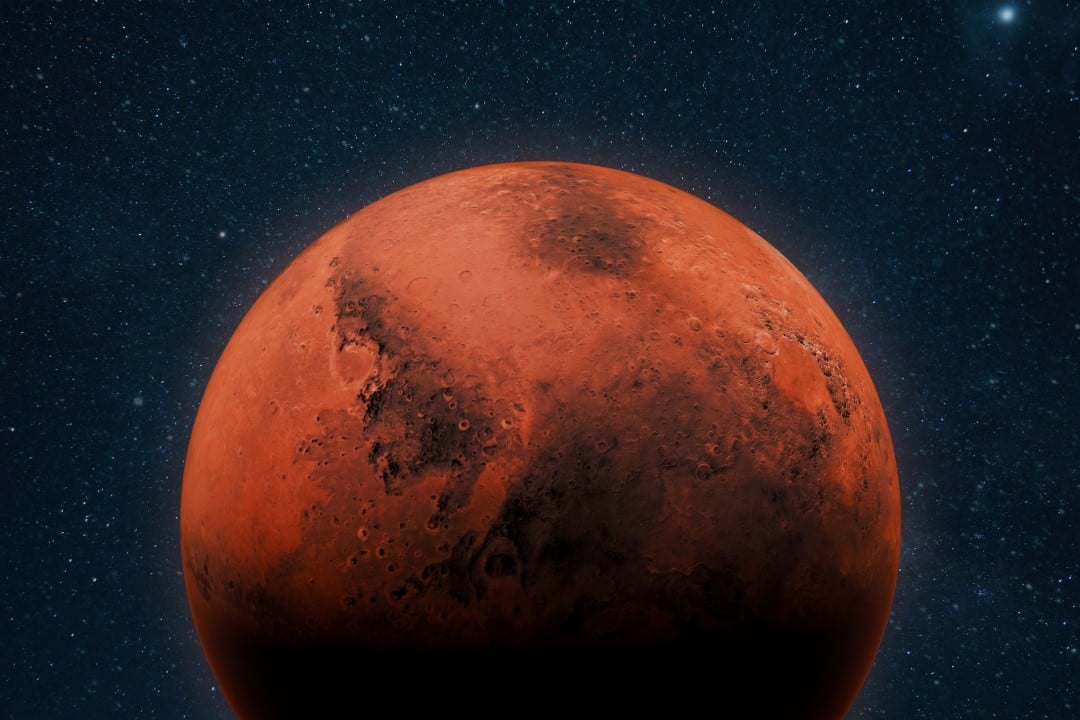
A study led by Brazilian physicist Marcelo of Oliveira Souza, of Universidade Estadual of Norte Fluminense (UENF), presented an unprecedented orbital calculation for interplanetary exploration. The research proposes a new space trajectory capable of shortening the total time of a mission to and from the red planet to just seven months. The mathematical model challenges the traditional routes used by aerospace agencies in recent decades.
The method is based on advanced principles of celestial mechanics and the use of highly specific launch windows. Atualmente, conventional journeys require six to nine months just for the outward journey, forcing crew members to wait years for a new planetary alignment favorable to their return. The discovery optimizes the propulsion of ships and creates a type of gravitational bridge, which could redefine the logistical planning of future human bases outside Terra.

The orbital physics behind the new trajectory
The orbital mechanics traditionally used in interplanetary travel depend on so-called Hohmann transfer orbits, which seek the lowest possible fuel expenditure at the expense of transit time. The work developed at the Rio de Janeiro institution changes this logic by focusing on the fine synchrony between the propulsive impulses and the exact position of the celestial bodies. The researchers calculated complex variables, including the total mass of the spacecraft, the maximum capacity of contemporary engines, and the astrodynamic conditions of the solar system. Essa approach requires extreme mathematical precision to ensure that the ship gains speed by taking advantage of the gravity of other planets without wasting directional energy. The gravitational bridge concept works as an invisible shortcut in deep space, allowing a much more direct route between the orbits of Terra and Marte. For the maneuver to be successful in practice, navigation systems will need to perform engine burns in fractions of a second rigorously calculated by onboard computers. The technical feasibility of this strategy goes hand in hand with the development of more powerful ionic and nuclear thrusters, which are already in the testing phase. Dessa way, aerospace engineering gains a new robust theoretical tool to overcome the time barrier over vast astronomical distances.
The drastic reduction in flight time transforms the paradigm for exploring the inner solar system. Instead of planning multi-year expeditions, scientists can now envision short-term missions. Essa operational agility brings science fiction closer to current technological reality.
Direct impact on the health and safety of astronauts
Prolonged time in deep space represents one of the greatest medical obstacles to interplanetary colonization. Fora protection from the Earth’s magnetic field, crew members are exposed to dangerous levels of galactic cosmic radiation and unpredictable solar storms. A round trip completed in seven months drastically decreases the cumulative dose of radiation absorbed by biological tissues. Consequentemente, the risks of developing cancer, genetic mutations and degenerative diseases of the central nervous system fall to much more manageable levels. Space medicine considers this damage mitigation a decisive factor in approving the sending of humans to the neighboring planet.
Another critical factor involves the physical degradation caused by continuous microgravity. Prolonged weightlessness causes accelerated loss of bone mass, muscle atrophy and changes in blood circulation and vision. Encurtar the journey minimizes these debilitating effects, ensuring that the crew arrives at their destination with full physical capacity to operate heavy equipment and carry out extravehicular activities.
Resource savings and financial viability
The logistics of supporting life in space is a mathematical puzzle where each kilogram of cargo costs millions of dollars to escape Earth’s gravity. Missões long periods require huge stocks of drinking water, freeze-dried food, compressed oxygen and spare parts for filtration systems. By limiting shipping to seven months, demand for these essential supplies plummets accordingly. Esse Relief in the ship’s overall mass allows engineers to reallocate the saved weight to more sophisticated scientific instruments or more comfortable housing modules.
Weight optimization also translates into substantial savings in fuel consumption during initial launch. Foguetes Smaller and cheaper devices could be used to put the mission into orbit, making the project cheaper. Essa Energy efficiency attracts the interest of private companies seeking to make commercial transportation viable.
- Drastic reduction in daily operational monitoring costs from control bases at Terra.
- Increased safety margin with the inclusion of redundant life support systems in the freed space.
- Possibility of sending robotic pre-refueling probes more frequently and using less energy.
- Expanding the windows of opportunity for possible rescue missions in the event of critical engine failures.
The role of Brazilian science in the global aerospace scenario
The formulation of this new route highlights the analytical capacity of national researchers in areas of extremely high technological complexity. Embora or Brasil does not maintain its own program focused on sending humans to other planets, the country’s academic production provides indispensable theoretical foundations for space powers. The work conducted at Universidade Estadual of Norte Fluminense demonstrates how higher education institutions outside the traditional axis can generate innovations with a global impact. Astrodynamics is a field where intellect and computational processing power are worth as much as building physical rockets on launch pads. Pesquisas of this magnitude help to insert Brazilian scientists into international exploration consortia, opening doors for academic exchanges and transfer of advanced technology. The recognition of this study in specialized congresses reinforces the importance of continuous funding for basic and applied science in the national territory. Sem support for long-term projects, revolutionary calculations like this would only remain in the field of ideas not tested in the laboratory. The country’s presence in discussions about the future of humanity in space consolidates the prestige of South American research in the global community.
Next steps and validation by international agencies
Transitioning from a successful mathematical model to a real mission requires a collaborative effort on a global scale. Professor Marcelo’s proposal from Oliveira Souza now undergoes the rigorous scrutiny of the international scientific community and peer review in high-impact publications. Agências like NASA, Estados Unidos, and ESA, Europa, constantly monitor innovations in orbital mechanics to improve their own programs, such as the Artemis campaign and future Martian flights. Validation of these calculations by foreign supercomputers is the next crucial step in confirming the safety of the trajectory.
If the route is officially adopted, it could initially be tested with unmanned cargo transport probes. The success of these preliminary missions will pave the definitive path for human exploration. Assim, the first astronauts will be able to step onto Martian soil faster and safer than anyone thought possible.
