
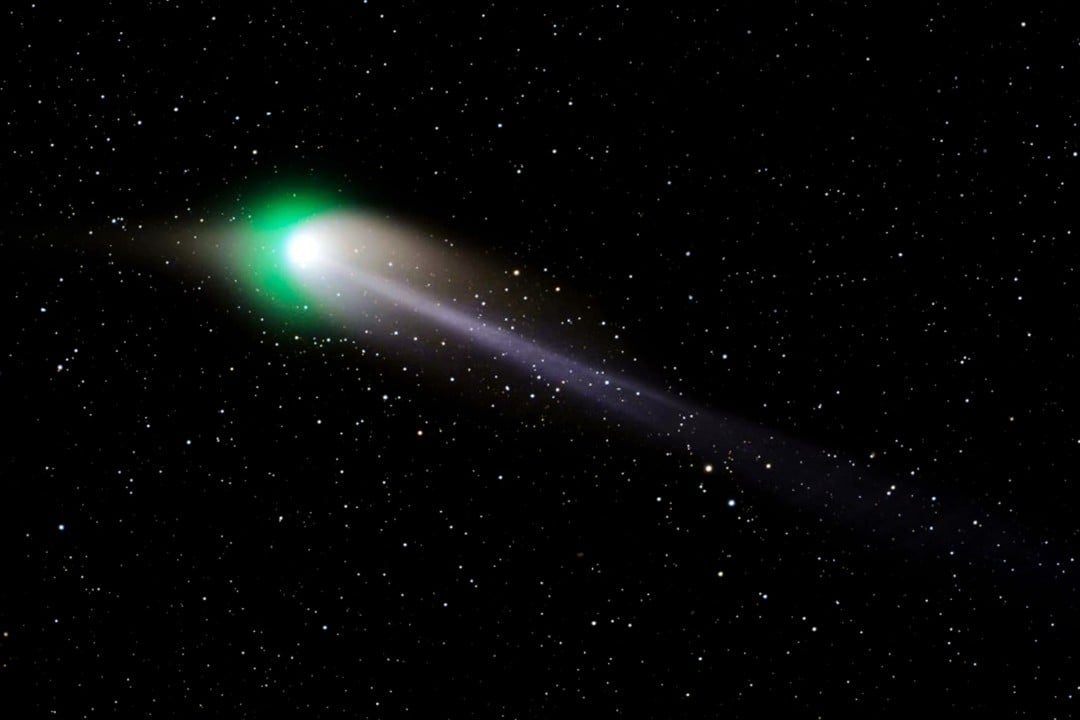
Telescópio Espacial Hubble captured a rare astronomical anomaly involving comet 41p/Tuttle-Giacobini-Kresák. The object completely reversed its direction of rotation during its passage through the inner solar system. The phenomenon occurred throughout 2017, but the detailed data continues to generate intense debates in the scientific community. The sudden change in the spin of the celestial body, which is about a kilometer in diameter, defies the conventional laws of astrophysics.
The discovery was documented in an article led by astronomer David Jewitt. The text points out that the object’s angular velocity underwent an extreme change after reaching perihelion, the closest point to Sol on its trajectory. Enquanto The traditional explanation focuses on the release of surface gases acting as natural propellants, independent researchers have raised other possibilities. Eles hypothesized that the behavior may indicate a technological signature. The debate exposes gaps in understanding about the composition and longevity of smaller bodies.
Core survival intrigues experts in orbital dynamics
41p’s erratic behavior raises profound questions about how the comet’s physical structure was able to withstand such extreme forces without fragmenting in space. Cálculos of orbital dynamics indicate that the intense mass release activity should have destroyed the nucleus or caused its complete evaporation many centuries ago. The object orbits 5.4 years and scientists estimate that it has remained on this same path for at least 1,500 years, suffering continuous wear and tear with each solar approach. The resistance of the material to the violent torque applied by the gas jets suggests that the internal composition of the celestial body differs substantially from the common space icebergs observed to date. If degassing reached the power necessary to brake and reverse the rotation of a kilometer-long rock, structural integrity would inevitably be compromised. Jewitt argues that observation equipment may have recorded a completely atypical spike in activity, which ended up inflating estimates about the loss of volatile material. Outra academic perspective proposes that the current nucleus represents only the central fragment of a much more massive and stable original body. Essa primordial rock would have resisted the erosion processes caused by solar radiation over millennia. The absence of visible fragmentation during spin reversal remains the main obstacle to the unanimous acceptance of natural theories.
The rotational anomaly requires researchers to review the mathematical models applied to the degradation of comets from the family of Júpiter. Sem a definitive explanation for the cohesion of the material, the astronomical community keeps the object under constant surveillance. The mystery of 41p’s longevity serves as a warning about the limitations of current deep-probing instruments.
Artificial propulsion hypothesis divides the scientific community
Faced with inconsistencies in natural wear models, astronomer Avi Loeb introduced a divergent and highly controversial perspective to explain the data captured by Hubble. The researcher suggests that the millimeter change in rotation may function as a technological signature, operating in a similar way to a built-in artificial propulsion system. Sob From this perspective, the comet would act as a camouflaged object, using gas jets in a controlled manner to perform precise orbital maneuvers. The precision of braking and subsequent acceleration in the opposite direction strengthens the idea of an unnatural mechanism operating inside the celestial body. Loeb argues that traditional academic rigor often rules out anomalies that could indicate the presence of extraterrestrial intelligence.
The space Trojan horse theory gains traction precisely because of the inexplicable survival of the nucleus from its own frenetic activity. Embora Most astrophysicists reject the idea of alien technology, Loeb’s provocation forces science to seek more solid answers. The debate highlights the need for space missions capable of drilling the crust of these mysterious objects.
Degassing mechanics and the impact of solar heat
The most accepted justification in academic circles for the change in rotational movement is based on the process of sublimation of surface ice when the comet approaches the heat emitted by Bolsas. Bolsas of frozen material melts quickly and turns into gas, creating powerful jets that act as true natural propellants in the vacuum of space. Esses jets exert continuous pressure on the comet’s irregular nucleus, which has a projected axial ratio of 1.4 to 1, facilitating the action of lever forces. If the distribution of these gaseous emissions occurs asymmetrically, the torque generated has enough force to brake the original rotation until total immobility. Logo Then, maintaining the pressure starts the rotation in the opposite direction, exactly as the 2017 records demonstrated. Esse cycle of acceleration and deceleration occurs in other smaller bodies, but the time scale and speed of the inversion in 41p are unparalleled in the archives of modern astronomy. The active fraction of the surface decreased considerably after perihelion, which, in theory, should reduce the energy available to cause such drastic changes. The mathematical discrepancy between the drop in surface activity and the dizzying increase in rotational frequency after the inversion fuels discussions at observatories. Scientists now need to map the exact thermodynamics of the nucleus to validate these mechanics.
Technical data confirms the magnitude of the physical transformation
The use of multiple ground and space observatories was essential to triangulate the information and confirm that there was no calibration error in the equipment. Observatório Neil Gehrels Swift detected the initial slowdown in March, while Hubble saw the complete reversal in December of the same year. The images captured over 3,840 seconds allowed detailed mapping of the gas plumes around the rocky structure. The use of specific filters highlighted the brightness contours and revealed the exact direction of material expulsion in relation to the comet’s velocity vector.
The main characteristics extracted from the technical reports reveal the complexity of the astronomical event and help to measure the impact of the forces involved. The numbers prove that the physical structure underwent mechanical stress unprecedented in the history of space observation. The precision of the measurements eliminates any possibility of optical illusion caused by the position of the Terra.
- The rotation period plummeted from a range of 46 to 60 hours to just 14 hours in a short span of months.
- The rate of mass loss recorded by the sensors is incompatible with the nucleus’ prolonged survival in its current orbit.
- The directional force of the gas jets expelled by the irregular crust generated the torque responsible for the change of direction.
- The systematic variation in brightness fixed the new rotational period at 0.60 days with a statistically zero margin of error.
Origin no Cinturão of Kuiper and the next steps of exploration
Orbital tracking indicates that comet 41p/Tuttle-Giacobini-Kresák began its journey in Cinturão of Kuiper, a vast region of frozen bodies located beyond the orbit of the planet Netuno. In the remote past, complex gravitational interactions with Júpiter captured the object and definitively launched it into the inner solar system. Essa new trajectory trapped the rock in uninterrupted cycles of extreme heating and deep cooling, a scenario that accelerates the structural degradation of any celestial body. Comparison with recent interstellar objects places 41p in a special priority category for international space agencies. Enquanto The vast majority of comets follow a predictable route of wear and fragmentation, the sudden maneuvers of this specific rock require the development of new monitoring technologies. The scientific community’s expectations rest on the next generation of thermal sensors and infrared telescopes, which will be able to penetrate the dense gas cloud that surrounds the nucleus. Identificar the exact morphology of openings in the crust and mapping the internal density of the material are the primary objectives of future observation campaigns. Até Once direct images of the solid surface are obtained, the true nature of the comet will remain one of the great enigmas of contemporary astrophysics. The joint monitoring effort will serve as a model for identifying other gravitational anomalies in deep space.
