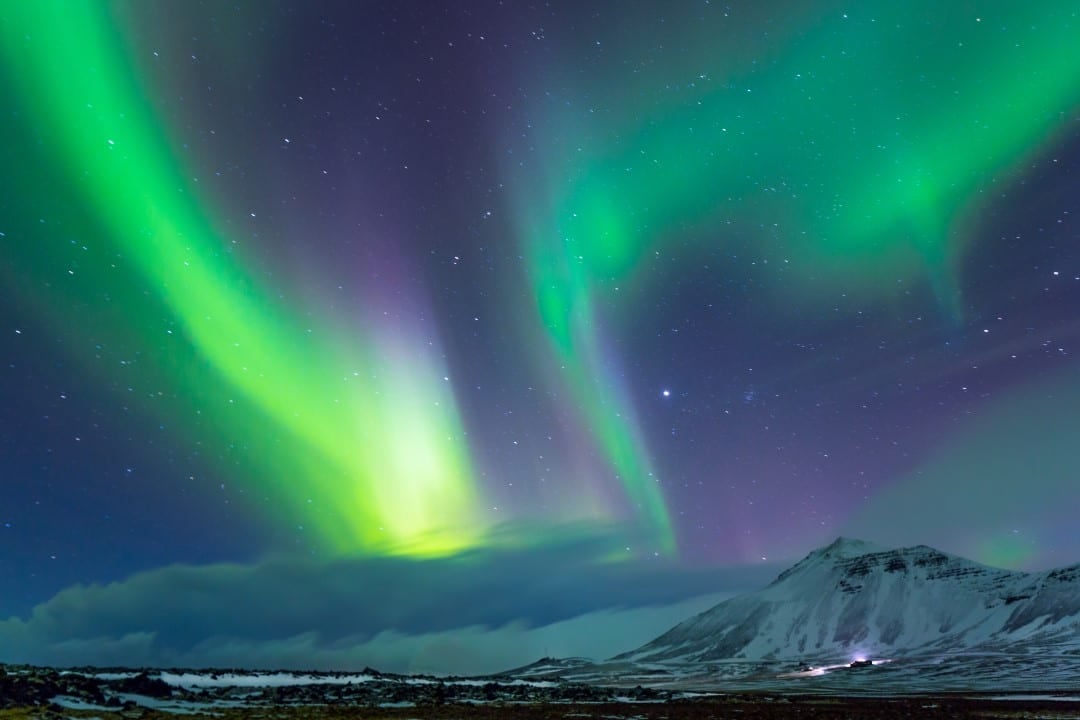
Northern lights activity is expected to remain relatively muted on Tuesday night, April 14, and in the following days, before possible intensification later in the week. Forecast systems indicate a lower brightness window, with predominantly calm to unstable conditions at Hemisfério Norte’s higher latitudes.
This forecast is released by NOAA’s Space Weather Prediction Center (SWPC), which constantly monitors space weather. Embora Although there is a small chance of a brief rise to minor geomagnetic storm (G1) conditions this evening, the general expectation is for a more notable increase in auroral activity around April 17th. Ventos Stronger suns are expected, which could significantly improve the chances of observing the aurora during the coming weekend.
Papel from Tecnologia to Previsão Auroral
The ability to predict the Northern Lights in advance depends directly on technological advances in monitoring Sol and from space. Satélites and ground-based observatories work together to collect crucial data on the solar wind, coronal mass ejections (CMEs) and the interplanetary magnetic field. Essas information feeds complex predictive models, which are the basis of forecasts released by agencies such as NOAA and Reino Unido. The accuracy of these tools has improved dramatically in recent years, allowing scientists and enthusiasts to know when and where to look for the northern lights. Understanding phenomena such as the Kp index and the Bz value of Campo Magnético Interplanetário (IMF) is fundamental.
The Kp index, for example, is a scale that measures the disruption of global geomagnetic activity, ranging from 0 to 9. Higher Um Kp generally means a stronger, more visible aurora at lower latitudes. Já the value Bz of the IMF, which can be easily viewed on platforms like SpaceWeatherLive.com, is crucial: a strong Bz pointing to the “south” (negative) is the ideal scenario, as it allows it to efficiently connect with the Earth’s magnetosphere, which points to the north. Essa connection facilitates the entry of energized particles into the atmosphere, where they collide with atoms and release the light that forms auroras. Compreender and interpreting this data in real time is an ongoing technological challenge.
Tools and Indicadores of Previsão
Tracking the Northern Lights involves analyzing various data and technological tools. Entusiastas and observers use online platforms and applications to monitor space weather in real time, combining information from different sources to optimize their chances of spotting the phenomenon. The synergy between scientific knowledge and digital interfaces is increasingly vital for the aurora hunting community.
- Kp index:Mede global geomagnetic activity on a scale of 0 to 9, indicating the potential intensity of the aurora.
- IMF value Bz:Componente of the interplanetary magnetic field; a negative value (to the south) significantly increases the chances of intense auroras when connecting with the Earth’s magnetosphere.
- CMEs (Coronal Mass Ejections):Grandes clouds of plasma and magnetic field ejected from Sol, which, when reaching Terra, can trigger geomagnetic storms and auroras.
- Coronal holes (Holes Coronais):Regiões openings in the solar corona that release fast solar winds, capable of inducing geomagnetic and auroral activity.
- Monitoring software:Aplicações web and mobile like SpaceWeatherLive.com provide real-time data on Kp, Bz and other solar conditions.
- Advanced predictive models:Utilizados by centers such as NOAA and U.K. Met Office to generate short- and medium-term forecasts based on complex algorithms and satellite data.
Monitoring of Flutuações and Atividade Solar
The recent period has been marked by an alternation between moments of greater and lesser geomagnetic activity, as detailed by forecasting centers. On April 13, for example, the aurora borealis remained relatively calm, with geomagnetic activity decreasing following earlier improvements in solar winds. Conditions ranged from calm to unstable, with no major spikes. Essa relative calm contrasts with expectations of a possible return on April 10, when fast solar winds should sweep through Terra, generating some activity. Naquele moment, minor geomagnetic storm conditions (G1) were likely, driven by a solar wind flow from a coronal hole facing Terra, and active activity was expected to persist through the weekend.
On April 9, the expectation was for intensification, with the arrival of faster solar winds, potentially reaching minor geomagnetic storm levels (G1), and with a small chance of stronger intervals (G2), if conditions aligned. Já on April 8, the skies were quieter, confined to high latitudes, but the forecast already indicated the arrival of fast solar winds between April 9 and 10, which could reignite G1 storm conditions. Mais Early on April 7, activity was similarly calm, with geomagnetic activity stabilizing following recent solar wind enhancements. Contudo, the prospect was for an increase at the end of the week, with the monitoring of fast solar winds that could bring the return of G1 conditions and improve the chances of sighting. Essas variations reinforce the complexity of the solar system and the importance of continuous technological monitoring.
Technologies for Observadores and Futuras Previsões
For northern lights enthusiasts, consumer technology has become an indispensable ally. Aplicativos Real-time forecasting, smartphone alerts and cameras with advanced low-light capabilities allow viewers to maximize their chances of witnessing the spectacle. The ability to query the current Kp index, the direction of Bz and the occurrence of CMEs via the web or apps transforms the “aurora hunter” into an active user of scientific data. Isso democratizes access to information that was previously restricted to researchers.
Looking to the future, the continued improvement of space weather models promises even more accurate and far-ahead predictions. Novos satellites and sensors are under development to collect data with unprecedented resolution and scope. Essa Technological developments will not only benefit the aurora observing community, but are also vital for protecting terrestrial and space infrastructures from potential impacts of geomagnetic storms. International collaboration between space agencies and research institutions remains a fundamental pillar in unraveling the mysteries of Sol and its impact on our planet.
