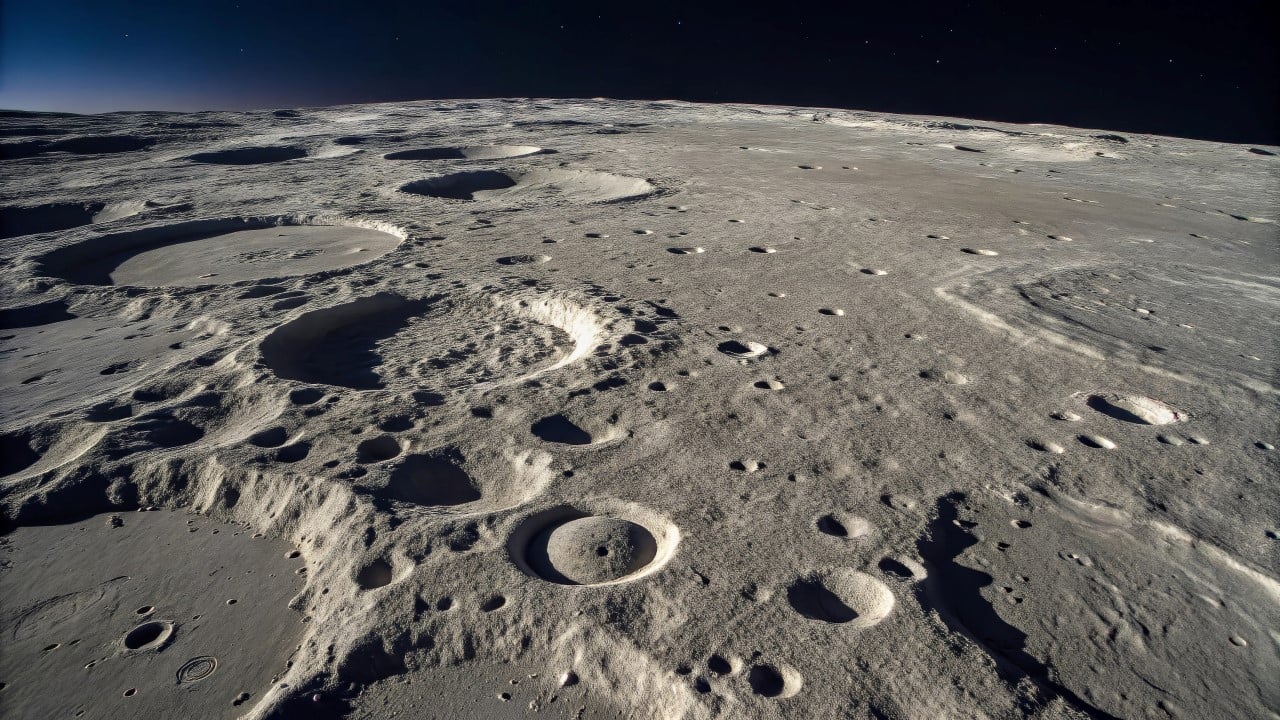
Older, permanently shadowed craters at Lua’s south pole concentrate greater amounts of water ice. Research published this week directly links the age of these formations to the distribution of ice detected by instruments on Nasa. The results show that the ice accumulated gradually over billions of years, rather than arriving in a single catastrophic event.
Scientists analyzed lunar surface temperature data collected by probe Lunar Reconnaissance Orbiter’s Lunar Reconnaissance Orbiter instrument. Computational Modelos considered changes in Lua’s tilt over time. Crateras that remained in shadow for longer periods exhibit stronger signs of ice identified by Lyman-Alpha Mapping Project from the same probe.
Irregular distribution of ice in polar craters
Ice does not appear uniformly in permanently shaded regions. Algumas Old craters hold larger amounts, while others that are more recent or that have undergone thermal variations throughout lunar history contain less material.
The team identified craters near the lunar south pole. Crater Haworth, for example, has remained in shadow for more than three billion years and shows some of the most intense radar signals for ice. Já Formations that only entered cold conditions more recently had less time to accumulate the resource.
- Older craters have greater ice coverage in their areas.
- Changes in Lua’s tilt have altered its shadow regions over billions of years.
- Ice exposed to light sublimes and is lost to space or migrates to other cold traps.
- Models combine thermal data from Diviner with ultraviolet observations from LAMP.
- Current distribution reflects continuous cycles of ice deposition and preservation.
The survey was conducted by Oded Aharonson, Instituto Weizmann, in collaboration with Paul Hayne, Universidade, Colorado, Boulder, and Norbert Schörghofer, Planetary Science Institute. study appeared in the magazine Nature Astronomy.
This is the clearest images ever recorded of the craters of Lua by humanitypic.twitter.com/lw7r3tpogS
— Astronomiaum (@astronomiaum)April 8, 2026
Changes in slope affect ice stability
The slope of Lua has varied throughout its history. Isso caused craters that were permanently in shadow for billions of years to now receive light during certain periods, while others began to offer more stable cold conditions. Quando Exposed, the ice sublimates and disappears or moves to more protected locations.
Models showed that older craters in permanent shadow accumulated ice continuously. The team ruled out the idea of a single impact from a giant comet that would have deposited water in large quantities at once. Instead, the process occurred more or less steadily for at least three to 3.5 billion years.
Previous missions such as Clementine in 1994, Lunar Prospector and Lunar Reconnaissance Orbiter detected signs of ice in the polar regions. Samples returned by missions Apollo between 1969 and 1972 showed dry regolith on the surface, which contrasted with later radar and spectroscopy data. The new research reconciles these observations by demonstrating that ice is preserved primarily in ancient, deep cold traps.
Scientists have noted that not all permanently shadowed craters contain the same amount of ice. Fatores how the time of exposure to shade, bombardment by micrometeorites and regolith turnover influence preservation. Regiões that maintained stable cold for longer periods are more likely to contain usable ice.
Possible sources of lunar ice
The ice may have arrived at Lua through smaller, frequent impacts from asteroids and comets over time. Outra hypothesis involves ancient volcanism that released water from the lunar interior, contributing to the formation of lava plains known as lunar seas. The solar wind may also have played a role by supplying hydrogen that reacts with oxygen on the surface.
Oxygen molecules and even water from the Earth’s atmosphere escape into space and reach Lua billions of years ago. Esses mechanisms act gradually, explaining the observed accumulation. The irregular distribution arises because each crater has had a different thermal history.
Crater Clavius and other large formations were also analyzed in complementary studies. Dados temperature and reflectance helped map where the ice has the greatest chance of remaining stable. The combination of instruments now makes it possible to prioritize targets for future exploration.
Relevance to lunar exploration missions
The presence of ice represents a valuable resource for future lunar bases. Astronautas can use water for drinking, generate oxygen for breathing and produce rocket fuel from decomposition into hydrogen and oxygen. Localizar Craters with greater concentration help define strategic locations for landings and extraction operations.
Crater Haworth appears as one of the main candidates due to the long period in shadow and the intense signs of ice. Outras Ancient craters at the lunar south pole are also highlighted in mission planning. Refined models guide where to search with the highest probability of success.
Paul Hayne leads the development of the Lunar Compact Infrared Imaging System instrument, known as L-CIRiS. Essa thermal camera will allow more detailed observations of polar craters. The equipment is expected to move to Lua in late 2027 as part of Nasa’s Commercial Lunar Payload Services program, aboard a Intuitive Machines module.
Analysis based on existing orbital data
The researchers worked with information collected by Lunar Reconnaissance Orbiter since 2009. Diviner provided temperature maps, while LAMP measured ultraviolet reflectance to identify exposed ice. The integration of these data with thermal simulations allowed us to reconstruct the history of each crater studied.
Results from missions like SOFIA and previous observations reinforce the presence of ice in shadowed areas. The new research explains why the amount varies so much between neighboring craters. Regiões younger ones in permanent shade accumulated less material, while older ones act as more efficient reservoirs.
Scientists emphasize that the exact origin of the water will only be confirmed with direct analysis of samples. Missões Robotic or manned vehicles that access the interior of polar craters will be able to bring material for study at Terra. Enquanto Therefore, current models guide exploration planning.
Details about ancient craters and cold traps
The team mapped the duration of the permanent shadow on several lunar formations. Crateras that have operated as cold traps for more than three billion years have concentrated a greater fraction of ice on their surface and underground. In contrast, areas that only recently achieved stable cold conditions show lower amounts.
The research confirms that ice is not distributed evenly even within the same crater. Variações Locations of temperature, particle impact and geological processes influence where material accumulates. Esses insights help understand similar processes on other Sistema Solar icy bodies, such as Mercúrio and some asteroids.
The study comes at a time of renewed interest in Lua. Programas and Artemis predict the return of astronauts to the surface. Ice can reduce costs by decreasing
