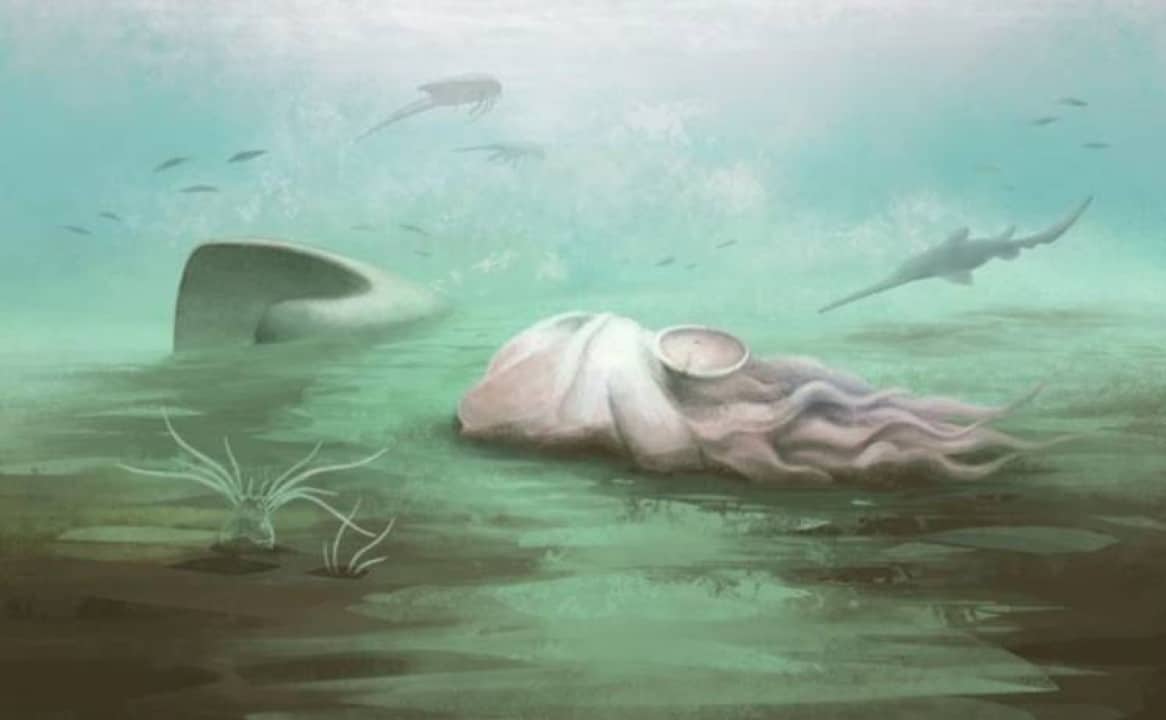
A 300-million-year-old marine specimen found in the region of Chicago has lost its place as the world’s oldest octopus after an in-depth taxonomic revision. The animal belongs to an extinct lineage of ancestors of modern nautiluses. The correction ends a scientific misconception maintained since the year 2000. Pesquisadores used extremely high-precision imaging technologies to see through the rock matrix. The method revealed perfectly preserved internal organs.
The discovery occurred thanks to the use of synchrotron light by a team from Universidade of Reading. The detailed study was published in the magazine Proceedings of the Royal Society B on April 8, 2026. Scientists proved that the external shape of the fossil resulted from a long decomposition process at the bottom of the sea. Rot distorted the soft tissue before burial. Essa severe degradation created folds that simulated long tentacles. The false appearance misled experts during more than two decades of superficial analysis. The new mapping changes the understanding of the distribution of primitive cephalopods in the prehistoric oceans.
How the particle accelerator works in fossil research
The reclassification of the organism depended exclusively on the application of X-ray beams generated by a synchrotron. Esse complex machinery operates like a gigantic particle accelerator. The equipment produces a brightness that is much higher than that of direct sunlight. The advanced technique allows three-dimensional scans to be carried out inside very dense rocks. Paleontologists are able to inspect the material without causing any damage to the physical structure of the piece. The method exposes microscopic details of the internal anatomy that would never appear in conventional exams. The radiation penetration capacity reveals the exact density of each mineralized component. Researchers can virtually separate the fossil from the host rock using three-dimensional modeling software.
The first evaluations of the fossil took place with scanning electron microscopes at the beginning of the century. Esses Ancient instruments only mapped the outer topography of the stone block. The initial interpretation was based entirely on the visible outline of the fossilized animal. The synchrotron radiation passed through the thick mineral layers. Technological advances provided the necessary data to put an end to the morphological suspicions raised by some experts over the years.
Teeth counting as definitive biological evidence
The central element revealed by the high-power scan was the animal’s radula. Essa mouth structure works like a rough tongue used by molluscs to scrape food in the marine environment. The machinery identified the exact preservation of the row of teeth within the stone matrix. The clear visualization of this internal organ provided the fundamental comparative basis for the study. The researchers compared the new characteristics with the anatomy of living and extinct species.
Morphological analysis of the radula demonstrated the presence of at least 11 teeth arranged in each food row. Esse volume directly contrasts with the biology of octopuses known to science. Members of the Octopoda group have a restricted anatomical pattern of seven to nine teeth in the same oral region. The numerical incompatibility represented the definitive proof that removed the specimen from the previous category. The team cross-referenced the information with vast databases of other mollusk families until they found the exact match with the nautilus.
The decomposition process and visual illusion in rocks
The external shape of the stone block has misled the scientific community for 26 consecutive years. The recent study indicated that the mollusk’s body faced several weeks of rotting on the ocean floor. The dead animal remained exposed to sea currents before being completely buried by heavy sediment. Prolonged deterioration drastically disfigured the organism’s original structure. The process created abnormal stretches that mimicked the appearance of thin arms and a limp body. The optical illusion generated by atypical fossilization demonstrates the influence of environmental factors on the preservation of ancient species. The mud at the bottom of the ocean acted as an imperfect mold for a body already in an advanced stage of structural collapse. Compression of the sediment flattened the organism in a way that completely masked its original symmetry.
The proportions of the supposed tentacles already motivated isolated debates among academics. The visible markings did not match patterns found in other records of early octopuses. The new identification turned the external features into mere distorted remains of a shelled ancestor. The Carbonífero period offered exceptional chemical conditions for the conservation of these soft tissues:
- The rapid deposition of minerals replaced organic cells before the total destruction of the body.
- The absence of oxygen at the bottom of the sea slowed down the action of decomposing bacteria.
- Geological pressure sealed biological material within extremely hard rock nodules.
The southern region of the city of Chicago is home to geological deposits rich in formations of this nature. The North American area holds essential information about the diversification of prehistoric ocean fauna. The correct cataloging of the inhabitants of this era provides a precise map of the geographic distribution of molluscs.
The impact on the evolutionary timeline of the oceans
The removal of this fossil from the octopus category alters the evolutionary chronology of this group of cephalopods. The estimated age of 300 million years placed the emergence of the species at a remote time. The ancient data contradicted other genetic and fossil evidence available in marine biology archives. The reclassification returns the oldest confirmed records of true octopuses to the range 90 million years ago. The temporal adjustment corrects an anomaly that confused experts in oceanic population dynamics. The gap of more than 200 million years between this specimen and true primitive octopuses has always represented a mystery with no apparent solution. The new dating harmonizes the fossil record with the projections made by the molecular clock of current species.
Taxonomic change generates immediate developments in mathematical models of evolutionary biology. Scientists need to recalculate the mutation rate and genetic divergence of cephalopod families. The nautilus family tree gains a new extinct relative originating from the Carbonífero period. Esses marine animals have a very different body configuration from octopuses. The presence of internal or external shells defines the primary physical structure of this specific lineage.
Review of collections in natural history museums
The case of the North American fossil drives a severe methodological change in research institutions. The discovery that decay forges entire anatomical features raises a global alarm. Curadores of museums faces the need to re-examine countless dubious pieces stored in drawers around the world. The use of synchrotron light is consolidated as a standard tool to validate descriptions based only on external morphology. Technology prevents visual interpretation flaws from contaminating academic literature for decades.
The work conducted by the British involved partnerships with international applied physics laboratories. The collaboration ensured the necessary usage time on the high-cost particle accelerator. The publication of the results underwent a rigorous peer review process before official release. The original fossil remains in the custody of institutions in Estados Unidos. The material remains available for future investigations with new scanning technologies. The relocation of the specimen to the tree of life maintains the historical importance of the discovery in the rocks of Chicago. The piece provides concrete material for studying fossilization conditions in low-oxygen marine environments. Paleontólogos continues to map the North American region in search of new specimens that can complement the structural information revealed by the recent scan.
