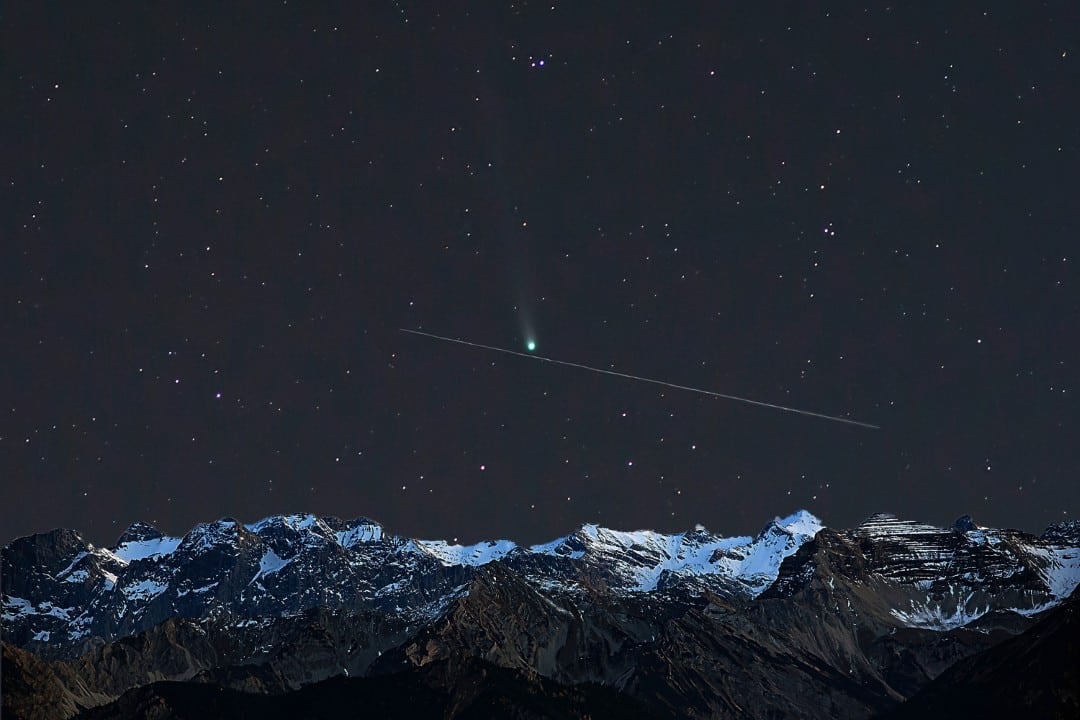
Comet C/2025 R3 (PanSTARRS) approaches the inner region of Sistema Solar. The object, originating from Cinturão of Kuiper, should be visible in Brasil from this Saturday, April 18th. Ele follows a stable trajectory, unlike another recent comet that disintegrated when it passed close to Sol.
Observation occurs mainly in the morning, about an hour before Sol rises. No Rio from Janeiro, for example, Sol rises at around 6:07 am on the 18th, which allows you to look at the eastern horizon at around 5:07 am. The estimated brightness varies between magnitude 4.7 and 4.2 on peak days. Quanto the smaller the number, the easier the detection.
Un espectáculo celestial está a punto de alcanzar su punto máximo y no querrás despegar la vista del cielo 🌠🔭
— La-Lista Deportes (@LaListaDeportes) April 16, 2026
El cometa C/2025 R3 (PanSTARRS) se perfila para ser el objeto más brillante de su tipo en 2026 y te decimos cómo podrás observarlo. https://t.co/PTw4pigHIZ
Cometa emerges from icy region beyond Netuno
C/2025 R3 was discovered in September 2025. Seu name follows astronomical convention: the letter C indicates a long orbit, longer than 200 years, the year marks the discovery and the rest identifies the position in the sequence. The celestial body travels from a distant, cold zone of Sistema Solar.
Essa origin explains the composition rich in ice and dust. As you approach the Sol, the heat activates the material and forms the characteristic mane and tail. Diferentemente of the Páscoa comet, which did not survive the previous solar passage, maintains a safer trajectory and should remain intact.
- Perihelion, the closest point to Sol, is scheduled for April 19 or 20.
- The brightness increases in this phase due to greater activity of the nucleus.
- Terra’s closest approach occurs around April 26 or 27, at about 73 million kilometers.
- Depois from this date, the comet continues out of Sistema Solar with no expected return soon.
- Observadores report that the object already appears in images with a prominent tail in places with dark skies.
Melhores visibility conditions occur over the weekend
The 18th, 19th and 20th of April are the main window for those on Brasil. The comet becomes brighter because of its proximity to Sol. The ideal is to look on the eastern horizon, in the direction where Sol rises, with the sky still dark.
Locais away from cities reduce light pollution and improve chances. A horizon free of buildings or mountains helps a lot. Binóculos or a small telescope makes it easier to locate, but in areas with low lighting the comet can be seen with the naked eye.
On the 18th, for example, the sky allows observation for a few minutes before dawn. The estimated magnitude favors those who wake up early and choose a strategic point. Astrônomos and Observatório Nacional highlight that this is a rare opportunity for the Brazilian public to follow a long-period comet.
Dispersão front may increase brightness at the end of the month
A phenomenon called frontal scattering could occur in late April. The dust from the tail reflects sunlight directly onto the Terra and increases its brightness suddenly. Isso has already occurred in other comets and creates favorable conditions for photos and visual recordings.
Entre On April 15th and 16th the object appeared close to a conjunction with Lua, Mercúrio, Marte and Saturno. Imagens captured in this configuration caught the attention of amateur and professional photographers in several countries. No Brasil, the main moment is yet to come.
Após perihelion, the comet enters the solar conjunction phase and becomes temporarily difficult to see between April 21st and 26th. From the 27th it reappears in the evening sky, in a more accessible position for night observation on Hemisfério Sul.
Segunda opportunity arises after solar conjunction
Quem misses the weekend morning window gets another chance. Starting on April 27, the comet moves away from Sol and becomes visible just after Sol sets, low on the western horizon. The minimum distance from Terra, around 73 million kilometers, occurs in this phase.
The object continues to move away after this and is not expected to return to the internal Sistema Solar in a timely manner for current human observation. Essa crossover represents the only known opportunity for the current generation to catch up to C/2025 R3.
Astrônomos monitor behavior with professional and amateur telescopes. Dados brightness and core activity help refine predictions. Até at the moment, estimates indicate binocular visibility over most of Brasil and naked eye visibility in ideal locations.
Detalhes comet C/2025 R3 technicians
The comet follows União Astronômica Internacional’s standard naming convention. Ele differs from interstellar objects such as 3I/Atlas, the third confirmed body outside Sistema Solar, which offers data on distant chemical composition.
- Descoberta: September 2025 via the PanSTARRS system.
- Origem: Cinturão of Kuiper, beyond the orbit of Netuno.
- Periélio: April 19 or 20, 2026.
- Aproximação from Terra: about 73 million kilometers on April 26th or 27th.
- Expected Magnitude: between 4.7 and 4.2 on peak days, with possible improvement due to forward dispersion.
- Recomendação: binoculars, dark place, clear horizon.
The event reinforces interest in observational astronomy. Clubes and observatories in several cities are preparing guided sessions for the public interested in seeing the comet.
