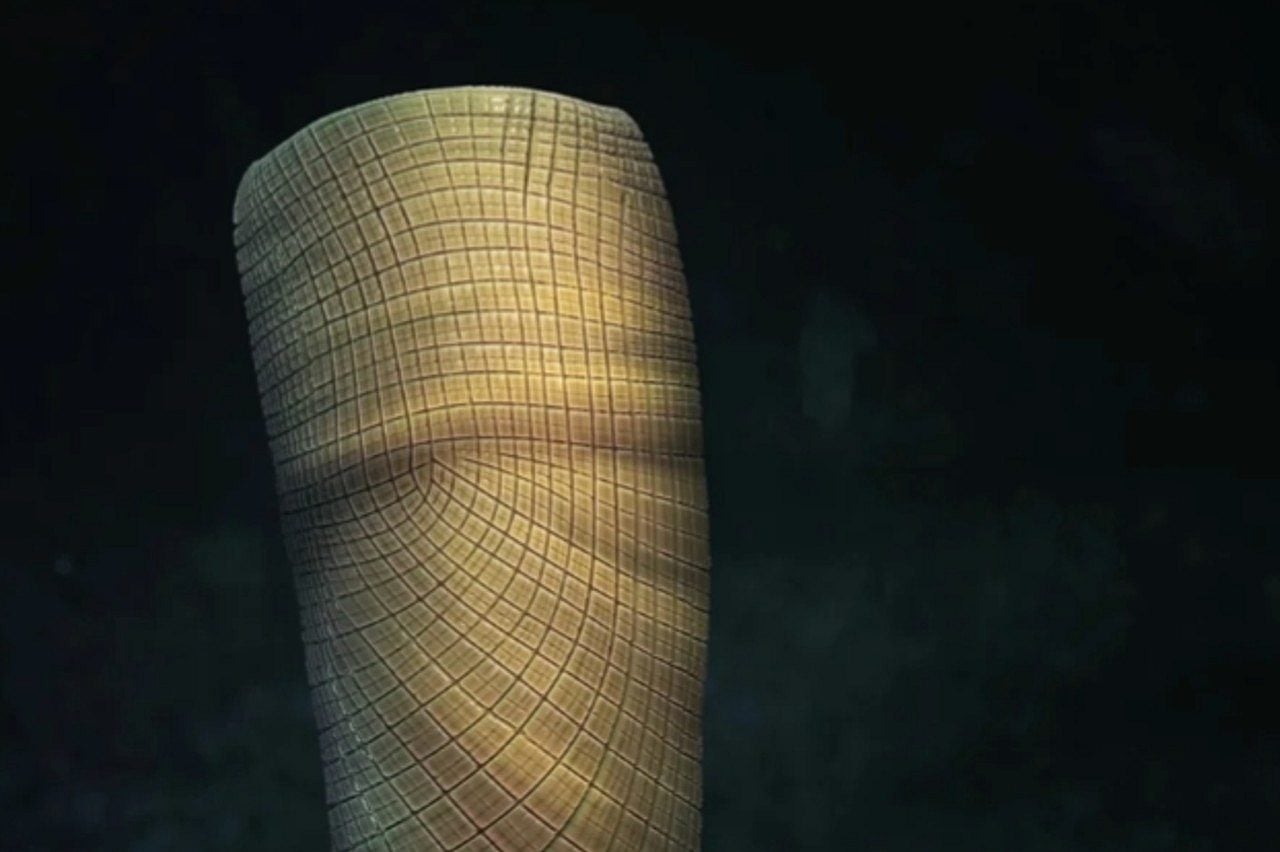
A marine sponge fossil dating back 550 million years helps explain a 160-million-year gap in the fossil record. The discovery occurred on the banks of the Yangtzé river, in China. Pesquisadores of Virginia Tech led the study with Chinese and British institutions. The specimen presents characteristics that indicate a soft body, without rigid mineralized parts. Isso answers long-standing questions about the emergence of sponges, estimated around 700 million years ago by molecular methods.
The finding was detailed in an article in the magazine Nature. The team analyzed the fossil after receiving a photo sent by a collaborator about five years ago. Geobiologist Shuhai Xiao, from Virginia Tech, immediately noticed the potential of the material. The specimen measures approximately 38 centimeters and displays a surface pattern with regular grid shapes. Esses features suggest a relationship with modern glass sponges, but with marked differences.
Esponja fills in the lost years of evolution
Cientistas use molecular clocks to trace the origin of sponges to around 700 million years ago. However, clear fossils only appear from 540 million years onwards. Essa difference created a gap of 160 million years without direct evidence. The new fossil fits exactly into this period. Ele reinforces the hypothesis that the first sponges had an entirely soft body.
Preservation occurred under special sedimentation conditions. Rochas fine carbonates captured delicate details that are typically lost. The material does not present mineralized spicules typical of later sponges. Previous Estudos from the same team already pointed to this possibility by observing that older spicules tend to be more organic.
- The fossil has a conical shape and is larger than expected for primitive sponges.
- The surface shows a pattern of subdivided boxes, distinct from other Ediacaran organisms
- The discovery occurred in the biota of Shibantan, known for preserving soft-bodied organisms
- Colaboradores includes researchers from Universidade of Cambridge and Instituto of Geologia and Paleontologia of Nanjing
- The study proposes that the search for ancient fossils should prioritize sites with rapid fossilization of soft tissues
Corpo mole explains rarity of older fossils
Sponges do not have a brain or intestine. Elas represent one of the simplest animal groups. Mesmo thus, their fossil record presents inconsistencies. Mineralized Espículas appears more frequently in more recent periods. Quanto further back in time, the greater the proportion of organic components in these structures.
If early sponges did not produce hard parts, the chance of fossilization dropped dramatically. Apenas environments with exceptional preservation, such as thin carbonate layers, could record these organisms. The new specimen demonstrates that soft-bodied forms existed in the late Ediacarano period. Isso aligns fossil evidence with genetic estimates.
Pesquisadores noted that the fossil does not fit into other groups such as sea squirts or anemones. The analysis eliminated alternatives and confirmed the classification as a sponge. The 38-centimeter size surprised the team, who expected smaller organisms at this initial stage.
Surface Padrão suggests kinship with glass sponges
The fossil displays a unique grid of box-like shapes. Cada unit subdivides into smaller repeating parts. Esse arrangement brings the specimen closer to certain current glass sponges. However, the absence of hard mineralization differentiates the material from later forms.
The discovery occurred in rocks from the Shibantan biota, in the Hubei province. The site is recognized for recording delicate Ediacarano organisms. The team combined morphological observations with data from previous work on spicules. The result indicates that the mineralization of skeletal structures gradually increased over time.
Mudança in the form of searching for traces of primitive life
The presence of soft-bodied sponges means that many traces may have disappeared without leaving a trace. Cientistas now need to expand the search to rare preservation conditions. Isso includes focusing on sediments that capture organic tissues before degradation. The find also revives old discussions about the emergence of multicellular animal life.
The international team analyzed the material for years. Testes comparisons ruled out other classifications. The fossil adds a concrete piece to the evolutionary history of sponges. Ele demonstrates that ancestral forms already exhibited greater body complexity than imagined, with a conical shape and elaborate surface pattern.
Implicações for the study of the first animals
The work brings together evidence that primitive sponges differed from modern ones in composition. The transition to mineralized skeletons occurred later. Isso explains why the fossil record appears to jump from 700 to 540 million years. The new approach suggests that similar gaps may exist in other early groups. Pesquisadores should consider exceptional preservation when interpreting Ediacarano.
The specimen was described with precise morphological details. Ele helps calibrate evolutionary models and temporal estimates. Collaboration between Virginia Tech, Chinese institutions and Universidade of Cambridge enabled multidisciplinary analysis. The result paves the way for new excavations at sites with potential for soft-body fossils.
