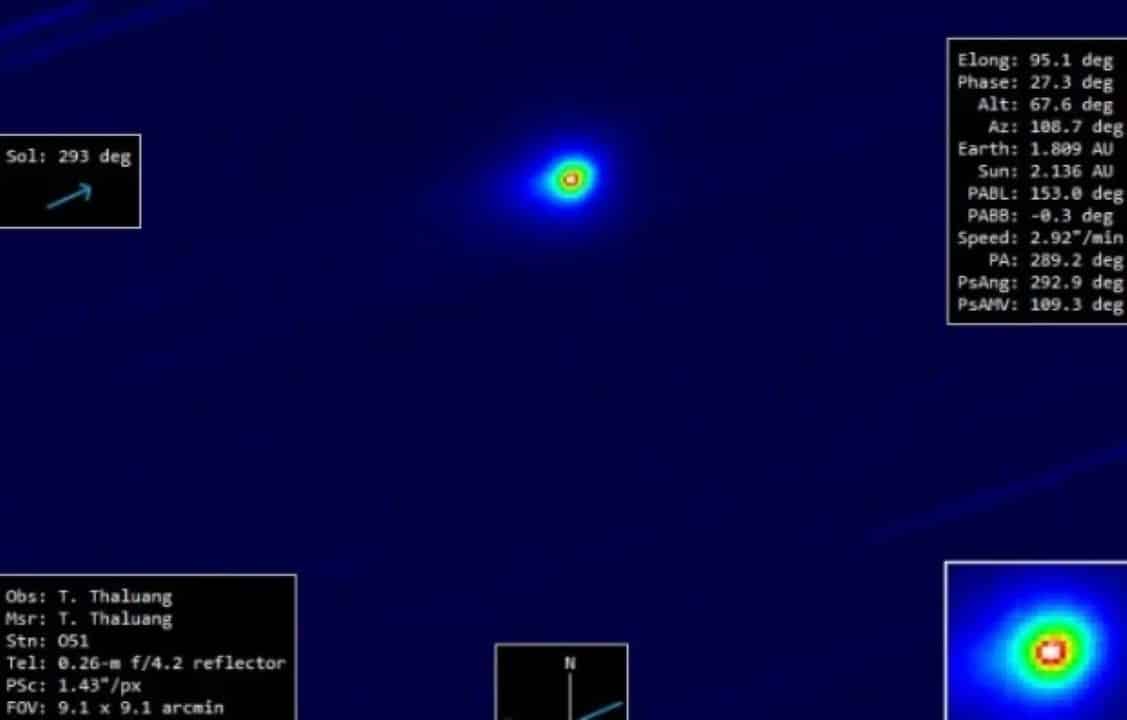
The interstellar comet 3I/ATLAS released water vapor in a volume equivalent to about 70 Olympic-sized swimming pools every day. The detection came from instruments on the JUICE probe, from Agência Espacial Europeia. The object passed the closest point to Sol in November 2025.
Data arrived at Terra in February 2026. Eles shows release of about two tons of material per second. The comet emerged from outside Sistema Solar and had been observed before by other telescopes.
Sonda JUICE captured unexpected comet data
The JUICE mission was heading towards Júpiter when operators adjusted the instruments to observe the visitor. Cinco scientific equipment was activated during narrow time windows. The thermal environment required care with the super-cooled cameras.
The MAJIS spectrometer recorded infrared emissions of water vapor and carbon dioxide. Imagens from the JANUS camera showed extensive coma and structures such as jets and filaments. NavCam helped track the trajectory from angles not accessible to the Terra.
- The comet released water even at distances greater than Terra’s orbit
- Parte’s material came from icy dust grains on the side illuminated by Sol
- Activity continued after perihelion
- Observações included differences in red and violet filters
- Dados allowed estimating core output flow

Essa opportunity arose by chance. The probe was in the right position at the right time. Scientists assessed operational risk, but the results were worth the effort.
Cometa of ancient origin presents distinct composition
3I/ATLAS formed more than 10 billion years ago, according to estimates. Isso makes him a relic from another star system. The proportion between light and semi-heavy water indicates a cold origin environment with intense ultraviolet radiation.
Astrônomos detected hydroxyl with NASA’s Observatório Neil Gehrels Swift in October 2025. At the time, the comet was already expelling around 40 kilograms of water per second at three times the Terra-Sol distance. Flow increased near perihelion.
The water didn’t just come out of the solid core. Grande part evaporated from a cloud of surrounding grain. Essa brittle structure explains the intensity of the emission. The phenomenon occurred earlier than expected for typical comets in our system.
Imagens reveals tail and gaseous halo in detail
The JANUS camera recorded the comet from tens of millions of kilometers away. The photos show a bright green coma due to the gases. Caudas stretched over millions of kilometers.
Different Filtros highlighted variations in dust and gas distribution. A red, green and blue image captured by JANUS highlighted the compact center and diffuse structures. The ultraviolet spectrograph detected elements extending up to 5 million kilometers.
Essas observations help understand how material affects the comet’s trajectory. Pequenas changes in the release of dust and gas influence the path through space. Dados thus contribute to planetary defense calculations.
Comet’s Atividade offers clues about planetary formation
The volume of water released surprised the team. Common Cometas also lose material close to Sol, but 3I/ATLAS showed high rates for its size. The presence of water in an interstellar object reinforces that chemical ingredients for life appear in other stellar systems.
Pesquisadores compared the initial flow to a fire hydrant at full power. The comet woke up earlier than expected. Isso suggests volatile ices buried beneath the surface that have been released by warming.
The JUICE probe will still analyze the data to understand the evolution after perihelion. The main mission continues to the moons of Júpiter, with arrival scheduled for 2031. The encounter with the comet served as an extra test for the instruments.
Observações combined expand knowledge about interstellar visitors
Telescópios Earthlings had difficulty during the solar conjunction. JUICE’s position allowed for a privileged view. Dados from Swift, Subaru and other observatories complete the picture.
Comet 3I/ATLAS is the third confirmed interstellar object. The previous ones were 1I/ʻOumuamua and 2I/Borisov. Cada one brought different surprises in the composition.
Cientistas continues to process the information. The object follows its hyperbolic path and will leave Sistema Solar. The measurements help model how icy bodies behave in distant environments.
The episode showed the JUICE probe’s ability to observe targets of opportunity. ESA’s Equipes highlighted the value of the data for future studies on icy bodies and planet formation.
