
Telescópio Subaru, in Havaí, recorded data that point to changes in the composition of the interstellar comet 3I/ATLAS. The observations took place on January 7, 2026, when the object was already moving away from Sol after reaching perihelion in October 2025. The team measured the proportion between carbon dioxide and water in the comet’s coma and found a value much lower than that detected in previous stages of the trajectory.
Esses results suggest that the material released by the core varied with heating near Sol. Comet 3I/ATLAS, also known as C/2025 N1, is the third confirmed interstellar object to have passed Sistema Solar. Ele was discovered on July 1, 2025 by the ATLAS system, on Chile.
Post-perihelion Observações captures different signals in coma
The analysis used high-resolution optical spectroscopy with the high-dispersion instrument mounted on the Subaru. Astronomers observed forbidden lines of atomic oxygen. The ratio between the intensities of the green and red lines allowed us to estimate the proportion of CO2 in relation to H2O.
The value found after perihelion was below what space telescopes had indicated before Sol’s closest passage. Essa drop coincides with progressive warming of the core.
The comet released gases from more superficial layers at first and then exposed material from internal regions with a different composition.
- The CO2/H2O ratio measured in January 2026 was lower than that recorded in August 2025
- The object was about 2.87 astronomical units away from Sol on the date of observation
- Técnicas already tested on Sistema Solar comets were applied to the interstellar visitor
- The team compared the data with measurements from other instruments at different times in the orbit.
Equipe led by Japanese astronomer applies consolidated method
Yoshiharu Shinnaka, from Instituto from Ciências Espaciais Koyama from Universidade Kyoto Sangyo, coordinated the work. The research was accepted for publication in The Astronomical Journal and has been available on the arXiv platform since March 2026.
The researchers used the same type of analysis developed to study comets originating from our Sistema Solar. The idea was to directly compare objects formed in different environments. Comet 3I/ATLAS came from outside and was traveling at a high speed compared to Sol.
Previous Dados from telescopes such as JWST and SPHEREx had pointed to a CO2-rich composition in the approach phase. The new Subaru measurements indicate that this relative abundance decreased after perihelion.
The variation reinforces the hypothesis that the nucleus is not uniform. Camadas external and internal would have different amounts of volatiles. Solar heating removed surface material first and then exposed the interior.
Comparação with other interstellar comets and Sistema Solar
Comet 3I/ATLAS is third on the list of observed interstellar objects. The first was 1I/’Oumuamua, in 2017, and the second, 2I/Borisov, in 2019. Diferente of ‘Oumuamua, which showed no clear cometary activity, 3I/ATLAS developed a visible coma and tail.
The G/R ratio measured in the oxygen lines was above the average for Sistema Solar comets at similar distances. Ainda thus approached values seen in 2I/Borisov.
Essas similarities and differences help us understand how objects formed in other star systems behave when entering ours. The study contributes to mapping the diversity of planetesimals in distant regions of the galaxy.
Implicações for the internal structure of the core
The change in the proportion of gases suggests that the comet has a heterogeneous structure. Partes deeper depths may contain less CO2 or more water than the surface.
Quando the object approached Sol, the heat activated sublimation in different layers over time. Isso explains the chemical evolution observed in coma.
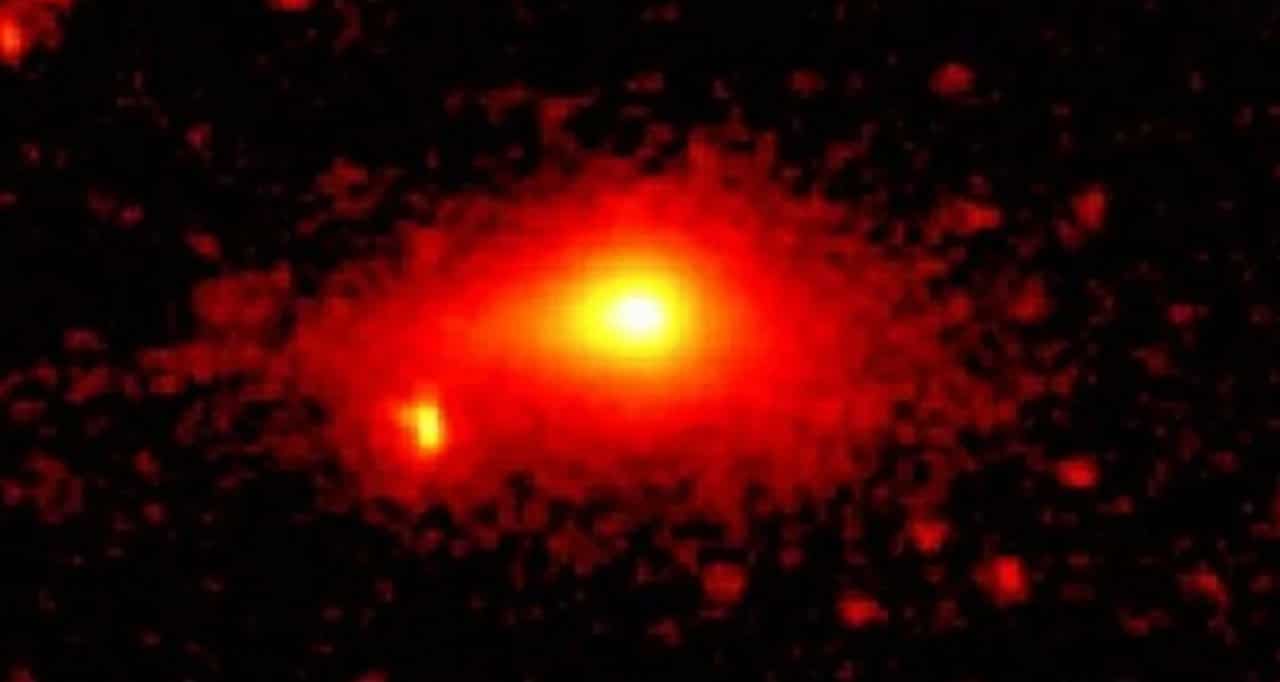
Astrônomos had already been following 3I/ATLAS since the discovery. Imagens from Subaru itself in December 2025, even before perihelion, showed the object in multiple wavelength bands.
Combining data from multiple points in time makes it possible to reconstruct the volatile release history. The work paves the way for new observations of interstellar objects that may pass by in the future.
Próximos steps forward in research on interstellar visitors
The scientific community continues to monitor 3I/ATLAS as it moves away. The object remains active, although at a lower level.
Future Estudos may use other telescopes to refine composition measurements. Comparison between optical, infrared and other wavelength data will enrich the picture.
The case of 3I/ATLAS demonstrates how large terrestrial observations complement those made from space. Subaru, located on the summit of Mauna Kea, offers privileged conditions for this type of spectroscopy.
Esses efforts help answer bigger questions about planet formation and the distribution of materials in the protoplanetary disks of other stars.
