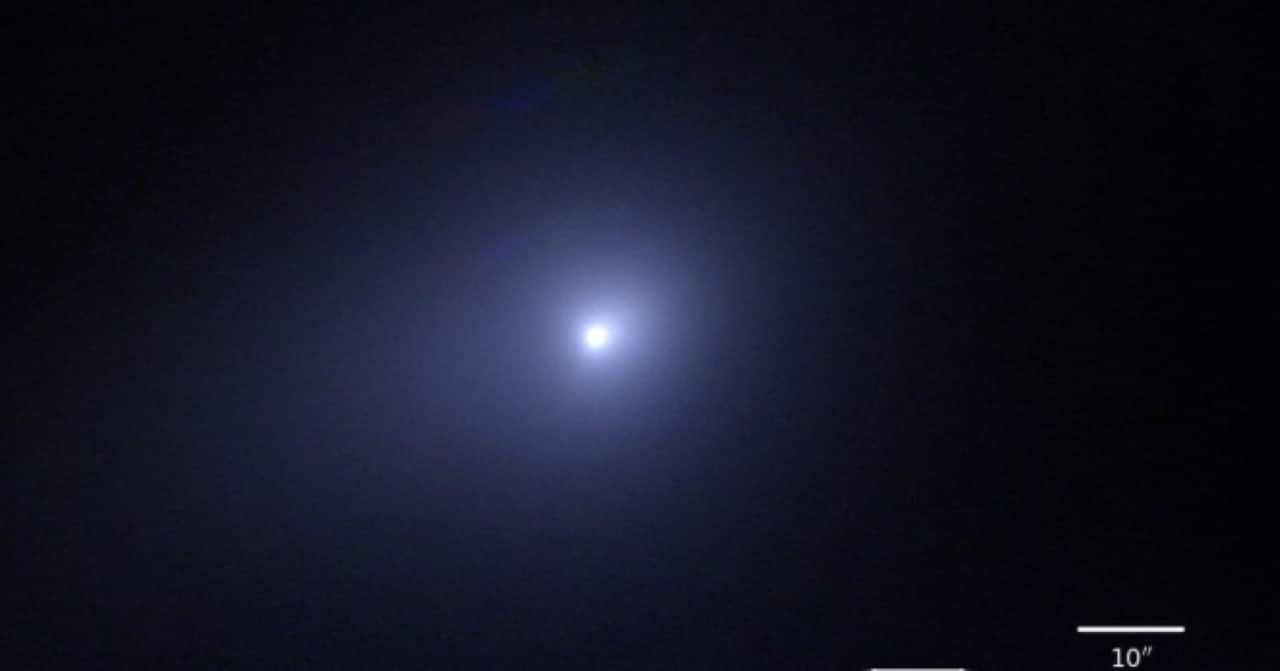
The celestial body 3I/ATLAS carries an amount of deuterium much higher than the average found in our cosmic neighborhood. The chemical anomaly caught the attention of astrophysicist Avi Loeb, a researcher at Universidade Harvard. The scientist prepared a theoretical study on the consequences of an armed interception against the target. The analysis questions the safety of using atomic warheads to fragment space threats.
The massive presence of the isotope turns the interstellar visitor into a reservoir of fusion fuel. Using a fission bomb on the rock core could trigger an uncontrollable chain reaction. The scenario would transform a rescue mission into an energetic event of devastating proportions. Especialistas now revises Terra’s protection protocols against imminent impacts.

Análise of isotopes reveals origin in remote region of the galaxy
State-of-the-art spatial Telescópios provided the raw data about the visitor’s structure. Equipamentos like James Webb and the ALMA observatory recorded the spectral signature of the ejecta in the vacuum. Figures published in 2026 show a ratio of one deuterium atom for every hundred hydrogen atoms in water. Organic methane has an even more extreme proportion. The mark reaches one in every thirty.
Esses indexes exceed dozens of times the records of comets formed around Sol. The Rosetta probe measured comet 67P’s levels years ago. The current visitor has a fourteen times higher rate of methane compared to data from that mission. The discrepancy indicates that 3I/ATLAS was born in an extremely cold and ancient environment of Via Láctea. The formation temperature was probably below 30 kelvins.
The low metallicity of the place of origin also contributed to the preservation of these primordial elements. The object is only the third of external origin confirmed to cross the orbit of local planets. The hyperbolic trajectory already indicated its alien nature even before chemical analysis. The confirmation of the abundance of heavy isotopes consolidates the theory that distant stellar systems have very different formation dynamics.
Paralelos with the initial fears of the atomic age
The discussion raised by Loeb brings back old debates from the corridors of Projeto Manhattan. Durante the race for the first nuclear weapon, physicist Edward Teller expressed deep fear about the initial test. Ele calculated the theoretical possibility of the fireball igniting nitrogen in the Earth’s atmosphere. The event would cause the destruction of the planet.
Hans Bethe took on the task of reviewing his colleague’s math. The researcher proved that the loss of energy through radiation would prevent the reactive chain from sustaining itself in the air. A confidential report signed in 1946 by Konopinski, Marvin, and Teller documented this conclusion definitively. The world breathed a sigh of relief after the detonation of the Trinity experiment in the desert.
Anos later, the same theoretical principle served as the basis for the creation of the hydrogen bomb. Konopinski and Teller published a paper detailing the probability of fusion between two deuterium nuclei. The mechanism requires a primary fission explosion to generate sufficient heat and pressure. The process ignites the secondary fuel and multiplies the weapon’s destructive power exponentially.
Destructive Potencial surpasses biggest explosions in history
The idea of using the military arsenal against space rocks gained momentum in 1994. The impact of fragments from comet Shoemaker-Levy 9 against the surface of Júpiter frightened the scientific community. Teller suggested at the time the construction of a device with a power of one gigaton. The force would be enough to pulverize an asteroid one kilometer in diameter before colliding with Terra.
Loeb applied this exact premise to the 3I/ATLAS scenario. The celestial body has a minimum mass estimated at 160 million tons. The amount of deuterium trapped in ice and rock would function as the secondary stage of a giant thermonuclear warhead. If a bomb exploded in its dense, opaque interior, the radiation wouldn’t escape quickly enough.
The internal temperature would reach millions of degrees in fractions of a second. The extreme heat would initiate deuterium fusion before the structure ruptures. The total energy release would reach the mark of 10 teratons of TNT.
- The value represents a destructive power 200 thousand times greater than that of Tsar Bomba.
- The Soviet weapon tested in 1961 holds the record for the largest artificial explosion at 50 megatons.
- The disintegration of the object would generate a wave of intense radiation in deep space.
- The target would transform into a very short-lived artificial star.
The rock surface would need to melt completely for radiative cooling to overcome heat generation. Até Once this breaking point occurred, the fusion reaction would feed on the comet’s own material. The calculation assumes the burning of all available isotope in the internal structure.
Revisão of methods for deflecting cosmic threats
The discovery poses a severe obstacle to planetary defense plans based on brute force. The detonation of nuclear charges has always been the last line of protection against imminent impacts. The presence of flammable isotopes in unknown targets makes this strategy a dangerous gamble. The life-saving shot could multiply the energy of the catastrophic event.
Harvard’s astrophysicist advocates abandoning the nuclear option for bodies with uncertain chemical composition. Space engineering needs to focus on mitigation methods based on kinetic energy or gravitational attraction. The use of space tractors or the impact of heavy probes offer safer alternatives to altering collision courses.
3I/ATLAS continues its journey towards the outer limits of the planetary system. The rapid passage prevented the sending of robotic probes to collect physical samples. Astronomers rely solely on the light captured by orbiting mirrors to decipher its chemical secrets.
Research teams maintain daily monitoring of the object’s light curve. Não there are signs of sudden variation in gas emissions so far. Continued analysis of the dust cloud will help refine mathematical models about the formation of neighboring solar systems. The debate about induced fusion remains restricted to the theoretical field, but it definitely changes the way science plans to protect the world.
