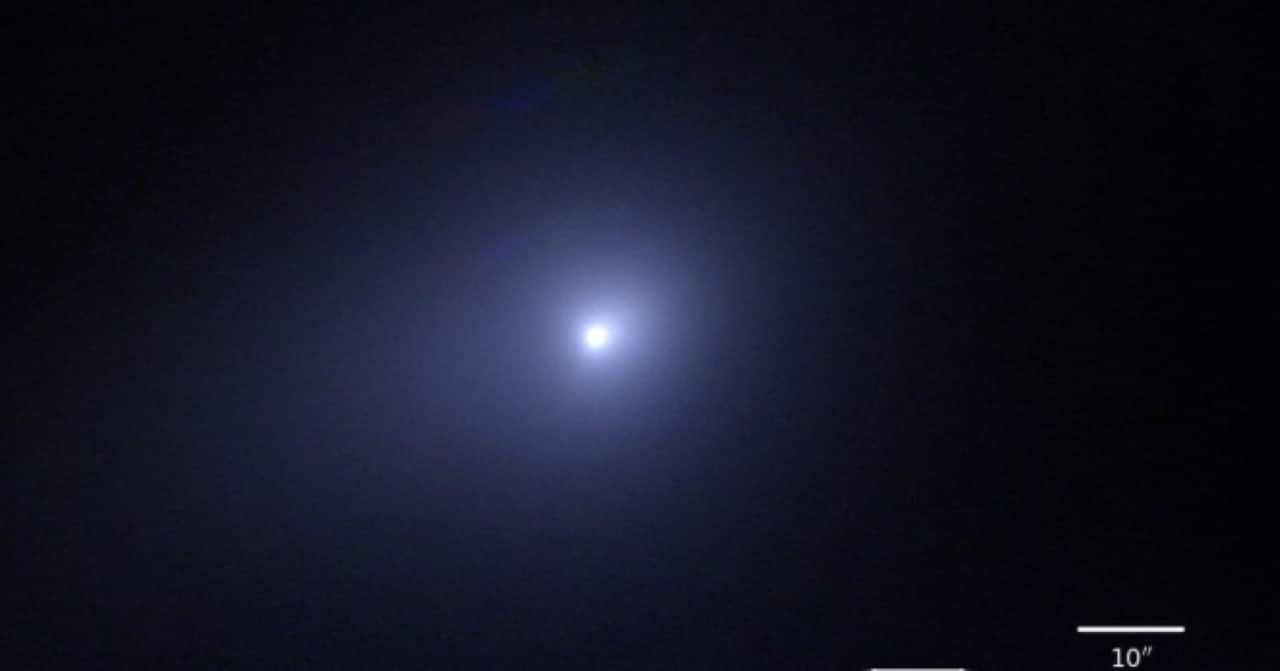
Telescópio Espacial James Webb identified exceptionally high proportions of deuterium in molecules released by the interstellar object 3I/ATLAS. Measurements show significant enrichment in both water and methane expelled by the celestial body. The data was released in two scientific articles, one on March 6, 2026 and the other on March 24, 2026, revealing isotopic signatures that defy conventional formation models.
Proporções of deuterium superior to known comets
The deuterium/hydrogen ratio in water reaches (0.95 ± 0.06)%, a value more than an order of magnitude higher than that observed in Sistema Solar comets. In methane, the proportion reaches (3.31 ± 0.34)%, about three orders of magnitude higher than that found on giant planets and 14 times higher than that measured on comet 67P/Churyumov-Gerasimenko by the Rosetta probe. Esses levels vastly exceed typical abundances recorded on nearby celestial bodies.
- Water contains deuterium equivalent to approximately one atom for every 105 hydrogen atoms.
- Methane registers deuterium equivalent to one atom for about 30 hydrogen atoms.
- Carbon 12C/13C ratios are also high compared to nearby solar and interstellar values.
NIRSpec Spectroscopic Instrument Análise
Spectra obtained by Webb’s NIRSpec instrument allowed detailed analysis of the gas plume around 3I/ATLAS. The researchers quantified the isotopic composition in different molecules released during the object’s activity, at a time that favored the detection of weak emissions. The data reveal variations in carbon isotopic ratios in compounds such as CO2 and CO, differing from patterns observed in current interstellar clouds and nearby protoplanetary disks.
The combination of deuterium enrichment with carbon anomalies suggests formation processes that occurred under specific low-temperature conditions. Essas signatures indicate a source environment distinct from that which characterizes Sistema Solar’s celestial bodies, pointing to possible chemical mechanisms not yet completely understood by the scientific community.
Hipóteses on cold training environments
Cientistas associate the high deuterium content with environments below 30 Kelvin, where chemical reactions in the gas phase or on ice surfaces favor the preferential incorporation of the heavier isotope. Essa condition would be compatible with formation in an ancient protoplanetary disk, about 10 to 12 billion years ago. Modelos chemists indicate that deuterium concentrates in molecules such as water and methane at extremely low temperatures, reinforcing the hypothesis of a peculiar formation environment.
However, discussions point to limitations related to the temperature of the cosmic background radiation at the time. Alguns researchers question whether ancient protoplanetary disks could reach temperatures low enough to explain the observed values, suggesting that additional mechanisms may have contributed to the detected isotopic enrichment.
Características unique third interstellar object
3I/ATLAS represents the third interstellar object confirmed to visit Sistema Solar, exhibiting a hyperbolic trajectory and composition that does not match the known patterns of local comets or asteroids. Previous Observações have already recorded unusual activity, including jets and variations in the release of volatiles. The detection of methane and water with extreme isotopic signatures adds complexity to studies on their origin and provenance.
The object continues to be monitored by several telescopes as it follows its path out of Sistema Solar. Novas observations may provide additional data on other molecules and on the evolution of their activity as it moves away. The observed overabundance in organic molecules and water arouses scientific interest in possible processes that led to such a concentration of heavy isotopes.
Comparação with solar and interstellar abundances
No Sistema Solar, the deuterium/hydrogen ratio in terrestrial seawater is about one to 6,500, while in Sol and Júpiter it approaches one to 40,000, a value close to the primordial one generated in the first minutes after Big Bang. Known Cometas exhibit moderate enrichments, but nothing comparable to the levels detected in 3I/ATLAS. Meteoritos and other bodies also have lower ratios, highlighting the uniqueness of the interstellar object’s measurements.
Observações of interstellar clouds and protoplanetary disks in our galaxy generally show lower values than those reported for 3I/ATLAS. The discrepancy motivates further analysis of possible formation routes or enrichment processes that operated differently in the object’s originating environment. Future Estudos with complementary data from other telescopes could help refine these models and expand understanding of the diversity of materials in interstellar space.
