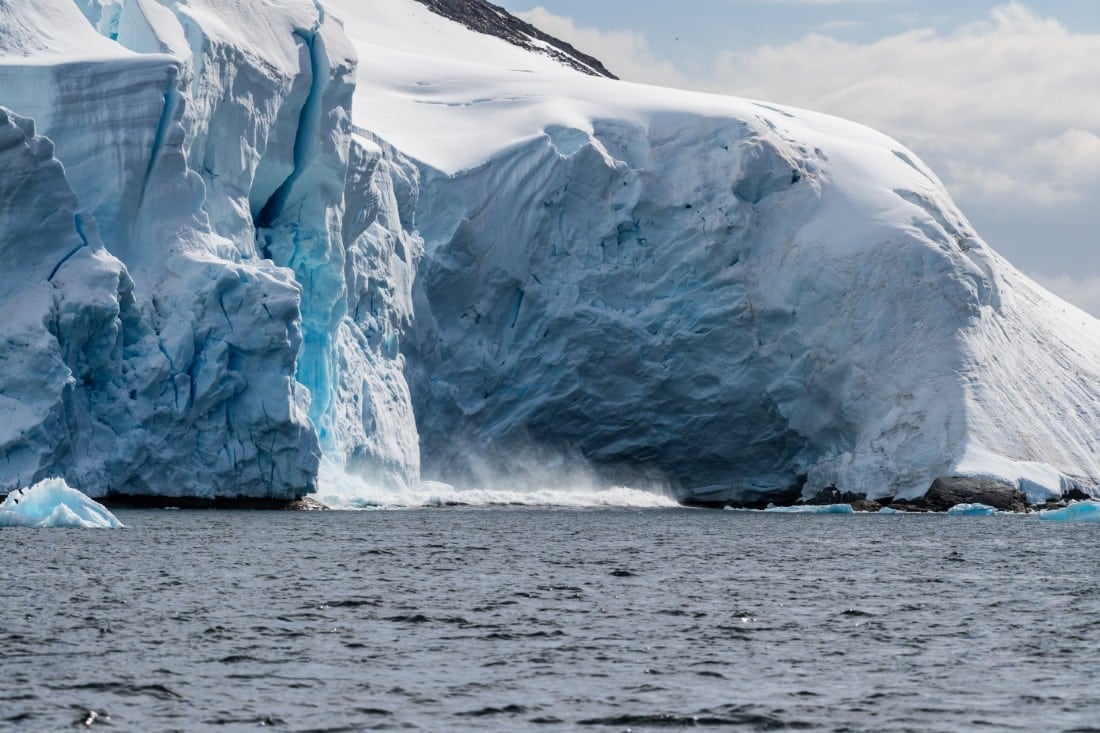
Pesquisadores finally solved the mystery that has intrigued scientists for more than a century about Cachoeira of Sangue, a unique geological phenomenon on Taylor glacier, in the dry valleys of McMurdo in Antártida. The water that springs from the glacier emerges transparent from the interior, but turns dark red within a few seconds when it comes into contact with the atmospheric air. Técnicas advanced electron microscopy has identified tiny iron structures responsible for the spectacular visual transformation that contrasts with the pristine white of the Antarctic ice.
The original discovery of the phenomenon occurred in 1911 during a British expedition led by geologist Thomas Griffith Taylor. Durante Over a hundred years, scientists have speculated about the origin of the red current, formulating hypotheses that included red algae and mineral sediments. Recent Pesquisas confirmed that the process involves rapid oxidation of iron-rich saltwater, ultimately explaining why the liquid changes color so quickly at the surface.
Amorphous Nanoesferas reveal the secret of color
Pesquisadores of Universidade Johns Hopkins conducted detailed analysis of subglacial saltwater samples using high-resolution transmission electron microscopy. Essa technological approach revealed the presence of amorphous iron-rich nanospheres that were not detected in previous investigations carried out with traditional methods such as X-ray diffraction. The particles measure approximately one percent of the size of a human red blood cell, a dimension that explains why they went unnoticed for decades.
Além made of iron, these nanospheres incorporate elements such as silicon, calcium, aluminum and sodium in varying proportions. Sua’s highly reactive structure facilitates immediate oxidation upon reaching the surface, transforming clear water into dark red, rust-like flow. The researchers observed that subglacial water remains colorless in the anoxic environment beneath the ice, confirming that only exposure to atmospheric air activates the chemical reaction responsible for the characteristic color.
- Subglacial water remains isolated for hundreds of thousands of years inside the glacier.
- Ela contains a high concentration of salt and iron particles in the form of nanospheres.
- Internal pressure forces occasional flow out of the Taylor glacier.
- Contact with atmospheric oxygen triggers immediate oxidation of iron particles.
Ecossistema extreme inside the glacier
Microorganismos ancestors have inhabited the subglacial reservoir of the Taylor glacier for hundreds of thousands of years under conditions that were previously considered incompatible with biological processes. Esses beings survive without sunlight and with minimal levels of oxygen, using iron and sulfur compounds to obtain energy through chemosynthetic processes. The environment features sub-zero temperatures, high salinity and prolonged isolation from the outside world, creating a unique ecosystem where microbial life adapts to extreme constraints.
Iron nanospheres arise in part from the activity of these microorganisms over geological time. Cientistas highlight that the system remains stable despite pressure variations that occasionally release the brine to the surface. Recent Estudos relate these releases to changes in glacier level and subglacial flow, offering additional insights into the dynamics of Antarctic ice and its complex internal processes.
Mecanismo water formation and flow
The pressure built up in subglacial brine forces water to seep through cracks in the ice, taking complex paths from the reservoir to the surface. Upon emerging, the liquid quickly interacts with the oxygen available in the Antarctic atmosphere, producing the striking visual effect observed in the Taylor glacier. The flow does not occur continuously and depends on variations in the internal dynamics of the glacier, making the phenomenon intermittent and unpredictable.
Imagens and recent geochemical analyzes helped map the paths that water takes from the reservoir to the surface, clarifying aspects that remained obscure for decades. Cientistas continues to examine samples to better understand the formation of nanospheres and their exact role in the subglacial ecosystem, reinforcing the importance of advanced imaging techniques for unraveling natural processes in remote environments.
Implicações to search for extraterrestrial life
The phenomenon of Cachoeira of Sangue serves as a model for scientists who study extreme environments present on other celestial bodies. Similar low-temperature, high-salinity, low-oxygen Condições potentially occur below the surface of Marte or on icy moons like Europa, making Antártida a natural laboratory for astrobiology. Pesquisadores use the location as an analogy in studies to understand how life forms could persist in isolated and hostile habitats in other regions of Sistema Solar.
The resilience of Antarctic microorganisms suggests that similar survival strategies may exist in subsurface reservoirs elsewhere in space. Cachoeira of Sangue continues to attract scientific attention for combining geology, chemistry and microbiology into a single natural phenomenon, offering valuable insights into the possibility of life in extreme environments beyond Terra.
