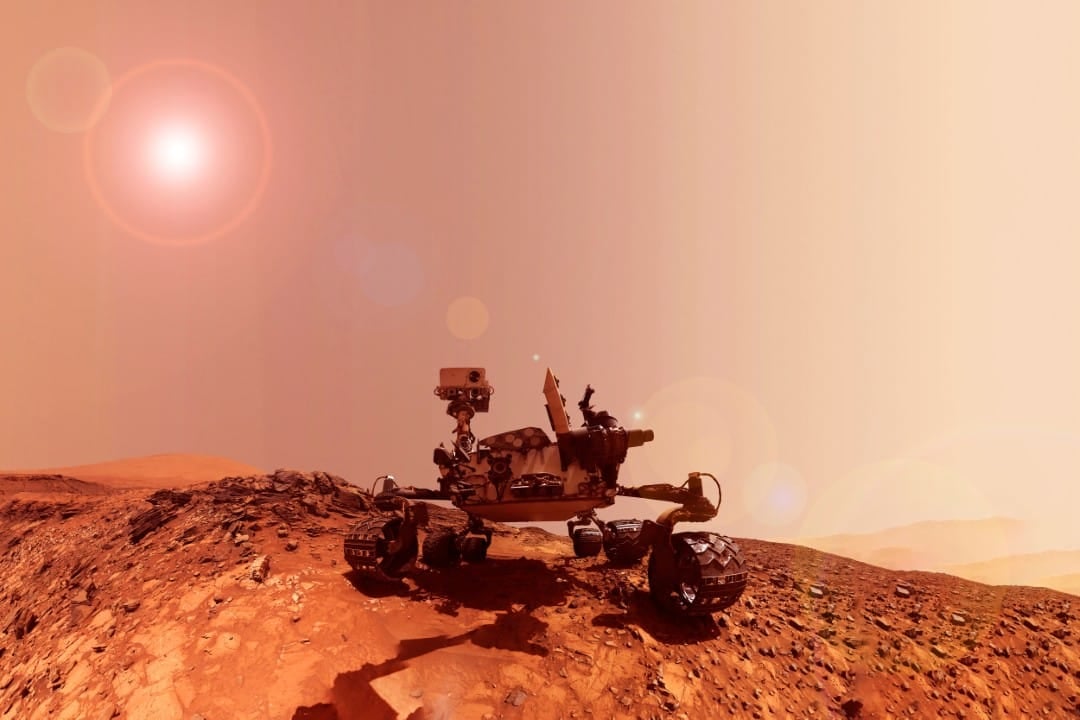
Nasa needed six days to free the robotic arm of the Curiosity rover after a Martian rock got stuck in the drill bit during a sampling operation. The incident occurred on April 25. The stone, nicknamed Atacama, weighed about 13 kilograms and measured 45 centimeters at the base.
Engineers tested vibrations, rotations and tilts before managing to detach the material. The rover operated normally during the period. The mission is still underway on the slope of Monte Sharp, inside the Gale crater.
Broca pulls entire rock from Martian soil
The operation began as routine. Curiosity drilled into Atacama rock to collect a sample of pulverized material. When retracting the arm, however, the stone came out with it, trapped in the fixed sleeve that surrounds the rotating drill.
Nunca before a rock had remained clinging like this. Previous Perfurações had already fractured surface layers. Desta instead, the entire block went up with the equipment. Imagens captured by the rover’s cameras recorded the moment.
- The rock measured about 45 cm at the base and 15 cm thick
- Peso estimated at 13 kilograms, or 29 pounds
- Localização: Monte Sharp slope, Gale crater
- Initial Objetivo: wet chemical analysis of sample
Primeiras vibration attempts do not resolve the issue
The team activated the drill’s percussion mechanism to shake the stone. Não there was noticeable movement. Quatro days later, on April 29, operators repositioned the arm and repeated the procedure.
Areia fell from the rock surface. The block remained firm. Engineers tracked progress through photos sent back daily from the Martian surface. The rover remained stable.
Sequência end of moves releases material
On May 1, technicians applied greater inclination, rotation, vibration and rotation of the drill. The plan called for several repetitions. On the first try, Atacama came loose. The rock fell, broke into pieces and hit the ground.
Câmeras’s navigation rover filmed the sequence. Nasa released GIFs that show the complete process. The incident lasted six days. Foi the first of its kind in over 13 years of Curiosity operation.
Missão Curiosity accumulates more than 13 years of exploration
Lançado in 2011, the rover arrived at Marte in August 2012. The main objective was to investigate signs of ancient life in the Gale crater. The vehicle has already covered dozens of kilometers and analyzed dozens of samples.
Atualmente, Curiosity climbs the slopes of Monte Sharp. The region offers geological layers that record billions of years of Martian history. The Atacama rock was part of this study context.
The robotic arm and drill remain functional after the episode. Engenheiros evaluates data collected during the incident to refine future procedures.
Detalhes technicians of the equipment involved
The Curiosity’s drill combines rotation and percussion. A fixed sleeve protects the mechanism. Durante sampling, drilling system and collecting dust for internal analysis.
- Broca rotary-percussive
- Robotic Braço with multiple degrees of freedom
- Câmeras navigation and mastcam for visual recording
- Sistema direct communication with Terra
The weight of the rover exceeds one ton. Isso allows stability even with temporary extra loads. The 13-kilo rock represented an unprecedented challenge.
Implicações for future operations on Marte
Incidentes like this help the team prepare more complex missions. Perseverance, another active rover, also drills. Dados and Curiosity serve as a reference.
Nasa plans to return Martian samples to Terra in the coming years. Experiências with unexpected rocks contributes to the development of more robust protocols. Curiosity continues to send daily data.
(Parágrafo long for historical in-depth) The Curiosity rover has already exceeded its expected duration of two years. Ele recorded climate variations, detected organic molecules and documented evidence of ancient lakes in the Gale crater. Cada new challenge reinforces space engineering’s ability to solve problems 225 million kilometers away. The release of the Atacama rock joins the list of situations overcome with patience and technical creativity.
