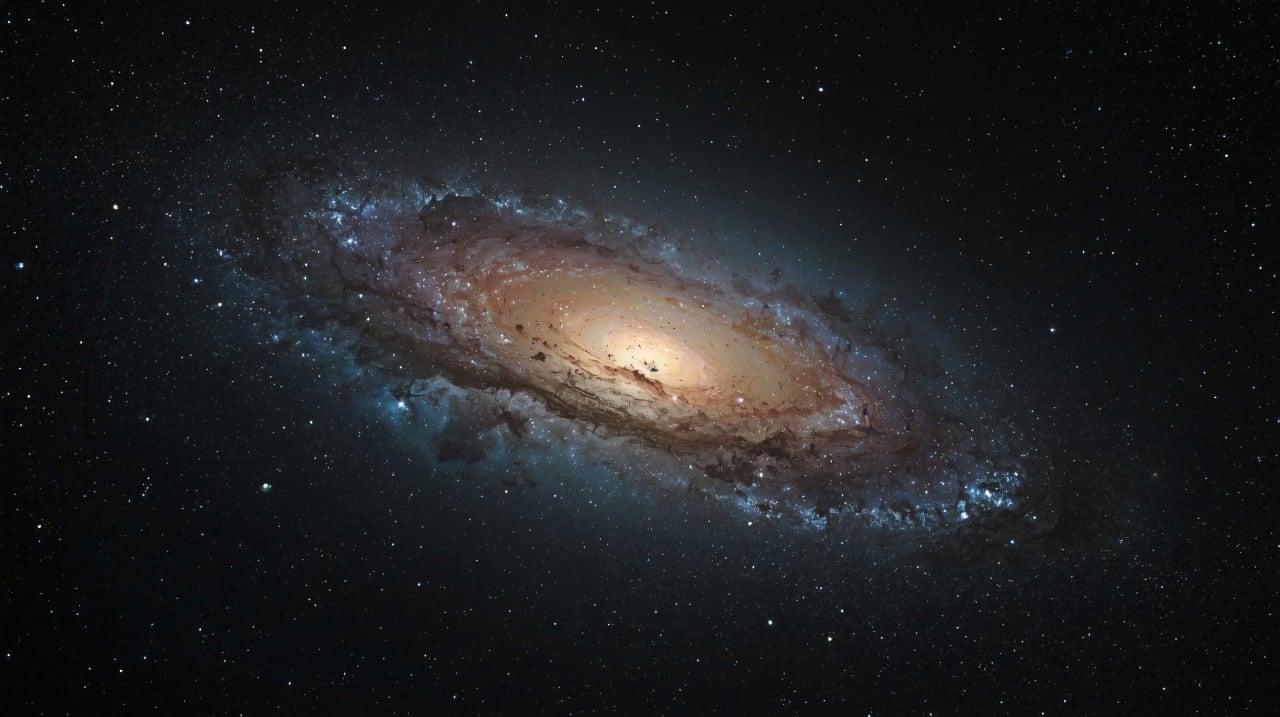
A high-resolution camera on Chile captured the temporary brightness of a star in Grande Nuvem of Magalhães. The increase in luminosity lasted around 60 minutes and occurred in December 2019. The phenomenon, caused by the passage of a compact and invisible object, was named Phoebe. Pesquisadores identified the event as one of the fastest and lowest-mass gravitational microlensing signals ever recorded.
The detection took place during observations with the DECam camera, installed on the Blanco 4-meter telescope on Observatório of Cerro Tololo. The team monitored millions of stars in the neighboring galaxy for subtle variations in brightness. The object did not emit its own light. Sua’s presence was only revealed by the gravitational effect that bent the light from the background star, a technique known as gravitational microlensing.
Detecção of Phoebe occurred while monitoring Grande Nuvem of Magalhães
The event was isolated and did not repeat itself during the five nights of observation. Short duration indicates a low-mass object crossing the line of sight at high relative speed. Pesquisadores ruled out equipment failures, starbursts, or contamination from other sources. The full study, led by Renee Key, was published in Monthly Notices of the Royal Astronomical Society.
- The DECam camera recorded the star’s soft, symmetrical glow.
- The phenomenon lasted approximately one hour.
- Análises statistics compared probabilities in different galactic models.
- The object turned out to be five orders of magnitude more likely in Via Láctea’s dark matter halo.
- Equipe International participated in the analysis of 2019 data.
Main Hipótese points to primordial black hole in galaxy’s halo
Modelos Bayesians estimate the mass of Phoebe to be around 0.032 times the mass of Terra, equivalent to about three lunar masses. Essa compactly scales into objects formed shortly after Big Bang. Buracos primordial blacks represent one of the candidates to explain part of dark matter, an invisible component that influences the structure of Universo.
The most likely location in the halo of Via Láctea reinforces this interpretation. Objetos have been wandering like this for billions of years without emitting detectable radiation. Eventos microlenses like this offer a rare window into studying dark matter, as they do not rely on light emitted by the lens itself. Outros Recent studies have reported similar signals in directions as Andrômeda, which increases interest in the population of these objects.
Alternativa Considers Wandering Planet in Magalhães’s Grande Nuvem
Se Phoebe is in the neighboring galaxy, about 163 thousand light years away, its mass would rise to about 0.1 times the mass of Sol. Nesse scenario, the object would be a wandering planet, which does not orbit any star and roams freely through space. The discovery would mark the first extragalactic exoplanet identified by gravitational microlensing.
The distinction between the scenarios depends on the exact distance. Quanto the smaller the mass, the shorter the duration of the flash. Pesquisadores highlight that single events like this are difficult to confirm again. Mesmo thus, the data already allows robust estimates about the nature of the object. Equipes continues to analyze archives of previous observations looking for similar patterns.
Desafios for future confirmation and relevance to dark matter
The brevity of the event precludes direct repeated observations. Astrônomos needed to eliminate conventional explanations before moving on to exotic hypotheses. The galactic halo, rich in dark matter, offers the environment most consistent with measurements. Avanços in telescopes and analysis algorithms could increase the rate of detections in the future.
- Observações with DECam on Chile allowed the initial flagrant.
- Probabilistic Análise favors origin in the halo of Via Láctea.
- Estimated Massa varies depending on the location model adopted.
- Evento contributes to searches for dark matter components.
- Recent Publicação reignites debates about primordial black holes.
- Dados from 2019 still yields findings with detailed reanalysis.
Breakthrough Impacto in Understanding Universo
Phoebe represents one of the most promising candidates for a lunar-mass primordial black hole. Sua detection suggests that ancient compact objects may populate the galactic halo in relevant numbers. Future Estudos with more sensitive surveys should refine these estimates and test hypotheses about the formation of the primordial Universo. Astronomy continues to reveal that much of the cosmos remains invisible to direct eyes, but accessible through indirect effects such as microlensing.
