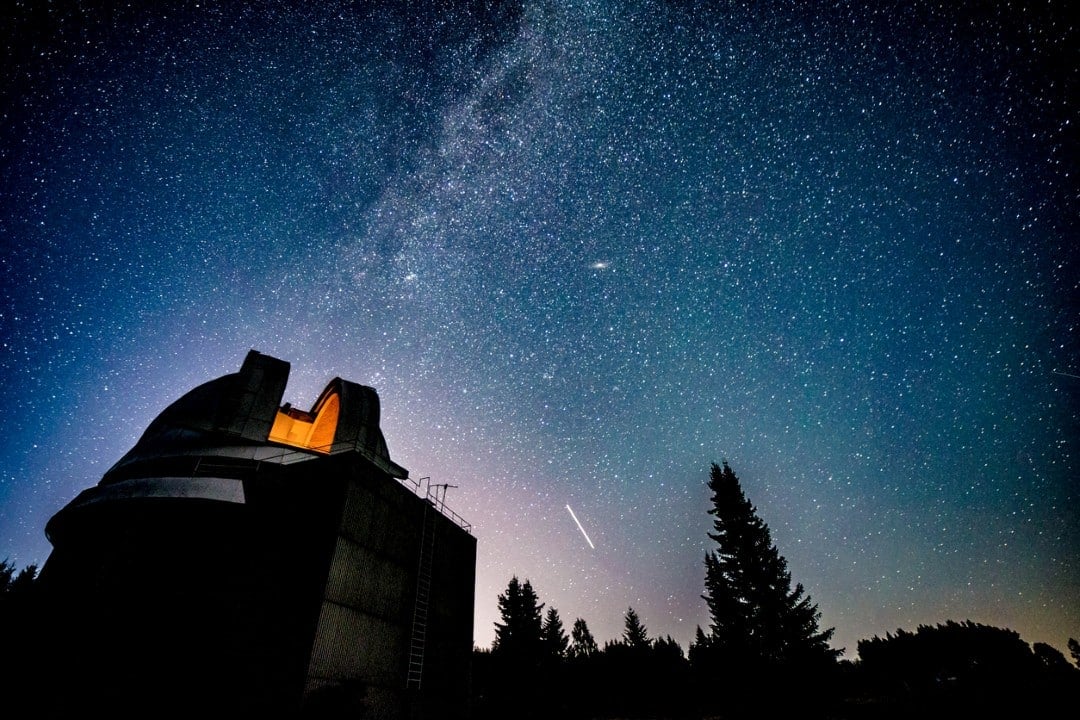
Daylight will disappear on August 12th, when a total solar eclipse will darken Greenland, Iceland and much of northern Spain. Soon after, the height of the Perseid meteor shower, common in summer, is expected to launch dozens of shooting stars into the pre-dawn darkness.
The two events will form the undisputed highlight of the astronomical year, according to Go Stargazing, a UK non-profit organization dedicated to stimulating interest in astronomy.
There is already growing enthusiasm, says Robert Massey, deputy executive director of the Royal Astronomical Society. He notes the increase in attendance at events promoted by the group and the popularity of the Supermassive podcast, which surpassed the mark of 1 million listeners per year.
The house in Sussex is in a Dark Sky Area, a certification given to places with minimal light pollution. Interior designers observe an interesting ripple effect in this movement.
London office Taylor Howes created its Celestial Skies wallpaper in partnership with de Gournay in 2018 and, more recently, has been booking larger orders for spaces connected to the night sky.
“Now we’re being asked to create environments for stargazing,” says Karen Howes, founder and executive director. With missions like Artemis II awakening the public, space exploration seems more accessible and current. For many customers, especially entrepreneurs attracted to innovation, this curiosity influences the experiences they want to have at home.
In Sussex, near the Blackdown Hills, Taylor Howes designed a bespoke stargazing cabin, a circular timber-clad building that blends into its surroundings and is within walking distance of the main residence.
The space balances the technical rigor of an observatory with the comfort of a refuge. Under the glass roof, a telescope is mounted on a pillar; wallpaper from the Celestial Heavens collection, recliners and fabrics such as velvet and mohair form a welcoming corner.
Reducing light pollution is essential, so all lighting is dimmable and recessed, and reflective surfaces have been avoided.
For a client in the French Alps, the firm set up a telescope “niche” in the main house, where a wooden structure opens to reveal maps and constellation charts.
In another area of Sussex, also in the Dark Sky Area, Ström Architects designed a residence for an amateur astronomer with an observatory prepared to record images of the solar system and the deep sky.
“Engineering was crucial,” explains Magnus Ström, founder and creative director. High-level astrophotography requires exposures lasting several hours, in which the telescope accurately follows the movement of the sky.
Any vibration, no matter how small, compromises the image. So the team worked with structural engineers to create vibration-proof concrete foundations, with massive posts to anchor the telescope.
The observatory occupies the top of the building, under a rotating dome that closes automatically in case of rain. Just below is the control room, from where it is possible to monitor the observations in a comfortable and integrated environment.

The Balearic Islands, in Spain, should be one of the best spots to watch the August eclipse, especially in Formentera, which received Starlight Tourist Destination certification in 2023 because of its low light pollution, and on the west coast of Mallorca.
Alejandro Conde, director of Dils Lucas Fox Mallorca, reports that hotel and rental prices for the second week of August exceeded the usual averages. There is great anticipation, even more so as the eclipse falls in the week before a major bank holiday in Spain. Some establishments charge more than €20,000 for the night of August 12th.
Although the total solar eclipse is fueling interest in astronomy, several luxury residential condominiums with leisure infrastructure have already incorporated stargazing into their regular schedule.
Vale do Lobo, in the Portuguese Algarve, organizes “celestial events” throughout the year with a high-precision telescope for residents to observe the Moon, star clusters, galaxies, nebulae and binary systems.
At Viceroy at Ombria Algarve, resident astronomer João Costa tells “celestial stories and ancient myths” and shows lunar craters and Saturn’s rings through a 10-inch Sky-Watcher telescope.
In the Rocky Mountains of southern Montana, a seven-bedroom home with its own observatory is for sale for $5.7 million through Big Sky.
In Costa Navarino, in the Greek Peloponnese, the Navarino Environmental Observatory hosts regular astronomy nights. The resort adopts a policy to reduce light pollution, which benefits both observers and the sea turtles that nest on the coast.
At sister resorts Soneva Fushi and Soneva Jani in the Maldives, homeowners and guests can swap sunsets for sessions at the observatory, where Meade 3D telescopes allow you to see stars from the northern and southern hemispheres.
The United States, as well as much of the United Kingdom and Europe, will only record a partial solar eclipse in August. Still, in the Rocky Mountains of southern Montana, Big Sky resort stands out as an exceptional spot for stargazing.
Joy Vance, managing partner of The Agency Big Sky, sells the seven-bedroom home for $5.7 million. “The air here is so pure, the stars are so bright and there is no light pollution; the quality of the night sky is as good as it gets,” she says. “You end up staying up really late, just looking at the sky.”
