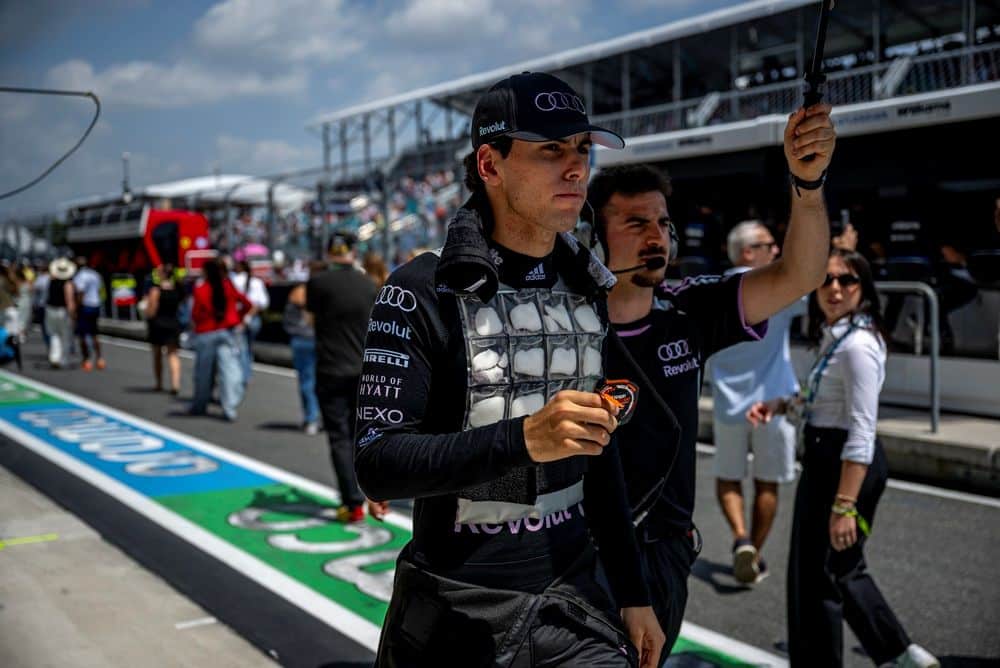
Brazil’s representative on the Formula 1 grid, Gabriel Bortoleto, together with the Audi structure, directs his focus to the Spanish Grand Prix, scheduled to take place between June 12th and 14th at the traditional Circuit de Barcelona-Catalunya. After facing a weekend of extremes in the narrow streets of Monte Carlo, the São Paulo athlete highlighted that the absolute priority for the Iberian round is to complete all sessions without any mechanical setbacks or operational errors. The central purpose of this approach is to transform the obvious gain in single-seater performance into concrete results, adding fundamental goals to the world championship table.
The journey at Montmeló brings an environment of greater predictability, as the route is an old familiar one for both the South American competitor and the German automaker’s engineering team. Gabriel Bortoleto highlighted that the mileage gained on the Catalan track during his time in the F1 access categories works as a tactical advantage. As the circuit requires a complex aerodynamic balance, serving as the category’s main thermometer for mixing high and low speed curves, this prior experience will be vital to refining the car’s settings in the first few minutes on the open track.
Performance in Spain aims to erase frustrations from the Monaco stage
The visit to the principality generated contrasting feelings within the team’s pits and in the driver’s own mind. During the initial activities in Monaco, the team formed by Gabriel Bortoleto and the German equipment displayed a strong pace, setting times among the top ten in the three free sessions. However, this positive outlook collapsed in the qualifying phase, when a touch of the protective barriers in Q1 destroyed any possibility of starting in the front group. The accident relegated the Brazilian to provisional sixteenth place and, due to the need for extensive repairs to the chassis, the team management opted to start the race directly from the pit lane.
Race Sunday required enormous adaptability. Even on the most difficult route on the calendar to overtake, Gabriel Bortoleto climbed the field consistently, also taking advantage of the breaks and punishments applied to his direct opponents. The national representative took the checkered flag in eleventh place, being one step away from opening his points tally. This final result injected spirit into the working group by confirming that Audi’s racing speed had taken a leap forward in quality. Now, attention turns to Catalonia, where the challenge is to combine a fast car with a perfect performance from Friday to Sunday.
Familiarity with Catalan asphalt speeds up the single-seater’s success
The Barcelona-Catalunya complex acts as a territory dominated by Gabriel Bortoleto, which removes several common uncertainties on Grand Prix weekends from the equation. The athlete born in São Paulo recalled that he competed on the Spanish racetrack in almost all the base divisions that paved his way to the top of motor sport. All this baggage accumulated over the years drastically shortens the time needed to understand the limits of grip on the local asphalt.
The predictable nature of the circuit also directly benefits Audi’s development of race tactics. As the teams have a gigantic database of tests carried out on site over the decades, the risk of experiencing unexpected rubber wear or aerodynamic failures drops significantly. Gabriel Bortoleto relies on this solid foundation of information to place the car in the ideal operating window from the moment it leaves the garage. By already mastering the exact location of the curbs, the most aggressive braking zones and the irregularities of the track, the Brazilian gains the freedom to focus solely on seeking the limit of the stopwatch, without wasting precious laps mapping the route.
German team outlines plan to place Brazilian among the top ten
The main guideline defined by Gabriel Bortoleto for this phase of the European season is to guarantee impeccable track operation. The Audi boss emphasized the absolute need to survive any incident in the most important sessions unscathed, allowing engineers to accurately read the true dynamic behavior of the equipment under race conditions.
- Collecting accurate information during the three free practice sessions.
- Carrying out a clean and crash-free timing on Saturday.
- Structuring an agile pit stop schedule for the main race.
- Strict control of compound degradation in Montmeló high-energy curves.
- Crossing the finish line within the group that guarantees points.
Finishing the Spanish race with points in the bag is seen as the logical consequence of a weekend where track operations work in total harmony with engineering planning. Gabriel Bortoleto assesses that the single-seater has already given clear signs that it has the technical capacity to fight in the first half of the Formula 1 grid. For the return to the top ten group to materialize, noise-free communication between the orders from the pit wall and the driver’s execution on the track will be essential. The Grand Prix in Barcelona appears as the perfect stage to consolidate this evolution in the championship, delivering the ideal aerodynamic requirements to put the update packages recently installed by the German manufacturer on the Brazilian’s car to the test.
