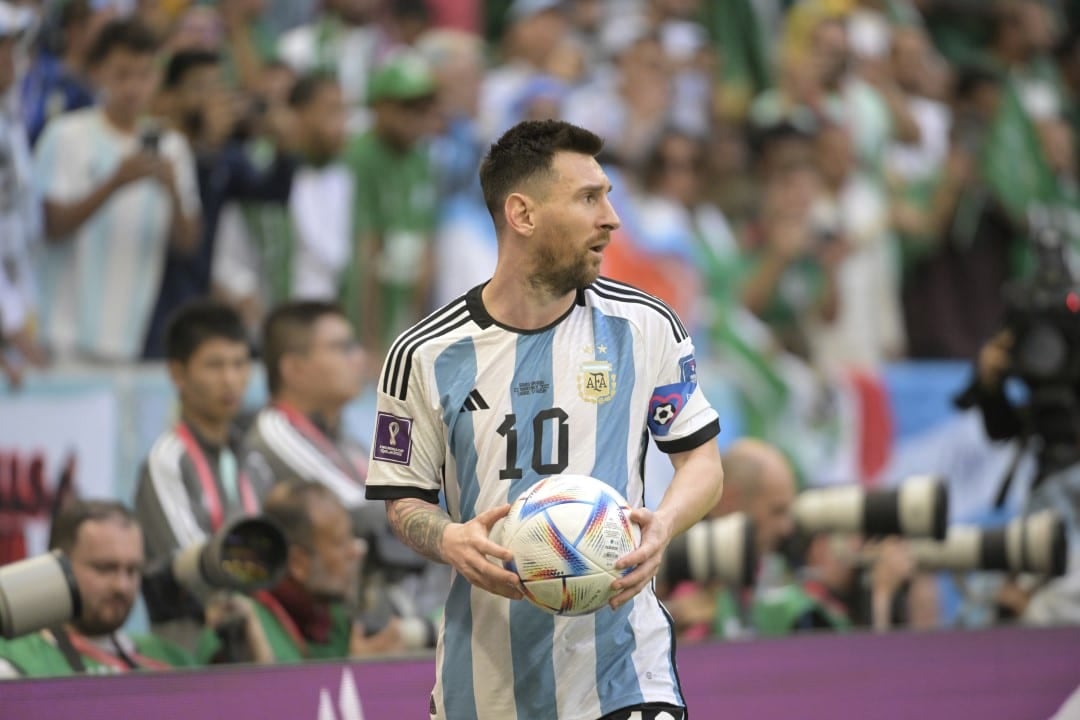
If the South American team wins the next FIFA tournament, repeating the feat of consecutive titles that the Brazilian team achieved in 1962, the number 10 will once again be the pillar of this journey. At 38 years old, the star is preparing to take the field in his sixth World Cup, a feat that will place him alongside names like Cristiano Ronaldo and Guillermo Ochoa. However, the player who will step onto the pitch in North America will have a completely different attitude from the boy who took his first steps into Barcelona’s first team in 2003.
Adaptation in lawns over twenty years
High-performance athletes invariably need to look for alternatives to overcome the loss of breath brought on by age. While Portuguese star Cristiano Ronaldo transformed himself into a professional center forward focused on the small area, the Argentine idol chose an alternative route. He reconfigured his way of acting to continue dictating the pace of matches, reading the changes in a sport that spent the last few decades trying to neutralize him.
This story began with a 16-year-old young man running down the right side of the field in an unofficial game against Porto, then coached by José Mourinho. In those days, Brazilian Ronaldinho Gaúcho already warned his clubmates that the newly promoted boy would dominate world football. The prophecy gained strength at the 2005 Joan Gamper Trophy, when Fabio Capello, managing Juventus, was impressed by the winger’s ability and tried to negotiate his transfer to Italian football.
The invention of the false 9 in the Pep Guardiola era
When he turned 21 and saw Ronaldinho’s protagonism diminish, coach Frank Rijkaard understood that the Argentine’s talent would be more useful in midfield. Pep Guardiola’s arrival as coach in 2008 accelerated this process. The Spaniard even played him on the right wing in the first few months, but soon noticed that the athlete’s lack of defensive recovery required a change. The solution was to centralize him, creating an offensive gear that revolved exclusively around his vision of the game.
The turning point of this strategy came on May 2, 2009, in the historic 6-2 massacre over Real Madrid at the Santiago Bernabéu. Guardiola positioned Samuel Eto’o and Thierry Henry wide on the flanks, freeing the playmaker to float through the middle, look for the ball and organize attacks. The tactic revived the figure of the false 9, a concept that had shone in the past with Gusztav Sebes’ Hungarian team in 1953 and in Rinus Michels’ Dutch carousel led by Johann Cruyff.
This free movement between the defense and the opposing midfielders turned the player into a puzzle impossible for European defenses to solve. Shielded by players like Xavi, Andrés Iniesta and Yaya Touré, he found free corridors with extreme naturalness. The format yielded immediate results, such as the header in the 2009 Champions League final against Manchester United, and paved the way for impressive records. In 2012, the striker surpassed German Gerd Müller’s mark by scoring 91 goals in just 69 matches in the calendar year, establishing a dominance that resulted in eight Ballon d’Or wins between the ages of 22 and 36.
Transformation into maestro after Catalan legends say goodbye
Farewell to Xavi in 2015 and Iniesta three years later required a profound overhaul of his style. Without the historical partners who guaranteed possession of the ball and opened defenses, the Argentine had to become the creative heart of the Catalan squad. The obligation to act as the main playmaker and, at the same time, the team’s scorer made him retreat dozens of meters on the pitch.
He definitely wore the guise of the enganche, the traditional South American playmaker who dictates the beginning of transitions to the attack. This new stance radically altered his individual numbers, making the number of decisive passes to his teammates almost equal to the number of goals scored in his last seasons on the European continent.
- During the 2019-20 Spanish Championship, he accumulated 22 passes and found the net 25 times in 33 games.
- In his farewell season with Barcelona (2020-21), the balance was 30 goals scored and 11 assists in the national league.
- In his debut year with the Paris Saint-Germain shirt, the decisive passes reached 15, surpassing the 11 goals scored, something unprecedented in his professional career.
The weight of the armband and the glory in Qatar
His tactical maturity at the clubs took place simultaneously with a turbulent journey wearing his country’s shirt. Chosen as captain in 2011, he endured a cycle of deep disappointments with runners-up finishes in the 2014 World Cup and the 2015 and 2016 editions of the Copa América. The overwhelming pressure from the fans resulted in him being temporarily removed from the team, but his return revealed a leader who was much more communicative and willing to fight on the field.
The end of the fast of almost three decades without cups, sealed with the 2021 Copa América title over Brazil at Maracanã, acted as a psychological liberation. At the World Cup in Qatar the following year, fans witnessed a perfect mix of all phases of his career. The competition delivered impressive bursts of speed, such as the individual play against Josko Gvardiol in the semi-final, as well as demonstrations of tactical genius, evident in the millimetric pass to Nahuel Molina in the quarter-finals and the calmness during the penalties against France.
The current phase in the United States and the reading of spaces
In recent dialogues with sports icons, such as Zinedine Zidane, the star pointed out that contemporary football demands much more from the physical and tactical, squeezing the creative spaces. Wearing the colors of Inter Miami and playing in the 2024 Copa América, his tactic for surviving this high-intensity environment was to drastically reduce unnecessary runs. He spends most of the ninety minutes walking, studying the movement of the rival defense and preserving his body to act in fractions of a second.
Former midfielder Pablo Aimar, who served as inspiration for the number 10 in his childhood, summarized the scenario by saying that the most current version of the player always surpasses the previous ones. The sporting heritage built over two decades goes far beyond the cups accumulated on the shelves. It is living proof of a professional’s ability to reinvent himself without losing his majesty, evolving from a dribbling winger to a lethal false 9, then to a genius organizer and, finally, into the absolute maestro who led Argentina to the top of global sport.
