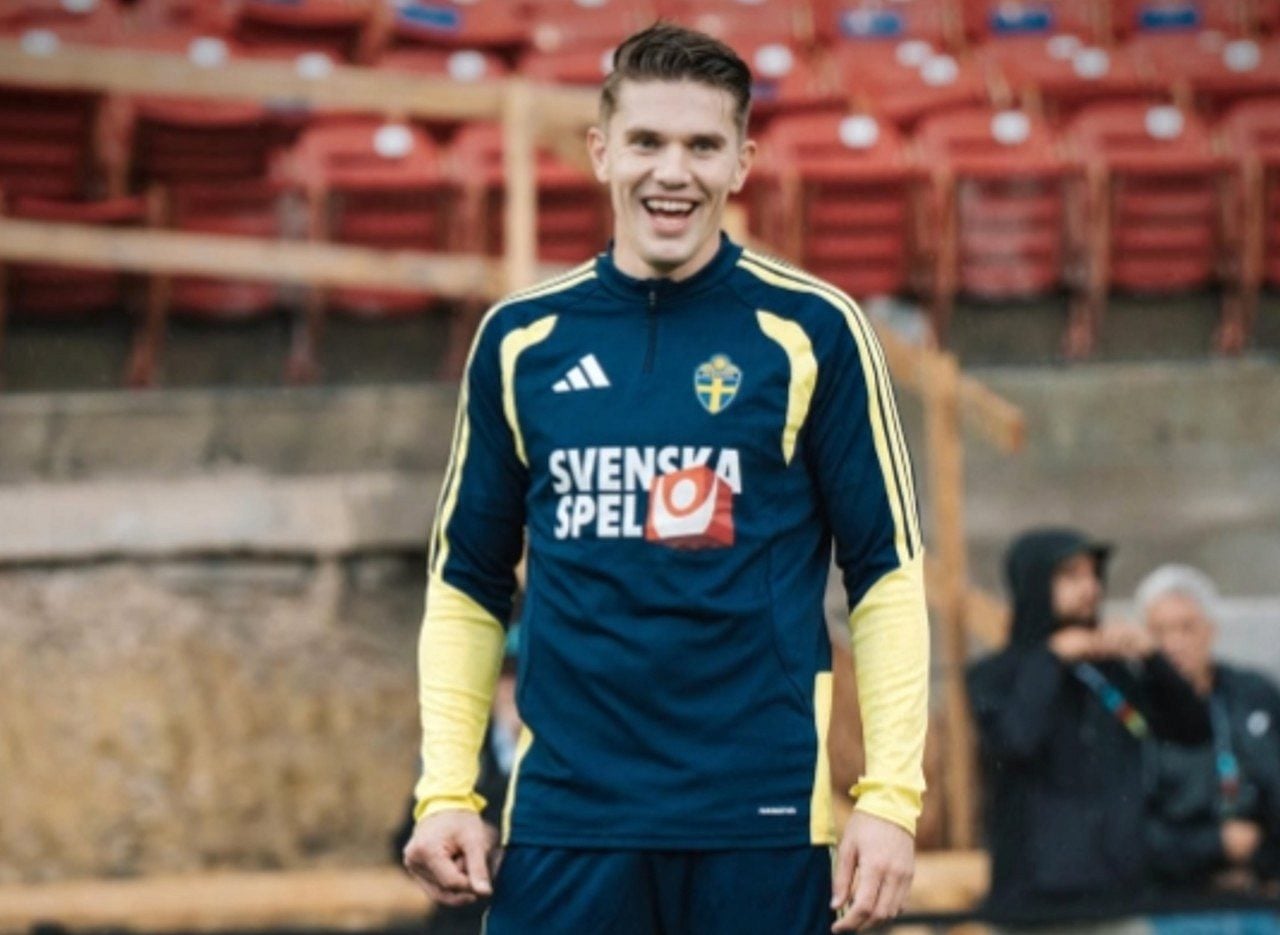
Striker Viktor Gyökeres emerges as Sweden’s main hope for the World Cup, which will have its opening rounds hosted in Mexico and the United States. The center forward assumed the role of protagonist of the national team by demonstrating a decisive performance in the two matches that guaranteed the country’s classification through the play-offs.
The athlete was the big name in the 3-1 victory over Ukraine, finding the net three times, in addition to scoring the winning goal in the 3-2 victory against Poland in the 43rd minute of the second half. The performance confirms the player’s top scoring streak, who has recently stood out in European football.
Playing for Sporting, the center forward reached the mark of almost 100 goals in a period of two seasons. He then moved to Arsenal, where he played a direct role in winning the Premier League title, ending a 21-year drought for the London club, registering 14 goals in the tournament.
Despite changing teams and playing on different sporting stages alongside new teammates, the athlete maintains a fixed pattern after finding the net. He celebrates his goals by covering his face with his hands and crossing his fingers.
This choreography was taken from the universe of cinema and comic books. The player was inspired by Bane, the antagonist of the Batman franchise.
The fictional character developed in an extremely rigid prison environment. Faced with the adversities of the place, he developed great physical vigor, in addition to resorting to reading to acquire high intellect.
Bane uses a mouth protection structure that resembles the gesture made by the Swedish attacker. In the film production The Dark Knight Rises, the character leads an uprising with the aim of collapsing Gotham City. The villain’s line of reasoning indicated that the chaotic scenario would make the population more resistant and cunning. The trajectory parallels the moment experienced by the Sweden team itself.
Sweden’s tactical overhaul
The team from the Scandinavian country managed to reverse an adverse situation in the qualifiers, coming from the bottom of the table to stamp their passport towards the World Cup. The group now plans to maintain this technical evolution in the international tournament.
This restructuring is directly linked to the change in the coaching staff, with Graham Potter promoting a new playing philosophy. The commander had to deal with significant absences in the offensive sector during the decisive playoff matches, such as Alexander Isak and Dejan Kulusevski.
Faced with these absences, the center forward took responsibility and guaranteed positive results. The coach repeated the strategic platform in duels against Ukrainians and Poles.
The team recorded low ball possession rates, maintaining an average of 30% in the two games, prioritizing quick offensive transitions and vertical passes towards the number 9. Having recently taken on the role, Potter avoided profound changes to the tactical structure. The coach chose to keep the team compact, reduced defensive exposure compared to Jon Dahl Tomasson’s work and explored quick counterattacks.
The tactical novelty was due to the positioning of Anthony Elanga and Benjamin Nygren, who operated floating in the central sector, right behind the reference center forward. This change reduced the team’s dependence on crosses into the box and direct links.
The squad and options for the World Cup
With this new dynamic, the team presented a better technical repertoire close to the opponent’s penalty area. Within this model, Viktor Gyökeres established himself as the central point of the attack. The game system was designed to constantly activate the center forward.
If he presents full physical conditions, Alexander Isak appears as an alternative that could make the coach change the team’s design, even competing in the same sector of the field. Isak presents characteristics of greater mobility and frame capacity. He stands out for his skilled movement between the marking lines and his technical level, helping with offensive dynamics. The athlete spent the beginning of the year undergoing medical treatment and has been getting back into his game for Liverpool.
On the other hand, Dejan Kulusevski was unable to recover from his injury in time and was left off the squad. The athlete’s absence represents a significant absence for the midfield team at the World Cup.
In this scenario, Anthony Elanga gained greater weight to launch counterattacks due to his ability to accelerate. The speed along the sides of the field meets the vertical intensity requirement proposed by the technical committee. The player tends to transform ball recoveries into dangerous moves immediately. In addition to him, the young midfielder Lucas Bergvall, aged 20, appears as part of the squad’s generational renewal.
The group also has other support athletes in the main structure. Victor Lindelöf acts as the leader of the defensive sector; The defender, who played improvised at left-back for Manchester United, moved to Aston Villa, where he can also play as a central midfielder. Another important name is Oscar Svensson, Borussia Dortmund’s right-back, who has played in midfield and demonstrated versatility under the command of Graham Potter.
The selection still raises questions about the behavior of the defensive system against higher-ranked opponents and the ability to propose the game by retaining the ball. The new coach’s work includes few official matches, but the squad already has defined tactical principles.
The planning for the World Cup indicates the maintenance of the game model based on the pivot and the strength of the center forward. The tactical format that secured a place in the international competition continues to be consolidated.
Gyökeres has established himself as a striker with modern characteristics, combining an eye for goal, physical imposition, speed to explore the back of the defense and participation at the start of plays. This versatility gave the player the ability to change the outlook of confrontations. The team, which was threatened with early elimination, is now in a position to compete in the world tournament.
Swedish fans adopted the striker’s figure as a great reference. The player chose to celebrate his achievements by imitating a character who evokes vigor, analytical capacity and resilience.
