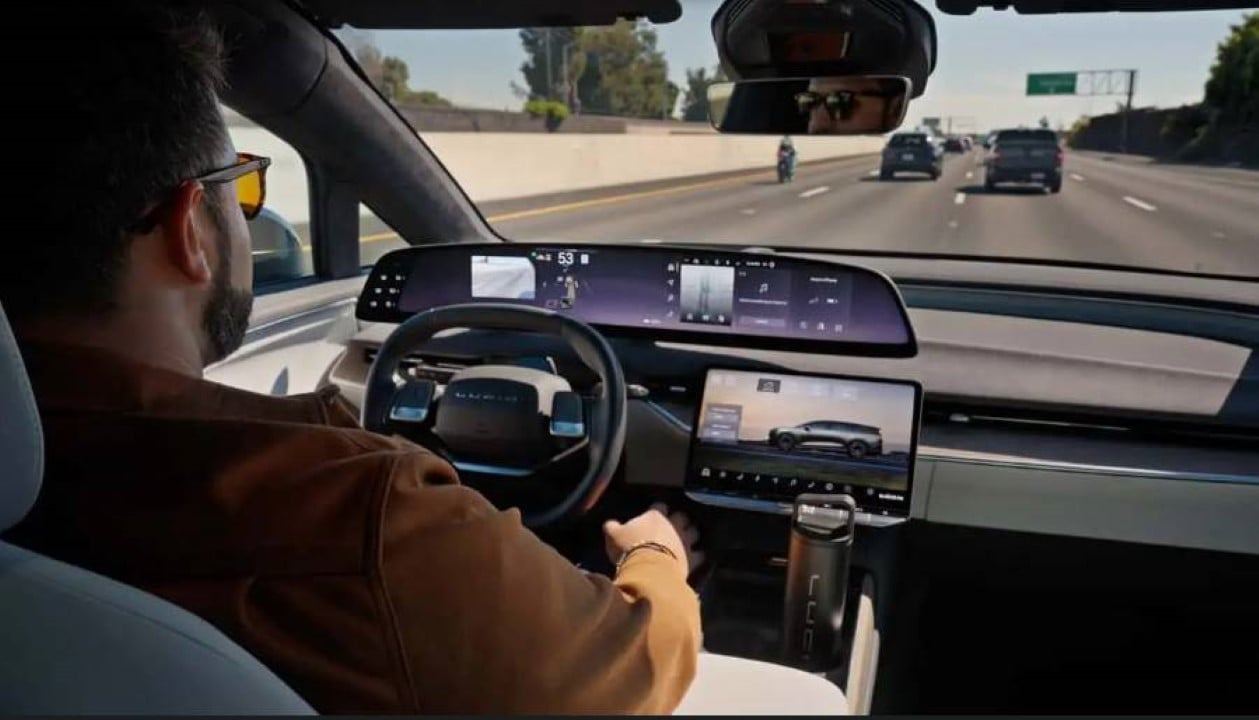
The high-end electric vehicle industry is undergoing a transformation where programming code becomes as vital as mechanical engineering. North American manufacturer Lucid Motors has started distributing a remote data package for the Gravity sports utility vehicle, unlocking the ability to drive on the road without the need to keep your hands on the steering wheel. The release initially occurs for owners in North America, marking a fundamental step in the automaker’s strategy to consolidate itself in the luxury segment.
The feature, commercially called Hands-Free Drive Assist, operates under the Level 2 autonomy classification of the Society of Mobility Engineers (SAE). This means the computer takes over directional control, acceleration and braking on mapped highways, but requires the driver to maintain full attention on traffic, ready to intervene at any time. Internal monitoring systems ensure that the driver does not look away from the road while the technology is active.
The evolution of driver assistance technology in the luxury market
To access the new functionality, the vehicle must be equipped with the DreamDrive Pro 2 hardware package, which encompasses a complex network of high-resolution cameras, radars and ultrasonic sensors. Real-time processing of this data allows the SUV to navigate accurately at cruising speeds while maintaining lane centering and a safe distance from vehicles in front.
One of the differences of the newly activated system is the ability to make lane changes automatically. The driver can start the maneuver simply by activating the turn signal, or allow the software itself to identify slow traffic and overtake autonomously. This fluidity in decision-making brings the driving experience closer to that offered by established competitors in the electric vehicle market.
The arrival of this technology in the Gravity utility vehicle comes approximately twelve months after Lucid made the same software architecture available for the Air sedan. The Gravity, commercially launched in 2025, represents the brand’s largest volume bet to date, designed to attract families looking for interior space without giving up sporting performance and cutting-edge technology.
System update details and user experience improvements
The release of hands-free driving is part of the interface update package known as UX 3.6. The automaker took advantage of the data sent to improve several other vehicle functions, responding directly to drivers’ usage behavior and optimizing the utility’s energy efficiency. Improvements range from external lighting to long route planning.
Among the main new features implemented by the UX 3.6 version, the following technical improvements stand out:
- High-intensity adaptive headlights that dynamically adjust the light beam to avoid dazzling oncoming drivers, maintaining maximum illumination at the edges of the road.
- Expanded integration with the Google Maps database, displaying user reviews, photographs and establishment opening hours directly on the central screen.
- Advanced control panel for battery thermal preconditioning, essential for maximizing recharge speed in direct current (DC) stations.
Battery thermal management has received special attention from software engineers. The new dashboard provides the driver with a clear view of the current temperature of the lithium-ion cells in relation to the ideal operating range. When the vehicle approaches a fast charger, the system heats or cools the battery pack in advance, ensuring the car accepts maximum peak power as soon as the cable is connected, reducing waiting time on highways.
The competitive landscape against automotive giants
The introduction of Hands-Free Drive Assist puts Lucid in a head-to-head position with the most mature technologies on the market. Tesla dominates discussions with its Autopilot and Full Self-Driving systems, while traditional automakers like General Motors and Ford offer, respectively, Super Cruise and BlueCruise, both widely praised for their precision on North American highways.
To justify its starting price of approximately $80,000, Gravity needs to deliver a flawless digital experience. The model already stands out for its physical engineering, offering an estimated range of up to 450 miles (about 724 kilometers) on a single charge, a number that surpasses the vast majority of electric utility vehicles currently available. However, consumers in this segment demand that the software keeps up with the excellence of the hardware.
The strategy of frequent updates via the internet has become the industry standard for keeping vehicles relevant years after purchase. Instead of waiting for the launch of a new model year, owners receive continuous improvements in their home garage, a factor that directly influences the brand’s resale value and perception of modernity.
Strategic partnerships and the future of autonomous mobility
The manufacturer’s plans go far beyond Level 2 assistance. The company structures a robust technological base to enter the on-demand autonomous transportation market. A partnership signed with Uber foresees the use of Gravity units as driverless taxis later this year, operating with technological support from Nuro, a company specializing in robotics and artificial intelligence.
The research and development department is also working on a two-seater autonomous capsule concept, focused on high-density urban mobility. At the same time, the automaker is designing a future midsize vehicle that will be born with Level 4 autonomy capacity, using Nvidia’s processing architecture. At Level 4, the vehicle is capable of carrying out all driving tasks in geofenced areas, without any need for human intervention.
Impact of remote updates on crash resolution
The distribution of the UX 3.6 package also serves as a route correction tool for the manufacturer. During the first months of the Gravity’s circulation, owners reported inconsistencies in the operation of the digital key by proximity and slow response from the physical buttons located on the steering wheel, which often required multiple touches to register a command.
Lucid’s software engineering team used previous data packages to mitigate most of these usability flaws. The ability to remotely diagnose problems and dispatch solutions without the customer having to schedule a dealership visit reduces the company’s warranty costs and improves the ownership experience.
The update notification is sent to the dashboards of compatible vehicles gradually. The automaker’s server infrastructure manages the download of data packages in the background, allowing the driver to choose the most appropriate time for installation, which requires the vehicle to remain parked and turned off for a few minutes.
