
The James Webb space super telescope, a joint project led by NASA with support from the European (ESA) and Canadian (CSA) agencies, has just set a new historic milestone by attesting to the veracity of the MoM-z14 galaxy. This star cluster now ranks as the most remote astronomical object ever documented by humanity. The photons captured by the equipment’s sensors began their journey when the cosmos was in its infancy, a mere 280 million years after the Big Bang, crossing the vacuum for an impressive 13.5 billion years before reaching Earth’s lenses.
The detailed work that resulted in this finding was coordinated by researcher Rohan Naidu, linked to the prestigious Massachusetts Institute of Technology (MIT). The group of scientists managed to measure a redshift of around 14.44, an index that easily displaces the holder of the previous title, the star system known as JADES-GS-z14-0, rewriting the textbooks on the genesis of the universe.
To find this cosmic relic, astronomers focused their lenses on the region called the COSMOS field, a piece of the firmament exhaustively mapped by different generations of telescopes. The NIRCam equipment was responsible for recording the primary brightness, while the definitive validation of the light properties took place using the NIRSpec spectrograph.
- The redshift index set at 14.44 points to the birth of the system about 280 million years after the great primordial explosion;
- The brightness emitted by the object surprises experts, registering a magnitude in the ultraviolet range of -20.2, something unusual for that period;
- The physical format of the cluster has very small dimensions, housing an amount of matter comparable to that of the Small Magellanic Cloud, our galactic neighbor;
- The almost total absence of cosmic dust grains was evident due to the abrupt drop detected in the ultraviolet spectrum.
This entire set of information consolidates the irreplaceable role of the ten billion dollar observatory in investigating eras that, until a few years ago, were considered completely invisible to modern science.
The technical differences of the space super telescope
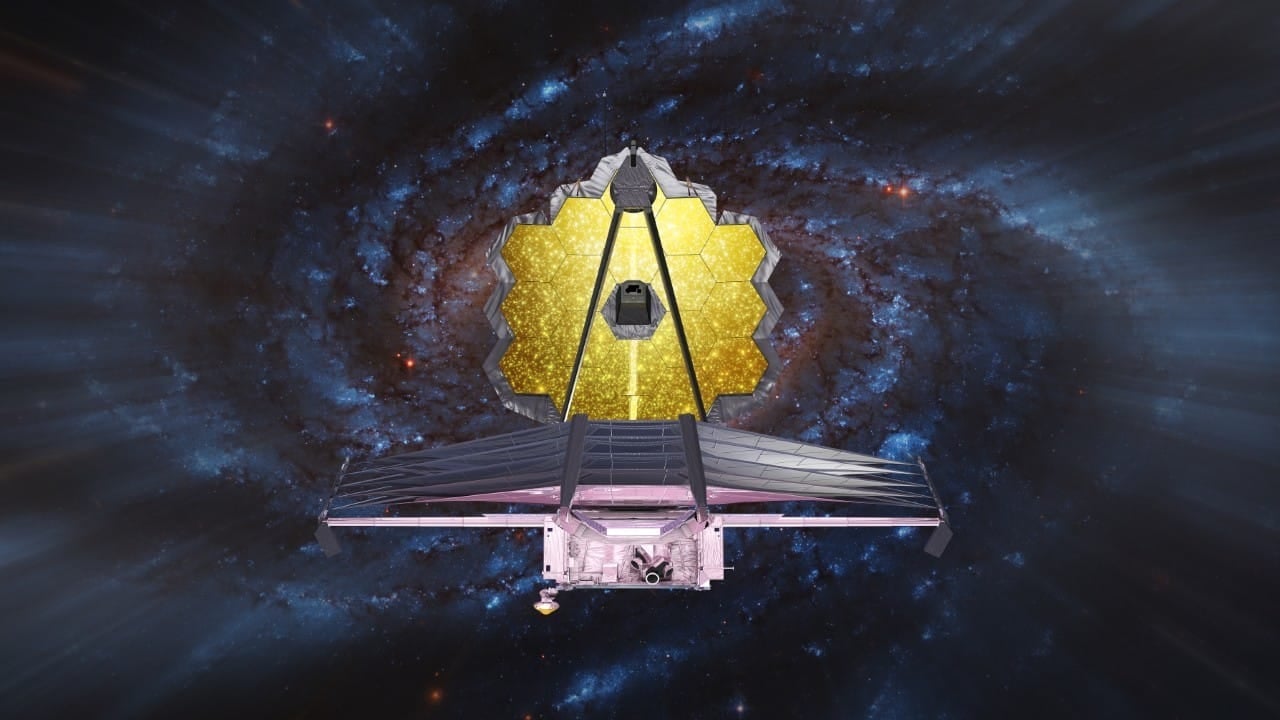
Equipped with a gigantic set of gold-plated mirrors measuring 6.5 meters in diameter, the observatory can see the infrared radiation emitted by celestial bodies located in the far reaches of space. While the veteran Hubble encountered a visual limit that prevented it from seeing beyond 500 million years after the Big Bang, the new marvel of space engineering manages to penetrate the primordial mists much closer to the moment of creation.
Very high precision sensors, such as NIRCam and NIRSpec, were designed to work with very long wavelengths. It is precisely this technical capacity that makes it possible to reveal stellar systems that simply did not emit detectable light for technologies developed in previous decades.
Chemical signature that intrigues researchers
One of the biggest surprises brought by MoM-z14 concerns its internal composition, which exhibits a disproportionately high amount of nitrogen when compared to carbon levels. This chemical recipe is far from that found in middle-aged stars like our Sun, closely resembling the material that forms the ancient globular clusters spread across the Milky Way.
The data indicates that almost all of the light captured comes from the burning of fuel from gigantic stars, ruling out the hypothesis that the glow came from a supermassive black hole devouring matter at the center of the system. This scenario corroborates the mathematical theses that already believed in a frenetic pace of birth of stars in the early days of the cosmos.
The lack of a specific signature in the light spectrum, known as a dampening wing, indicates that the gas surrounding the system was already partially ionized. This discovery goes against classical theory, which assumed an intergalactic environment dominated almost entirely by neutral and opaque hydrogen at that stage in cosmic history.
The physical shape of the early star system
In the first photographs processed by NASA teams, the distant object appeared to be just a tiny point of light lost in the darkness. However, the use of digital magnification techniques has demonstrated that the light emitted by stars is tightly packed into a very restricted space.
In-depth analyzes point to a direct link between the small size of the system and its richness in complex chemical elements. Observations confirm that more gravitationally squeezed galaxies have a natural tendency to accumulate greater reserves of nitrogen.
This specific behavior suggests that the mechanics of creating new suns occurred in a very peculiar way in the remote past. Conditions of extreme pressure and density act as true cauldrons, accelerating the forging of elements heavier than hydrogen and helium.
When putting these numbers side by side with other recent discoveries, scientists noticed a clear pattern of behavior. MoM-z14 is now part of a growing club of galaxies that shone brightly in the early chapters of the universe’s history.
The period of transformation of neutral hydrogen
The time window in which this galaxy emitted its light matches exactly the so-called era of reionization, a crucial moment of transition. It was at this time that radiation from the first nuclear furnaces began to break down the neutral hydrogen atoms that filled space, making the universe transparent.
Recent measurements indicate that the surroundings of this star cluster were already undergoing this cosmic cleaning process. The find forces theorists to review their calculations, as the general expectation was to find an environment still immersed in intact primordial mist.
The frantic pace of birth of new stars
The stellar nursery within this remote system operates at an impressive speed, consuming gas quickly. Because there are no large clouds of dust to block the view, astronomers are able to observe the internal dynamics with unprecedented clarity.
Physical models suggest that the conditions of that period allowed the emergence of stars with colossal masses, much greater than those we see today. The constant clash of matter in such a tight space created the perfect environment for the birth of these cosmic giants.
Unexpected similarities with our neighborhood
The proportion of chemical elements detected in the distant object acts as a mirror of the past, reflecting the same composition seen in the oldest globular clusters in our galaxy. These ancient structures hold the fingerprints of how the first generations of stars formed.
Analyzing light that has traveled over billions of years is the astronomical equivalent of excavating ancient ruins. By connecting the dots between these primitive structures and what we observe in the present, scientists can trace the family tree of cosmic evolution.
The next steps in exploring the deep universe
The scientific community is already preparing for the launch of the Nancy Grace Roman Space Telescope, which promises to revolutionize the hunt for these ancient objects. With lenses capable of scanning a much larger area of the sky at once, the new equipment has the potential to find hundreds of structures from the same era.
Meanwhile, the gigantic volume of information already collected by the current infrared observatory continues to bear fruit and reveal new potential targets. The expectation is that the distance record will be broken again as new spectroscopic examinations are completed.
Cross-referencing data obtained in different regions of deep space helps to flesh out the galactic census. Specific research initiatives, such as the Mirage program, dedicate exclusive observation time to confirm the exact distance of these extreme bright spots.
Combining readings from several different sensors allows us to refine the analysis of the cosmic periodic table. The breakdown of light into a detailed spectrum works like a barcode, betraying the exact presence of each star-forged heavy element.
The technological leap provided by the new instruments ensures that the exploration of deep space continues to break paradigms. Mapping the final frontiers of the cosmos continues to deliver surprising answers at an almost monthly pace.
The impact on theories about the origin of everything
The discovery of so many luminous galaxies at such an early stage of the universe calls into question the most accepted computer simulations until then. Physicists now need to recalibrate the equations that dictate how quickly matter coalesced at the beginning of time.
The detection of large volumes of nitrogen is definitive proof that nuclear reactions occurred much more quickly. Pioneering stars lived fast and died young, spreading complex elements across space in a short time.
Detailed study of this specific object helps fill an important gap in the cosmic timeline. The transition between the post-Big Bang darkness and the illuminated universe we know today gains increasingly clearer details.
Modern astrophysics work requires the perfect union between the light captured by lenses and the lines of code in supercomputers. Each new discovery serves to adjust the hands of the standard cosmological model, making our understanding of reality more accurate.
The revolution in long wavelength observation
The unprecedented sensitivity to capturing waste heat in the form of infrared light ushered in a golden age in astronomy. Celestial bodies whose light has been stretched by the expansion of the universe are now photographed as part of researchers’ routine.
Placing current results alongside images generated by classic missions, such as Spitzer and Hubble, highlights the technological gap between generations of satellites. The use of colossal mirrors combined with detectors cooled to extreme temperatures multiplied the range of human vision.
Behind the scenes of capturing the historic image
Before it became global headlines, the record-breaking galaxy was nothing more than a barely noticeable yellowish blur in a mosaic of thousands of photos. It was necessary to apply a series of specific filters to the NIRCam instrument to isolate the light signature that revealed its true nature.
The final proof came when spectrum analysis revealed very well-defined energy peaks. As scientists found no trace of light contamination from nearby objects, the identity of the primitive system was confirmed with absolute certainty.
The weight and brightness of the primordial structure
Preliminary calculations suggest that the system houses a quantity of matter equivalent to 100 million times the mass of our Sun. Its emission of ultraviolet radiation is so intense that it places it at the top of the ranking of the brightest objects of its time.
The compressed size of the structure indicates that the matter is squeezed to an extreme degree. It is precisely this absurd concentration of nuclear furnaces working in a tiny space that justifies the flash capable of crossing the entire universe until reaching Earth.
