

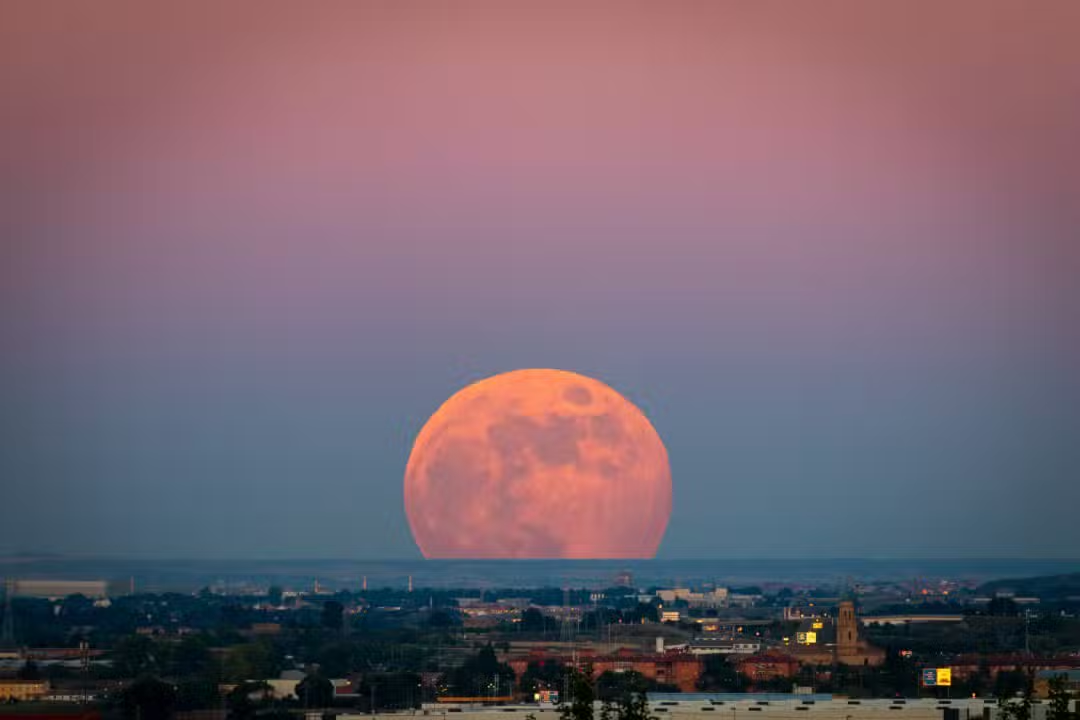
The Strawberry Moon, June’s full moon, will appear on June 11, 2025, at its lowest point in the sky in nearly two decades. Visible worldwide, especially in the Northern Hemisphere, the event peaks at 4:46 AM on Wednesday. Astronomers note that the major lunar standstill, a 18.6-year cycle, makes this spectacle unique. Clear horizon spots are ideal for observation. The proximity to Antares, a star in the Scorpio constellation, adds extra charm to the phenomenon.
The event carries a name tied to strawberry harvests among Native American tribes. In the Southern Hemisphere, the Moon will appear higher, contrasting with the Northern view. Astronomers suggest checking weather forecasts for the best experience.
- What makes it special? The major lunar standstill shifts the Moon’s orbit, creating a unique visual.
- Where to observe? Areas with unobstructed horizons, like beaches or open fields.
- When is the peak? At 4:46 AM on June 11.
The 2025 lunar phenomenon promises to captivate enthusiasts and casual observers with unforgettable details.
Origin of the Strawberry Moon name
The term “Strawberry Moon” stems from Algonquin tribes in North America, who linked June’s full moon to the wild strawberry harvest season. The name was adopted by settlers and gained global popularity for its natural connection. In the Southern Hemisphere, where seasons differ, the name retains its poetic appeal despite no direct harvest link.
Other cultures gave distinct names to the same moon. Some tribes called it the “Hot Moon,” signaling summer’s start. In medieval Europe, it was the “Mead Moon,” tied to honey wine production. These cultural variations enrich the astronomical event’s significance.
What is the major lunar standstill?
The major lunar standstill, or lunistice, occurs every 18.6 years due to shifts in the Moon’s orbital tilt relative to Earth. In 2025, this cycle will make the Moon appear extremely low in the Northern Hemisphere and higher in the Southern Hemisphere. The phenomenon resembles solar solstices but applies to the lunar orbit.
This movement alters the Moon’s path, creating unique observation angles. In some areas, the Moon may seem to “crawl” along the horizon, a striking visual effect. For astronomers, the lunistice offers a chance to study orbital dynamics.
- Frequency: Occurs every 18.6 years, last seen in 2006.
- Visual effect: Lower in the North, higher in the South.
- Scientific value: Aids in understanding lunar orbit variations.
- Observation: Best in low-light-pollution areas.
The 2025 event will be the most striking since 2006, experts say.
Proximity to the star Antares
During the Strawberry Moon, Antares, a bright star in Scorpio, will appear close to the Moon. In some regions, like parts of South America and Africa, the Moon may briefly hide Antares in an occultation event. This rare phenomenon draws attention from amateur and professional astronomers.
Antares’ reddish hue contrasts with the Moon’s silvery glow, creating a visual spectacle. The closest alignment will be noticeable from the evening of June 10 into the early hours of June 11. Binoculars or small telescopes can reveal stunning details.
Best observation spots
The Strawberry Moon’s visibility depends on weather and geography. Open horizon areas, such as beaches, fields, or hills, are recommended. Light pollution in urban centers may hinder viewing, especially of Antares.
In Brazil, coastal areas like the Northeast or rural regions in São Paulo and Minas Gerais offer good conditions. Choose spots facing east, where the Moon rises, and check for clear skies.
- Observation tips:
- Check weather forecasts in advance.
- Avoid areas with artificial lighting.
- Use binoculars for clearer Antares views.
- Bring chairs or blankets for comfort.
Cultural impact of the Strawberry Moon
Beyond astronomy, the Strawberry Moon holds cultural weight. Native tribes used June’s full moon to time agricultural tasks, with strawberry harvests marking community celebrations. This connection persists in modern festivals, particularly in rural U.S. and Canadian communities.
In Brazil, though the name is borrowed, the event inspires stargazing gatherings hosted by astronomy clubs and universities. In 2025, planetariums and associations are expected to hold public events with telescopes and talks.
Ideal conditions for 2025
The 2025 Strawberry Moon benefits from occurring early in June, when nights remain mild in many regions. In the Southern Hemisphere, the onset of winter may bring clearer skies in dry areas like Brazil’s Central-West.
Astronomers suggest tracking the Moon from sunset on June 10, when it rises. The peak at 4:46 AM on June 11 requires staying up late, but the view will reward the effort.
Related astronomical events
June 2025 offers more than the Strawberry Moon. Planets like Jupiter and Venus will be visible at dawn, potentially aligning with the full moon for striking photo opportunities.
The 2025 lunistice also marks the start of a period with greater variation in the Moon’s position throughout the year. Keen observers will notice subtle shifts in upcoming full moons’ altitudes.
Tools for observers
Simple tools enhance the Strawberry Moon experience. Astronomy apps like Stellarium or SkySafari help locate Antares and plan viewing. Binoculars (7×50) or entry-level telescopes suffice for lunar surface and star details.
Amateur photographers can capture the event with long-exposure cameras and tripods. Adjusting ISO and exposure time prevents overexposed images.
- Recommended tools:
- Astronomy apps for star tracking.
- Binoculars or small telescopes for details.
- Manual-mode cameras for photos.
- Printed sky charts for guidance.
Fun facts about the phenomenon
The Strawberry Moon carries stories beyond science. Its name reflects Native wisdom in syncing tasks with natural cycles. Other full moons, like the Wolf Moon or Harvest Moon, follow similar cultural logic.
The lunistice was tracked by ancient civilizations, like Stonehenge’s builders, who aligned monuments with lunar positions. In 2025, the event bridges modern science and ancient traditions.