

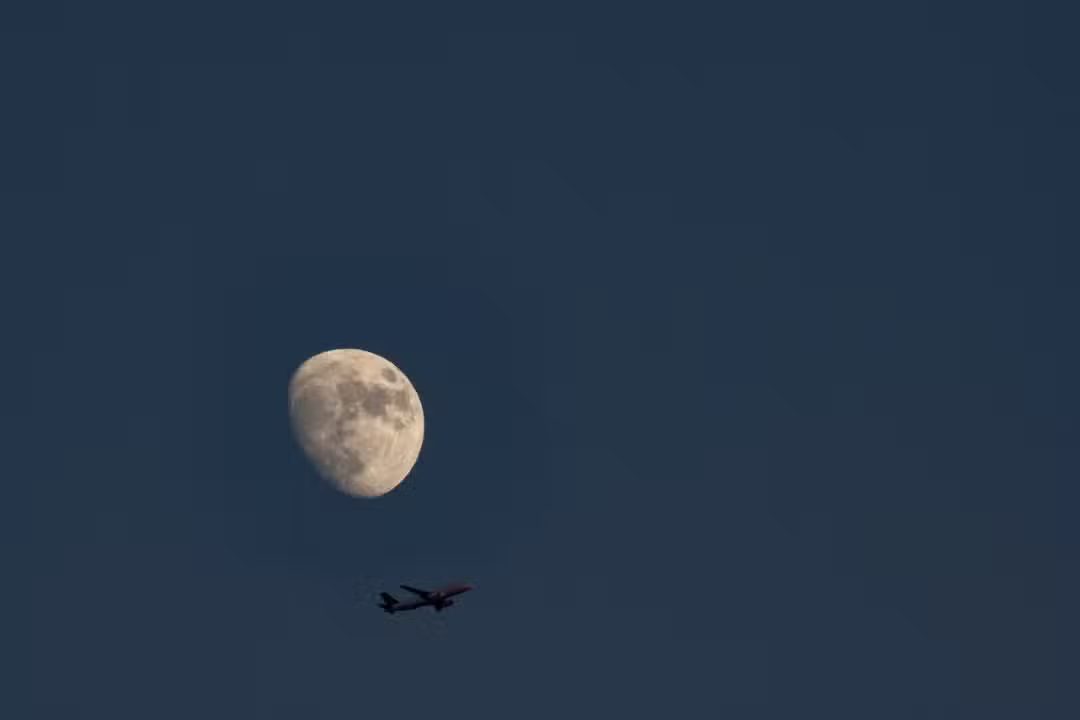
The crescent moon illuminates the sky this Thursday, August 7, 2025, with about 95% of its visible face reflecting sunlight, just two days away from reaching the full moon. This moment, part of the 29.5-day lunar cycle, is visible across Brazil and can be observed on clear nights, especially in urban and rural areas. The crescent phase, which began on August 1 at 9:41 AM, symbolizes growth and productivity, influencing everything from tides to cultural and spiritual practices. Astronomers and moon enthusiasts track the phenomenon, which also sparks interest in popular traditions, such as fertility rituals and project planning. The crescent moon’s visibility, appearing with the illuminated side on the left in the Southern Hemisphere, invites naked-eye observations without the need for special equipment.
The current lunar phase reflects the relative position between the Sun, Earth, and Moon, with the natural satellite moving away from alignment with the Sun (new moon) and approaching full opposition (full moon). This cycle, known as the synodic month, has fascinated humanity for centuries, guiding everything from agricultural calendars to spiritual celebrations. The Moon, at an average distance of 384,400 km from Earth, exerts a strong gravitational influence, particularly on the oceans, though there is no scientific evidence of direct impacts on human health.
- Main lunar phases in August:
- Crescent moon: Started on August 1, ends on August 9.
- Full moon: Expected on August 9 at 4:55 AM, with 100% visibility.
- Waning moon: Begins on August 16, marking the decline in luminosity.
- New moon: August 23 at 3:06 AM, nearly invisible from Earth.
- Crescent moon: Returns on August 31, restarting the cycle.
Energy of the crescent moon in daily life
The crescent moon is associated with a period of expansion and dynamism, seen in various cultures as ideal for starting projects or strengthening intentions. In Brazil, popular traditions suggest that cutting hair during this phase promotes growth, while farmers use the lunar cycle to plan planting. The phase, which began on August 1 at 9:41 AM, according to the National Institute of Meteorology (Inmet), ends this Saturday, when the full moon will take center stage in the night sky. The crescent, with its “C” shape in the Southern Hemisphere, brings greater nighttime brightness, favoring outdoor activities and astronomical observations.
The influence of the crescent moon goes beyond celestial aesthetics. Its growing light impacts the behavior of some marine species, such as corals and turtles, which adjust their reproductive cycles to lunar brightness. The phase is also celebrated in spiritual practices, with rituals harnessing the energy of growth to manifest goals. Despite the lack of scientific consensus on direct effects on mood or human health, the crescent moon continues to inspire beliefs and cultural practices worldwide.
- Activities recommended during the crescent moon:
- Plan new projects or personal goals.
- Perform prosperity or fertility rituals, common in some traditions.
- Observe the night sky to track the increase in lunar brightness.
- Leverage the energy for creative or productive activities.
Notable lunar events in 2025
The year 2025 is packed with astronomical events that capture observers’ attention. While August does not feature a supermoon, the lunar calendar predicts three moments when the Moon will be closer to Earth (perigee), appearing up to 14% larger and brighter. These supermoons will occur on April 27, November 5, and December 4. Additionally, the year will include four eclipses, with the total lunar eclipse on September 7, known as the “Blood Moon,” visible in Brazil. This phenomenon, caused by Rayleigh scattering, will give the Moon a reddish hue, attracting amateur and professional astronomers.
The September eclipse will be a highlight of the year, visible across the country. August’s full moon, called the “Sturgeon Moon” in some cultures, will also be a visual spectacle, with the satellite fully illuminated throughout the night. These events underscore the Moon’s importance as an astronomical and cultural landmark, bridging science and tradition.
Influence of the moon on tides and nature
The Moon’s gravitational force is responsible for well-documented natural phenomena, such as the movement of tides, which peak during the full and new moon phases due to alignment with the Sun. During the crescent moon, tides are less intense but still influence coastal ecosystems. Studies show that lunar brightness affects the behavior of nocturnal animals, such as migratory birds and mollusks, which synchronize activities with the lunar cycle. For instance, corals use the crescent moon’s light to initiate reproductive processes, while sea turtles adjust nesting to nighttime lighting conditions.
In Brazil, the connection with the Moon is strong in traditional communities. Fishermen and farmers often consult the lunar calendar to plan activities, using the crescent phase for sowing crops that rely on rapid growth. This connection with nature reinforces the Moon’s role as both a practical and symbolic guide.
- Natural impacts of the crescent moon:
- Moderate tides compared to full and new moon phases.
- Increased nighttime brightness, favoring nocturnal animal activities.
- Synchronization of reproductive cycles in marine species.
- Influence on traditional agricultural practices, such as planting and harvesting.
Traditions and myths associated with the crescent moon
The crescent moon has always held a special place in cultural traditions. In Brazil, it is linked to fertility and growth, with popular rituals aimed at attracting prosperity. In some regions, starting businesses or projects during this phase is believed to bring luck and success. In mythology, the Moon is often depicted as a deity, such as Selene in Greece or Iara in Brazilian indigenous legends. In the Southern Hemisphere, the crescent moon’s appearance, with the illuminated side on the left, differs from the Northern Hemisphere, influencing cultural and artistic representations.
Despite its strong presence in popular imagination, science confirms that the Moon has no direct impact on human health or mood, though its gravitational influence on the oceans is undeniable. The crescent phase, with its energy of expansion, continues to inspire both astronomers and those seeking spiritual or practical meanings in the lunar cycle.
- Popular beliefs in Brazil:
- Cutting hair during the crescent moon to promote growth.
- Starting projects or businesses to attract prosperity.
- Performing fertility rituals in traditional communities.
- Planning agricultural activities based on the lunar cycle.
Observing the crescent moon in Brazil
The crescent moon on August 7 can be observed across Brazil, especially in areas with low light pollution. Astronomers recommend seeking elevated spots or rural areas for a clearer view. The crescent phase is ideal for naked-eye observations, but binoculars or telescopes can reveal details of the lunar surface, such as craters and lunar seas. With the full moon approaching on August 9, this is a perfect time to plan observation nights with friends or family.
The Moon, with its regular 29.5-day cycle, continues to captivate with its beauty and influence. In August, the transition from crescent to full moon marks a period of energy and productivity, inviting both contemplation and action. Whether for practical, spiritual, or scientific purposes, today’s crescent moon is a reminder of humanity’s connection to the cosmos.