


An astronomical event of rare magnitude is predicted for January 22, 2026, when the interstellar comet 3I/ATLAS will form an almost perfect alignment with Sol and Terra. Essa cosmic configuration will provide scientists with an unprecedented opportunity to study material from another star system with a detail never before achieved.
The precise geometry, which will occur at 1 pm UTC, will reduce the comet’s phase angle to just 0.69 degrees. Essa condition is ideal for observing a phenomenon known as “opposition surge,” a sudden increase in brightness that reveals detailed physical properties of the dust ejected by the comet’s nucleus.
The privileged observation window will extend for approximately one week, between January 19th and 26th, during which time the phase angle will remain below 2 degrees. Astrônomos around the world prepare their instruments to take advantage of this unique chance to analyze the composition of a visitor from outside our Sistema Solar.
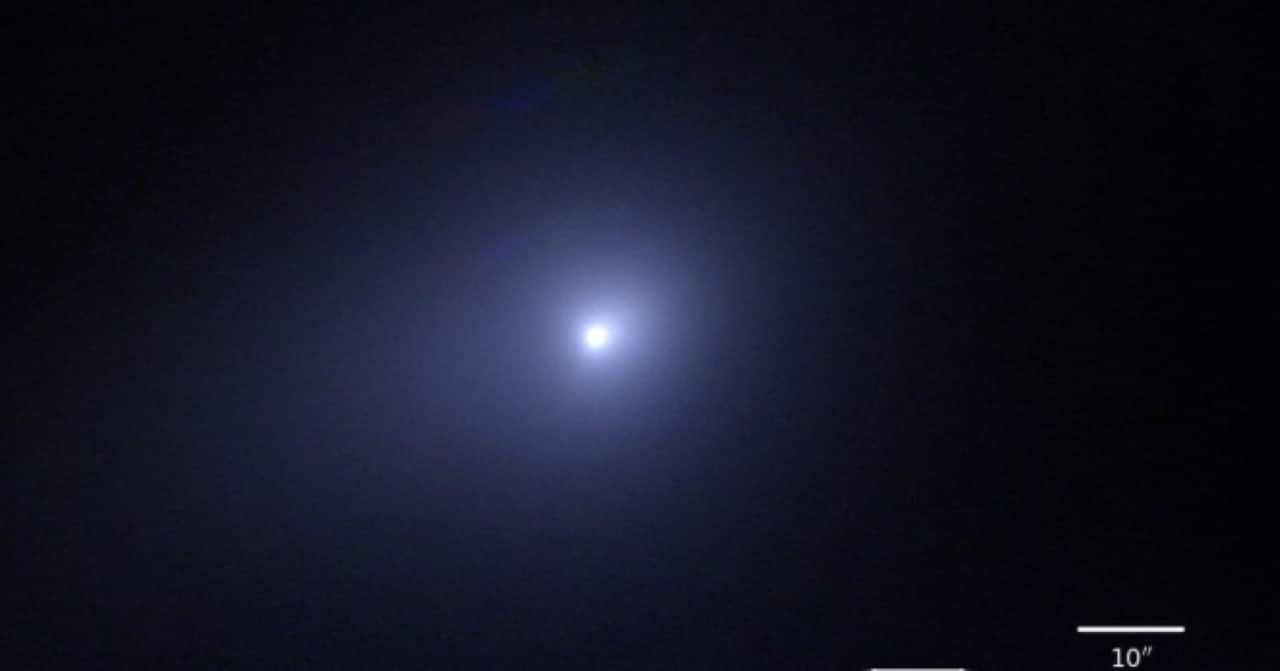
The discovery of the third interstellar visitor
3I/ATLAS was first identified on July 1, 2025, by the ATLAS (Asteroid Terrestrial-impact Last Alert System) celestial scanning system, designed to detect objects close to Terra. Análises subsequent sequences of its trajectory quickly confirmed its extraordinary nature, classifying it as the third interstellar object ever detected crossing our system, after 1I/’Oumuamua and 2I/Borisov. Sua’s hyperbolic orbit, with an eccentricity of approximately 6.139, is definitive proof that it is not gravitationally bound to Sol.
What further distinguishes this comet is its impressive speed. 3I/ATLAS travels at 57.7 kilometers per second relative to Sol, a higher value than its interstellar predecessors. Essa high speed suggests its origin is in a distant and dynamically different star system, offering a glimpse into a planet formation environment distinct from our own. Confirmation of its trajectory validates its status as a messenger from another star, carrying valuable information about its galactic home.
A perfect celestial geometry for science
During the maximum point of the alignment, the comet will be located at a distance of 3.33 astronomical units (AU) from Sol and 2.35 AU from Terra. Apesar of the distance, the geometric configuration is the crucial factor for the planned observations.
During this period, Terra will be positioned almost directly between Sol and the comet. Essa position allows sunlight to illuminate 3I/ATLAS from the front, from our perspective, eliminating most of the shadows cast by dust particles in its coma.
The object’s apparent magnitude is estimated at 16.7, meaning it will not be visible to the naked eye or amateur telescopes. Observation will require the use of medium to large professional instruments, capable of capturing the visitor’s faint light.
What makes this event particularly special is the duration of the favorable setup. Enquanto similar comet alignments to our Sistema Solar last just a few hours, 3I/ATLAS will remain in an ideal position for several days, allowing continuous and detailed data collection.
What is the opposition effect and why is it important
The phenomenon of “opposition surge” is a sharp, nonlinear increase in the brightness of a celestial body when observed at very small phase angles, that is, when the observer is almost directly between the light source and the object. Esse effect is caused by two physical mechanisms that act on the dust surrounding the comet. The first, known as shadow hiding, occurs when shadows cast by individual dust particles are hidden behind the particles themselves, increasing the visible illuminated area. The second mechanism, called coherent backscatter, is a quantum effect that occurs at extremely low angles, where light waves traveling along parallel paths through the dust cloud interfere constructively, amplifying the glow. Detailed analysis of the light curve during surge allows scientists to infer crucial characteristics of the material, such as albedo (the reflectivity of the surface), porosity and particle structure, differentiating between compact grains and fluffy, fractal aggregates. Portanto, this event offers a remote diagnostic tool for understanding the physics of interstellar matter.
An unprecedented scientific opportunity
Opposition surge analysis at 3I/ATLAS will provide the first detailed characterization of the microstructure of interstellar comet dust. The data collected will help determine whether the composition and structure of the material is similar or different to that found in comets from our own Sistema Solar.
This information is fundamental to understanding planetary formation processes in other stellar systems. The properties of the dust may reveal clues about the chemical and physical conditions of the protoplanetary disk where the comet originated billions of years ago.
Scientists will be able to directly compare the results with data obtained from missions such as Rosetta, which studied comet 67P/Churyumov-Gerasimenko. Qualquer significant difference could indicate variations in the building blocks of planets in different parts of the galaxy.
How 3I/ATLAS differs from ‘Oumuamua and Borisov
The first interstellar visitor, 1I/’Oumuamua, intrigued scientists because it did not have a visible coma, the cloud of gas and dust typical of comets. Isso drastically limited the possibility of studying its volatile material.
The second, 2I/Borisov, was clearly an active comet, but its trajectory never placed it in a favorable opposition geometry. Observations were restricted to phase angles greater than 16 degrees, insufficient to detect the “opposition surge”. 3I/ATLAS, in turn, combines the best of both worlds: it is an active comet and its trajectory offers perfect alignment, making it a unique natural laboratory.
Instruments and preparations for observation
A global observation campaign is being organized to maximize data collection during the January 2026 window. Coordination between observatories in different hemispheres will ensure continuous coverage, tracking the object as Terra rotates.
A legacy for future astronomy
The data collected about 3I/ATLAS will establish an important reference point for the study of future interstellar objects. The opportunity to apply opposition surge analysis techniques to extrasolar material is a milestone for planetary science.
After January 2026, the comet will rapidly move away from Terra and Sol, and its brightness will decrease dramatically, making detailed observations progressively more difficult. By 2027, its magnitude could drop to 24, and in 2028, to 25, putting it beyond the reach of most ground-based telescopes. Isso reinforces the critical importance of the planned observation campaign.



