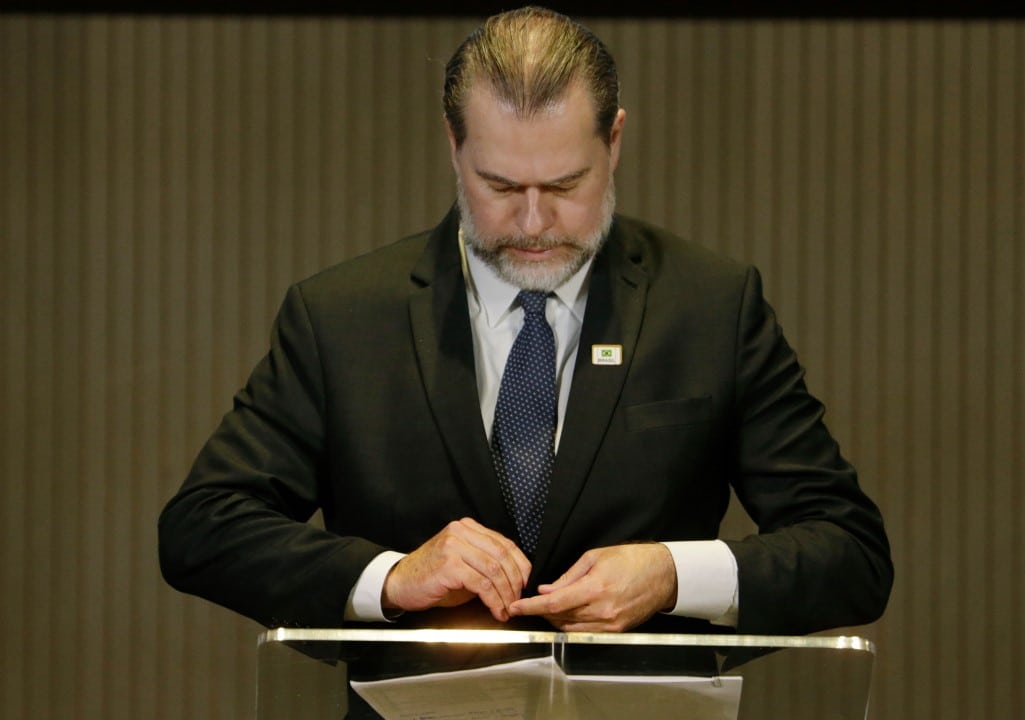
Brazil’s Supreme Court (STF) is currently navigating a significant internal crisis in early 2025, triggered by Justice Dias Toffoli’s handling of the ongoing investigation into alleged frauds involving Banco Master. Concerns regarding the inquiry’s direction and its potential impact on the Court’s image have intensified discussions among its members. This situation has led to strategic behind-the-scenes efforts aimed at mitigating reputational damage to the high court.
The negative publicity surrounding Justice Toffoli’s recent decisions has prompted STF President Edson Fachin to cut short his judicial recess. Fachin, still technically on vacation, returned to Brasília earlier than scheduled, citing to close associates that the “moment demands” his immediate presence in the capital. His early return signals the urgency within the Court to address the escalating situation.
President Fachin is actively engaging with fellow justices, seeking to forge an institutional resolution to the Court’s escalating image crisis. His proactive measures underscore the severity of the internal discord and the collective desire to restore public confidence in the judicial body.
Supreme Court grapples with mounting internal dissent
The recent decisions made by Justice Toffoli in the Master inquiry have generated considerable discomfort among several Supreme Court justices. This growing dissatisfaction has fueled private discussions within the tribunal on how to prevent further erosion of the Court’s credibility and public trust. The unfolding events are proving to be a critical test for the STF’s internal cohesion.
Sources indicate that the negative repercussions of Toffoli’s actions prompted President Fachin’s swift return. His objective is to hold crucial conversations with colleagues, aiming to address and resolve the perceived crisis in the Supreme Court’s public perception, which risks undermining its institutional authority.
Debates intensify on transferring the Master case
Among the solutions being considered by a segment of the Court, particularly those critical of Justice Toffoli’s decisions, is the potential transfer of the Master inquiry back to the first instance. This faction argues that, as of early 2025, there is insufficient robust evidence directly implicating federal deputy João Carlos Bacelar (PL-BA), who is named in the investigation, to warrant the case remaining at the Supreme Court level.
Advocates for this judicial maneuver contend that remanding the case to a lower court would significantly ease the intense pressure currently facing the STF. Such a move, they believe, would effectively remove the Supreme Court from the direct glare of public and media scrutiny, allowing it to focus on other pressing judicial matters while simultaneously preserving the validity of all orders previously issued by Justice Toffoli during his tenure as rapporteur.
Justice Toffoli maintains his position
Justice Toffoli, however, leads another faction within the Supreme Court that strongly advocates for allowing the investigation to proceed at its current pace. This group believes it is premature to reassign the case, emphasizing the need to await further progress in the inquiries to either firmly establish or definitively rule out the existence of conclusive evidence against the involved federal deputy.
Toffoli’s allies argue that a hasty decision to send the case back to a lower court without full clarity could be perceived as an impetuous action. They fear such a move might prematurely nullify key aspects of the ongoing process, potentially compromising the integrity and effectiveness of the entire investigation in the future.
Internally, Justice Toffoli has conveyed to close contacts his firm intention to retain the role of rapporteur for the Master inquiry. He asserts there are no valid legal grounds for him to declare himself impeded or suspicious from continuing to oversee the investigation at the Supreme Court.
Senior ministers rally behind the investigation
Despite the internal criticisms voiced by some members of the Supreme Court, prominent justices such as Alexandre de Moraes and Gilmar Mendes have publicly indicated their support for Justice Toffoli’s handling of the case. They maintain that the STF must not yield to either external or internal pressures, asserting that the Court is steadfastly fulfilling its constitutional mandate.
Interlocutors for Justice Toffoli affirm that all his decisions in the inquiry have been made in strict response to requests from federal police and the Prosecutor-General’s Office. They emphasize that these rulings were delivered with exceptional speed, specifically to ensure that the ongoing investigations were not hampered or delayed at any critical juncture.
Understanding recusal guidelines for judges
Brazilian law, specifically the Code of Criminal Procedure, outlines precise circumstances under which judges must recuse themselves from a case. These rules ensure judicial impartiality and prevent conflicts of interest, protecting the fairness of legal proceedings.
Judges are legally obliged to declare themselves impeded if:
* Their spouse or a close relative has previously acted in the process.
* They themselves served as an attorney or judge in the same case.
* They or their relatives have a direct financial or personal interest in the outcome.
Separately, a judge must declare themselves suspicious if:
* They are an intimate friend or a sworn enemy of any investigated party or their lawyers.
* They have provided counsel or advice to any of the parties involved in the case.
* They, or a relative, are involved in a separate legal process that must be judged by one of the case’s parties.
A declaration of suspicion or impediment by Justice Toffoli in the Master inquiry would lead to the automatic annulment of every order he has issued since the case arrived in his chambers. Such a development would necessitate a complete restart of the proceedings, with a new rapporteur subsequently being selected through a random draw.