

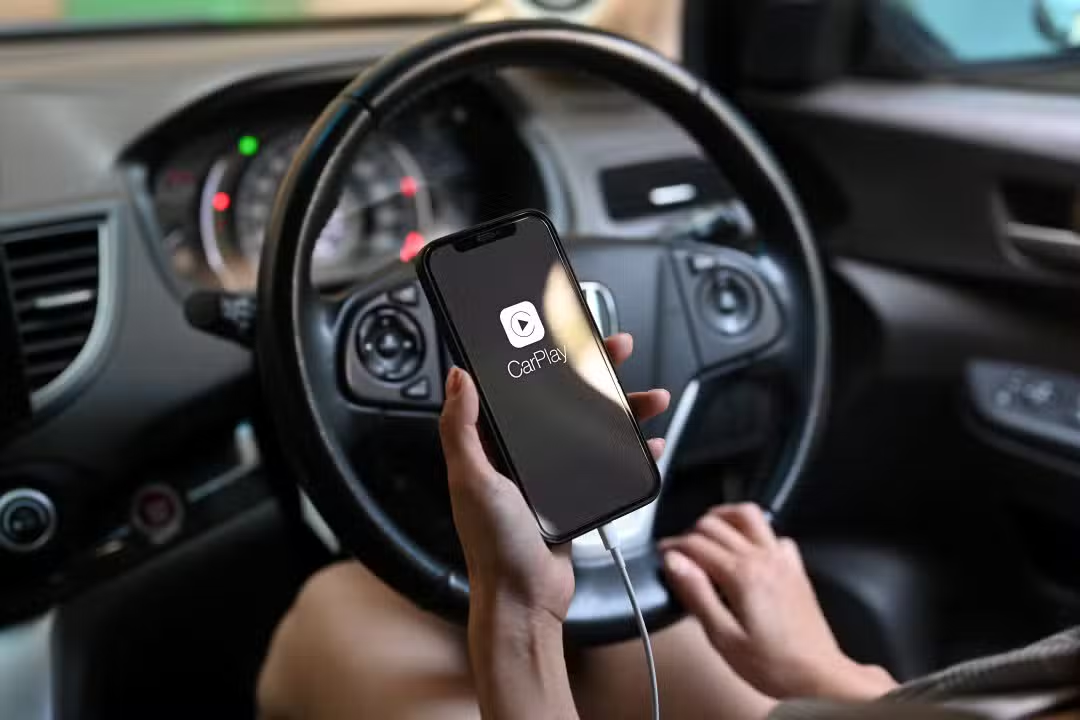
The technology industry has implemented a significant update to its vehicle-facing operating systems, setting a new standard for active safety for drivers and passengers. The central change consists of the immediate interruption of dynamic visual content, such as films and clips, as soon as the car begins any type of movement. Esta drastic measure aims to combat one of the main causes of accidents in modern traffic: the distraction caused by screens on the central dashboard.
The operation of the new tool is based on sophisticated communication between the entertainment software and the car’s mechanical components. Diferente From previous versions that could only depend on GPS, the system now communicates directly with the vehicle’s telemetry. The lock is activated instantly when sensors detect that the transmission has been switched to drive mode or that the wheels have started to turn, ensuring that the driver’s attention remains exclusively on the road.
To ensure the effectiveness of this digital barrier, strict operating criteria have been established that operate in the background. The main conditions for blocking include:
– Detecção of movement through the wheel sensors, regardless of the speed reached.
– Monitoramento of the gearshift position, blocking the screen when leaving the Park position.
– Verificação of the status of the electronic or mechanical handbrake.
– Continuous Análise data from the electronic control unit (ECU) to avoid signal failures.
Despite the visual restriction, the sound experience remains unchanged for the vehicle’s occupants. Audio from videos, podcasts or music continues to play normally, while the visual interface is replaced with static and safe elements. The driver now only sees navigation maps, album covers or simplified controls, eliminating the visual stimulus that competes with the attention necessary for defensive driving.
Integração profunda com a telemetria veicular
The robustness of this update lies in its ability to read real-time data from multiple vehicle checkpoints. The system was designed to not rely exclusively on satellite signals, which often experience latency or signal loss in tunnels, underground garages and urban areas with high building density. By connecting directly to the car’s electronic control unit, the technology eliminates blind spots when monitoring the vehicle’s status.
This integration prevents attempts to circumvent safety rules, a common practice where passengers or drivers tried to watch content during momentary stops at traffic lights or traffic jams. Safety protocol understands that slow or momentarily stopped traffic still requires full attention. Complete release of the screen for video display only occurs upon physical confirmation that the car is in a safe stopping state, with the handbrake applied or the transmission in parking mode.
Impact on application development
The new guideline imposes structural changes in the way developers create and update applications for the automotive ecosystem. Não is just a user interface change, but a technical requirement for content classification. New programming interfaces (APIs) require that all media material contain accurate metadata, clearly distinguishing what is an audio stream from a video stream.
Software creators who do not adapt their products to new digital labeling standards will face severe restrictions. The operating system acts as a relentless moderator, applying a kind of “digital curtain” over any application that attempts to reproduce moving images without proper security authorization. In practice, if an app is not compliant, it may have its functions limited or be suspended entirely while the vehicle is in operation.
This forced standardization creates a safer and more predictable environment. Apps now need to offer alternative views that automatically kick in when the car moves. Isso incentiva o desenvolvimento de interfaces mais limpas e menos intrusivas, focadas na utilidade e na rapidez da informação, em vez do entretenimento visual imersivo que é adequado apenas para ambientes domésticos ou veículos estacionados.
Risk factors and cognitive load
The initiative aligns with global traffic studies that point to visual distraction as a critical factor in the increase in collisions. Especialistas in road safety highlight that the human brain has difficulty processing two sources of dynamic visual stimulus simultaneously. The cognitive load required to follow a video scene on a screen directly competes with the processing required to assess distances, speeds and hazards on the road.
By removing the option to watch videos, technology takes the responsibility for self-control out of the driver’s hands and transfers it to an automated, tamper-proof system. The measure recognizes that, in moments of boredom in traffic, the temptation to consume visual entertainment is high, and the technical barrier serves as a guardian of physical integrity. The update reinforces the concept that vehicle connectivity should serve as a driving assistance tool, providing routes and voice communication, and not as a source of additional danger.