

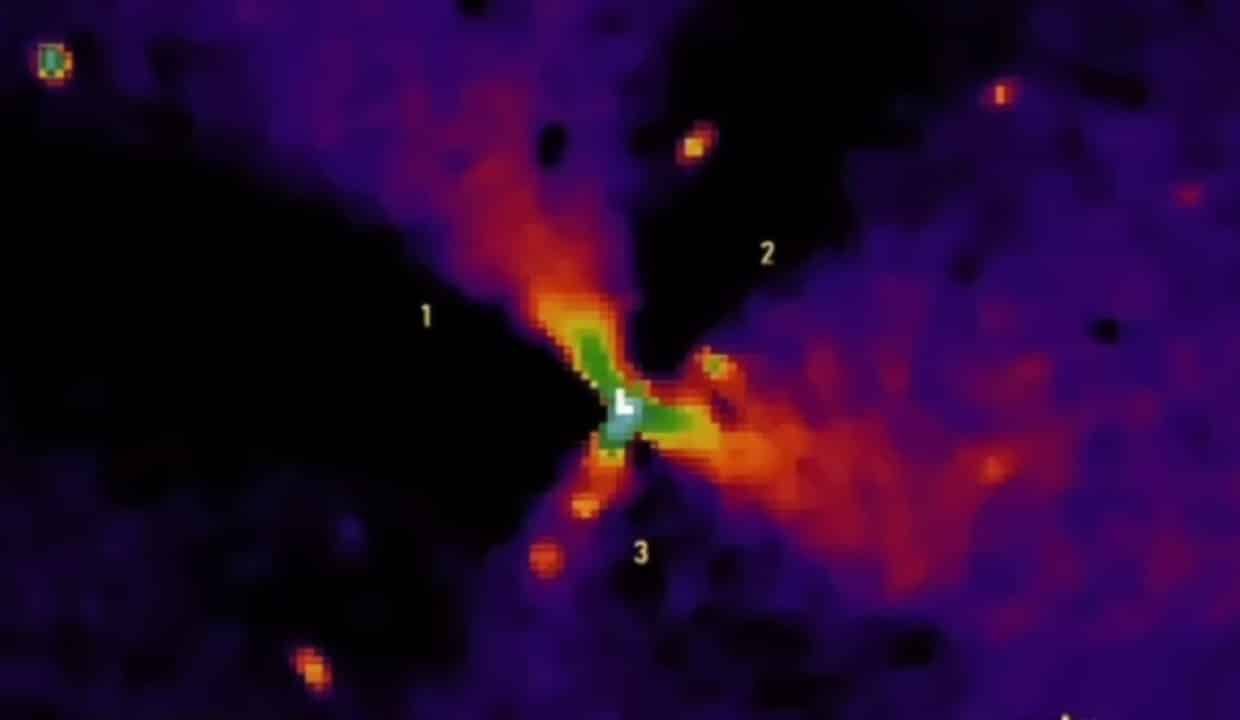
Researchers at Universidade Kyoto Sangyo have identified unprecedented chemical features in a celestial body recently arrived from outside our star system. The object, officially cataloged as 3I/ATLAS, caught the attention of the global scientific community by presenting an almost total absence of ammonia in its fundamental structure. Esta anomaly suggests that the visitor formed in a galactic environment with specific conditions fundamentally different from those that gave rise to the comets orbiting Sol.
The discovery sets a milestone for contemporary astronomy, adding real physical data to theoretical models of planetary formation in Via Láctea. The records point to a much greater chemical diversity than previously imagined to exist in stellar nurseries spread across the universe, altering the standard understanding of the distribution of basic elements in deep space.
Trata is the third interstellar object confirmed to cross our cosmic neighborhood, offering a prime opportunity to study material from other systems. The rapid passage of the celestial body required the immediate mobilization of terrestrial infrastructure to ensure the capture of light before the object returned to the darkness of interstellar space.
Monitoring on Observatório Astronômico Koyama
Equipes of astrophysicists used the Telescópio Araki, installed on the premises of the Observatório Astronômico Koyama, to track the exact trajectory of the space visitor. The observation window was rigorously calculated to coincide with the period between the end of November and the beginning of December, the moment immediately after the object’s closest approach to Sol, known as perihelion.
Durante this critical phase of the orbit, solar thermal radiation reaches the comet’s frozen surface with maximum intensity. The resulting physical process, called sublimation, transforms the ice directly into gas, creating the characteristic coma or hair around the rocky core and releasing the volatile compounds trapped since its formation.
The release of these gases is the event that allows terrestrial scientists to carry out chemical readings of the celestial body from a distance. Através of the spectroscopy technique, the light reflected and emitted by this gas cloud is decomposed into several colors, revealing exclusive signatures that function as a barcode for each chemical element present in the sample.
The rigor in data collection during this narrow time window ensured the integrity of the information. The team had to deal with terrestrial atmospheric variables and the extreme speed of the object to keep the telescope’s focus aligned, ensuring that the spectrum of light captured was clean and free of visual contamination from background stars.
Chemical signatures and the absence of nitrogen
Detailed analysis of the light spectrum revealed the abundant presence of cyanogen and carbon chains in the gas cloud surrounding 3I/ATLAS. Estes simple organic compounds are often found on most of the frozen celestial bodies already cataloged by astronomers, establishing a primary point of similarity with local comets.
However, measurement of NH2 molecules, which arise as a direct byproduct of the breakdown of ammonia when exposed to ultraviolet radiation from Sol, recorded levels close to zero. Esta weakened chemical signature indicates that the original object carries tiny amounts of the compound, a highly atypical scenario for bodies formed in peripheral regions of stellar systems.
Esta severe scarcity points out that the birthplace of 3I/ATLAS is a region of the galaxy where nitrogen, especially in its molecular form of ammonia, is a rare or non-existent element. The finding drastically differentiates this visitor from comets originating from Nuvem of Oort or Cinturão of Kuiper, where ammonia is one of the most common building blocks in primordial ice.
Differences from previous cosmic visitors
The 3I/ATLAS classification creates a new aspect of study when compared to the first two interstellar objects detected by humanity. The pioneer, known as 1I/Oumuamua, presented predominantly rocky and metallic characteristics, with an elongated shape and the absence of a significant gas cloud, behaving more like an asteroid ejected from its original system.
The second visitor, cataloged as 2I/Borisov, demonstrated behavior diametrically opposite to Oumuamua, but surprisingly familiar to scientists. Sua chemical composition, including high amounts of carbon monoxide and the presence of ammonia, was extremely similar to that of comets in our own solar system, suggesting that their home system had chemistry identical to ours. 3I/ATLAS, in turn, breaks with this pattern, inaugurating a category of objects with active chemistry, but alien to our local standards.
Fast capture spectrographic technology
The success of the chemical mapping mission directly depended on the implementation of the LOSA/F2 low-resolution spectrograph. Este highly sensitive equipment was coupled to the main 1.3 meter diameter telescope, forming an optical assembly capable of isolating specific photons emitted by the comet’s coma.
The sensitivity of the instrument allowed the continuous capture of light even when 3I/ATLAS was already beginning its journey away towards the limits of the solar system. The ability to perform fast and accurate analyzes on targets of opportunity is a fundamental technical requirement of modern astrophysics, since the escape velocity of these celestial bodies drastically reduces the useful viewing time from terrestrial bases.
Publication of data and advances in astrophysics
The complete results of the observational investigation were submitted and accepted for publication in the journal The Astrophysical Journal Letters, one of the most rigorous scientific documentation vehicles in the area. The formalization of this discovery not only formalizes the record of the third known interstellar body, but also provides an unprecedented empirical database for physicists studying fluid dynamics and the condensation of gases in distant nebulae. Cada Interstellar visitor traversing Earth’s orbit functions as a physical time capsule, carrying in its core frozen, unaltered samples from corners of the galaxy that current human technology is unable to reach. Continuous mapping of the night sky with automated scanning telescopes promises to increase the frequency of detection of similar objects, allowing science to build a comprehensive chemical catalog of the composition of other stellar systems without the need to launch long-duration interstellar space missions.



