

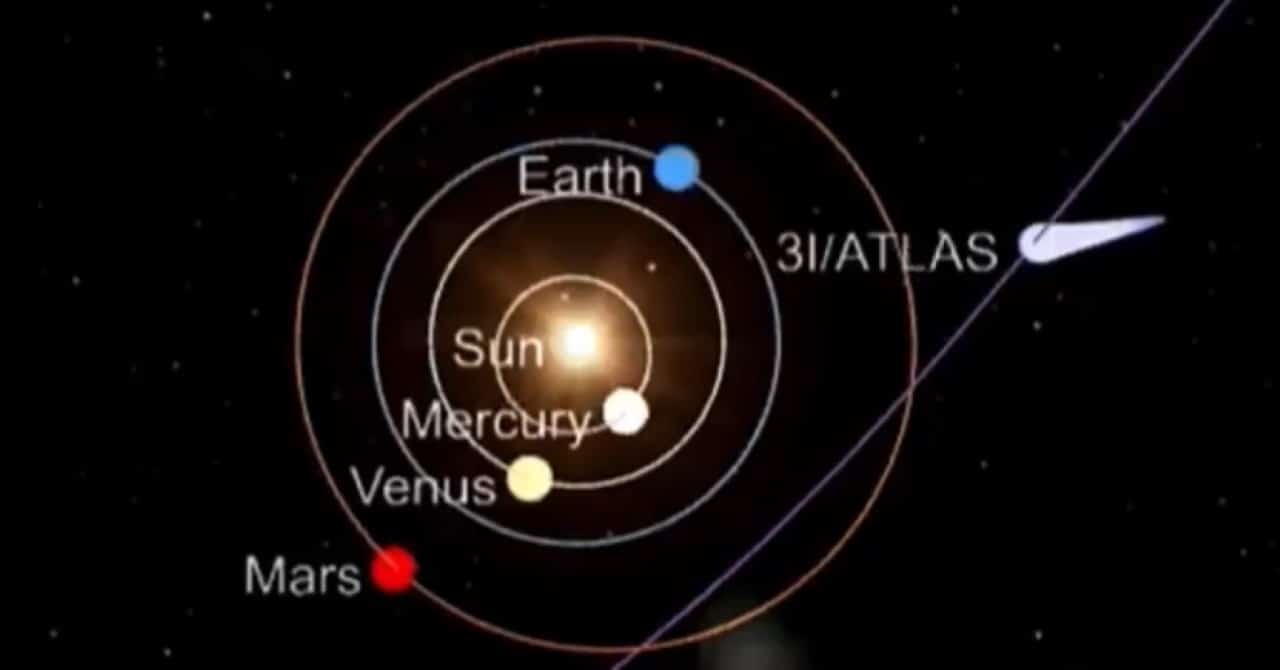
The third celestial body of origin external to our planetary system, officially cataloged as 3I/ATLAS, registered a drastic change in its recent physical and chemical structure. Observações continuous measurements carried out by the SPHEREx mission confirmed that the object abandoned its inert state to transform into an active emitter of cosmic dust and volatile substances. The phenomenon occurred shortly after the body’s closest approach to Sol, a period in which extreme thermal radiation activated deep sublimation processes in its rocky core.
The reactivation of the space visitor’s core generated a complex cloud of gases around the object, allowing detailed spectral analysis by ground-based and orbital observatories. The sudden warming exposed layers of ice that had been traveling dormant through deep space for eons, ejecting organic and inorganic material directly into the vacuum. Especialistas from the astronomical field classify the event as a rare observation window to understand the formation of matter in regions distant from Via Láctea.
The advanced instrumentation used to capture this information operated in the optical and infrared spectra, ensuring an accurate reading of thermal emissions. The ability to record the phase transition of matter in an environment of microgravity and extreme cold represents a milestone for observational astrophysics. Trajectory tracking has provided an unprecedented volume of data on the mechanics of bodies not gravitationally bound to any specific star.
Exponential increase in fluid release
Technical reports based on monitoring the object revealed an extreme variation in the amount of water ejected into space. Comparative measurements with data collected in August of the previous year indicate that the volume of water vapor released by the core grew twenty times. The quantitative jump marks a phase transition where the comet’s structural ice was exposed to solar heat and vaporized in a short space of time.
Severe thermal change transformed the appearance and behavior of 3I/ATLAS in real time. The celestial body, which initially resembled a dark and silent asteroid, developed a visible and bright coma, a classic characteristic of active comets. The violent ejection of dust particles and gases generated non-gravitational forces capable of subtly altering the object’s original route through outer space.
Sublimation occurs when ice passes directly from a solid to a gaseous state, driven by the space vacuum and thermal shock. In the case of 3I/ATLAS, fractures in the surface crust allowed heat to radiate into the core, triggering pockets of pressurized gas. Essa internal mechanics explains the explosive reactivation documented by orbital sensors during the perihelion phase.
Analysis of the coma generated by these explosions reveals an asymmetric distribution of material. Jatos directional beams were identified starting from specific fissures in the hemisphere of the comet facing Sol. The force of these jets works like a natural engine, adding complexity to trajectory calculations carried out by space monitoring agencies.
Organic and inorganic composition revealed
The comet’s period of greatest luminosity provided ideal conditions for carrying out advanced spectroscopy examinations. The chemical signature extracted from 3I/ATLAS demonstrated a surprising wealth of elements, harboring fundamental compounds for prebiotic chemistry. The clarity in detecting complex molecules in such a fast and distant target provided unprecedented data on the makeup of alien planetary systems.
Detection equipment confirmed the presence of cyanogen, methanol and formaldehyde in the cloud surrounding the nucleus. The identification of these substances points to the occurrence of active organic chemical processes on the surface or in the inner layers of the comet. The joint release of simple hydrocarbons, such as methane and ethane, reinforces the thesis that the interior of the object is composed of a heterogeneous mixture of ice and carbon compounds.
The similarity between the elements found in the space visitor and the composition of the comets formed around Sol brings new perspectives to astrophysics. The presence of carbon and water-based chemistry in a body of external origin suggests that star formation processes follow universal patterns in different regions of the galaxy.
Spectroscopy acts like a chemical barcode reader, where each gas absorbs and emits light at specific wavelengths. The precision of the data obtained allowed the scientists to separate the signature of the reflective dust from the signature of the fluorescent gas molecules. Esse level of detail is essential to avoid false positives in the identification of complex organic compounds in faintly shiny objects.
Orbital dynamics and displacement speed
Continuous mapping by 3I/ATLAS, since its initial identification by the automated warning system, demonstrates a hyperbolic trajectory that prevents its capture by solar gravity. The object crosses space at a speed of more than 57 kilometers per second, a rate that definitively attests to its interstellar origin. Orbital dynamics confirm that the celestial body makes a single passage with no possibility of returning to our system.
Unlike periodic celestial bodies that maintain closed elliptical orbits around our star, the current visitor has enough kinetic energy to overcome the local gravitational pull. The high speed guarantees its return to the interstellar medium, ending the brief observation window available to Earth scientists. Data collected during the approach and departure months will require years of processing to fully decode.
The speed of 57 kilometers per second not only attests to the object’s external origin, but also severely limits the useful data collection time. Corpos hyperbolic telescopes do not offer second chances for observations, requiring the entire network of ground- and space-based telescopes to operate in a coordinated manner. Global synchronization of the observatories ensured that no brightness fluctuations or gas emission went unnoticed during the critical approach period.
Comparative analysis with previous celestial bodies
The 3I/ATLAS observation adds a new layer of knowledge when compared to records of the first interstellar visitors, known as ‘Oumuamua and 2I/Borisov. The first object detected had an elongated shape and an almost complete absence of coma, while the second exhibited behavior identical to local comets from the beginning. The current visitor occupies an intermediate position, characterized by a late but extremely vigorous activation when approaching the solar heat source.
The proportions of carbon monoxide and water measured at the beginning of the year reinforce the theory of the universality of planet-building blocks. The discovery that three distinct bodies, coming from different coordinates in deep space, share essential chemical properties with objects in our system strengthens the premise of standardized galactic chemistry.
The taxonomy of interstellar objects is still in its infancy, depending entirely on the frequency with which these bodies cross our space region. The addition of 3I/ATLAS to the visitor catalog provides a more statistically relevant sample for formulating theoretical models about the density of errant material in the galaxy. Estima The Oort cloud and the Kuiper belt of other stellar systems are expected to eject trillions of similar fragments during their formative phases.
Monitoring of the comet continues as it moves away from the inner region of the planetary system. The continuous distance from Sol gradually reduces the surface temperature of the object, stopping the emission of gases and freezing its core again. The celestial body will continue its journey through dark space until it crosses, in the remote future, with the gravity of another star in the vastness of Via Láctea.