

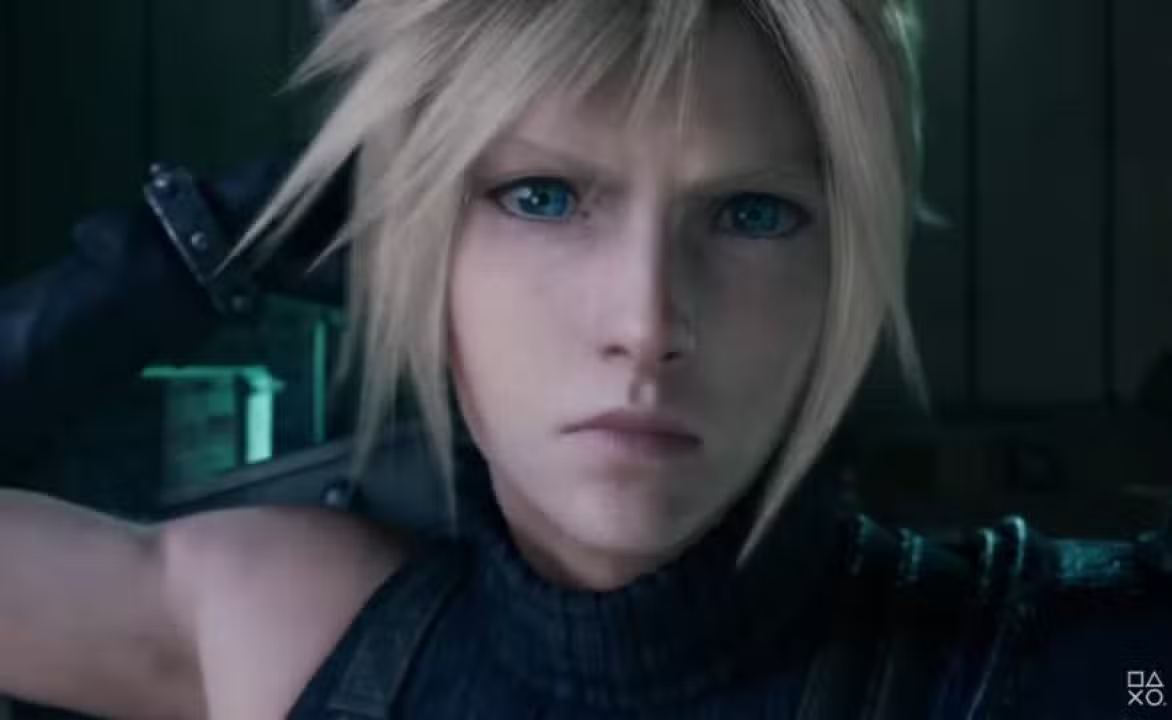
Japanese production company Square Enix has announced a fundamental change in its distribution approach for the highly anticipated third and final chapter of the classic Final Fantasy VII remake trilogy. The company decided to abandon the temporary exclusivity model that marked the first two games in the series. The end of the saga will be available simultaneously for current generation consoles and computers.
The corporate measure aims to reach the largest player base possible on the first day of sales on the global market. Company executives confirmed that the title will arrive at the same time for PlayStation 5, Xbox Series X and S, in addition to PC. The decision ends a long period of restricted partnership with Sony for this specific franchise, marking a new phase in the company’s software distribution.

The strategic move occurs after a detailed analysis of the commercial performance of previous launches. The developer’s management understood that the fragmentation of the public was harming the cultural and financial reach of its largest productions. With the simultaneous launch, the expectation is to unify the gaming community around the outcome of the narrative, regardless of the consumer’s preferred hardware.
Change in the developer’s commercial strategy
Square Enix’s new business guidance reflects an internal restructuring focused on maximizing profits and mitigating risks associated with developing high-budget games. Producing AAA-rated titles requires massive investments, often exceeding hundreds of millions of dollars in development and marketing costs.
To recover these costs efficiently, the restriction to a single platform has become a considerable financial hurdle in recent tax filings. The company’s management noted that the temporary exclusivity model limited initial revenue potential, just as public interest and media coverage peak.
Another determining factor for this change was the issue of plot leaks and the consequent loss of organic engagement. Jogadores on PC and Xbox often had to wait months or even years to access the games, during which time the story had already been widely discussed, analyzed and exposed on video platforms and internet forums.
This resulted in a natural drop in purchasing interest on the part of these consumers, who felt excluded from the original launch. The simultaneous multiplatform strategy eliminates this time lag and ensures that the entire global community can experience the conclusion of the narrative at the same time, protecting the value of the product in the market.
History of exclusivity with the PlayStation brand
The franchise’s recent history demonstrates how exclusivity shaped the reception and reach of previous games. The first chapter, Final Fantasy VII Remake, was released in April 2020 exclusively for the PlayStation 4, later receiving an enhanced version for the PlayStation 5. Essa fragmentation created a technical barrier to entry for many RPG enthusiasts who did not have the Sony console in their homes.
The market situation was repeated with the launch of Final Fantasy VII Rebirth in February 2024, which hit stores as an exclusive title for the PlayStation 5. The installed base of a single console, no matter how dominant it is in the current generation, has proven to be insufficient to sustain Square Enix’s continued growth ambitions, forcing the current revision of the route to the trilogy’s conclusion.
Technical details and innovations from the last chapter
From a technical and software engineering point of view, the third game in the series promises to be the most ambitious project in the entire franchise, making the most of the hardware capabilities of the current generation of machines. The development team confirmed that the title will not have versions for previous generation consoles, such as the PlayStation 4 and Xbox One. Essa pruning decision allows programmers to fully utilize the read speed of solid state disks (SSD) and the processing power of the new architectures. One of the most anticipated mechanical innovations is the implementation of free flight with the Highwind aircraft, which will require the rendering of a vast world map in real time, with no loading screens visible to the user. The transition between high-speed aerial exploration and ground combat will occur completely fluidly, a technical requirement that would be impossible to execute on older hardware without compromising performance. Além Furthermore, the battle system will undergo structural refinements, integrating the real-time action mechanics introduced in the first game with the group synergy tactics explored in Rebirth. The use of advanced graphics engines will ensure that the visual fidelity of the characters, the global illumination and the density of the scenes reach a new level of photorealism, maintaining the characteristic art direction that defined the universe of the original 1997 game.
Approach with Microsoft and the Xbox ecosystem
The inclusion of Microsoft consoles in the simultaneous release schedule represents a milestone in corporate relations between Square Enix and the Xbox division. Durante years, Xbox platform owners have observed a significant absence of the producer’s major Eastern RPG releases in their digital libraries.
Microsoft leadership has been actively working behind the scenes in the industry to reverse this exclusion scenario, seeking to ensure that large third-party developer franchises are available in its ecosystem on an equal basis. The arrival of the conclusion of the trilogy Final Fantasy VII to Xbox Series X and S demonstrates the effectiveness of these recent negotiations.
The availability of the title on the platform’s digital store changes the competitive dynamics of the table console market. The action allows Microsoft to offer its users one of the most anticipated titles of the decade without delays, strengthening the attractiveness of its hardware for fans of the role-playing genre.
Market expectations and continued development
The team of engineers and directors responsible for the project have signaled in statements that the development of the third chapter is progressing at a structured pace. The technological foundation already established by the previous two games allows creators to focus their resources on expanding geographic content and finalizing the narrative, rather than rebuilding physics and combat systems from scratch.
The financial market and shareholders of Square Enix are closely watching the next steps of the distribution campaign. The analytical projection is that the adoption of the multiplatform model will result in a substantially higher initial sales volume, diluting operational risks and justifying the years of financial investment in the complete recreation of this virtual universe.
The future of major RPG franchises
The decision to release the outcome of a work of this magnitude on multiple platforms simultaneously establishes a new operational standard for the high-cost electronic games industry. Produtoras large companies demonstrate that they are increasingly aware that hardware exclusivity represents a commercial risk that limits the revenue ceiling. Square Enix’s strategic move points to a scenario where software accessibility and immediate maximization of the user base outweigh the benefits of traditional exclusive partnerships on a single console.