

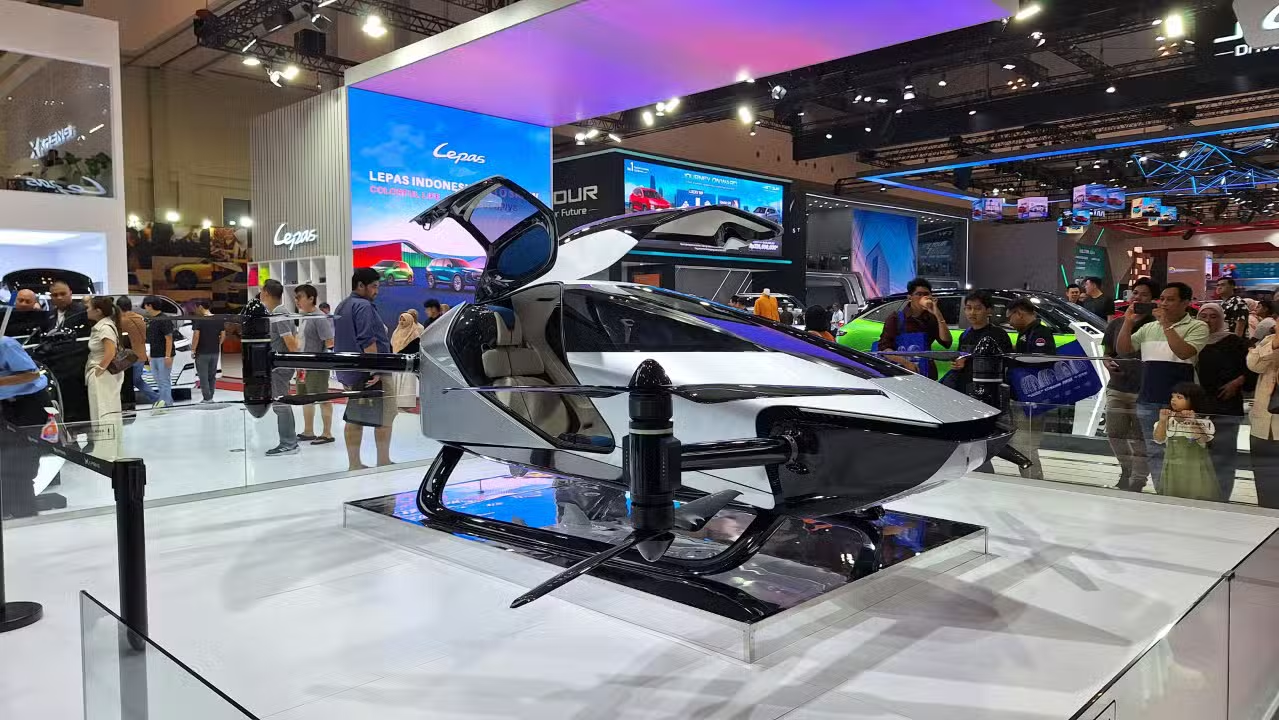
Chinese electric vehicle maker The project, which aims to improve urban air mobility, puts the company at the forefront of transport technology, promising to redefine the way people move in increasingly congested urban environments, with a planned launch date that signals an imminent transformation in the sector. The initiative was presented during the company’s Dia, Inteligência Artificial, at China, underlining Xpeng’s commitment to technological innovation.
This strategy is not limited to just the development of a vehicle, but encompasses the creation of a complete ecosystem for air mobility. The startup’s focus on an electric vertical takeoff and landing (eVTOL) vehicle and supporting infrastructure demonstrates a comprehensive vision that seeks to overcome the practical challenges of operating flying cars at scale.
Xpeng’s approach stands out on the global stage, where several companies are seeking similar advances. However, the integration of an “Aircraft Carrier Terrestre” as a mobile base for the A868 offers a unique solution to the infrastructure and logistics challenges that urban air mobility will face in the coming years.
Xpeng’s vision for urban air mobility
Xpeng clearly seeks to be recognized as a technologically advanced mobility company, positioning itself at the forefront of innovations. Essa ambition is reflected in the vision of a future where cities will not be limited by roads, but will have integrated land and air transport systems. The reveal of the A868 is a bold step in that direction.
Even though initial sales may be limited, the initiative represents a positive impact on the brand’s image, consolidating it as a pioneer. Essa pursuit of innovation drives Xpeng’s competitiveness in the global electric vehicle market and now in the emerging air mobility industry.
Innovation in eVTOL technology: the A868 in the spotlight
The A868 flying car is a fundamental piece in Xpeng’s mobility strategy. Projetado as an electric vertical takeoff and landing (eVTOL) vehicle, it offers the ability to operate in densely populated urban environments where space for conventional takeoff and landing runways is extremely restricted or non-existent.
eVTOL technology, which combines electric propulsion with advanced aerodynamics, allows the A868 to rise and land vertically, similar to a helicopter, but with the efficiency and sustainability of an electric engine. Essa feature is vital for navigation in urban scenarios, where land traffic is a constant problem and travel time needs to be optimized.
The A868 model, still in the development phase, already presents promising features that set it apart. With the fusion of drone and helicopter elements, the vehicle promises a fluid transition from ground transportation to air mobility, transforming daily commuting and opening up new possibilities for transportation services and personal use.
The strategic role of the land-based aircraft carrier
Complementing the development of the A868, Xpeng introduced the concept of an “Terrestre Aircraft Carrier”, a mobile platform designed to facilitate the take-off and landing of flying vehicles. Essa Infrastructure is crucial to enabling large-scale air mobility, as it addresses one of the main practical challenges: the lack of adequate airports or heliports in urban areas.
The land-based aircraft carrier would function as a mobile air base, allowing flying cars to be transported to different locations and deployed as required. Isso eliminates the need to build expensive fixed infrastructure at each point of interest, making the operation of eVTOLs more flexible and accessible.
This innovative solution demonstrates Xpeng’s concern with creating a complete ecosystem for air mobility, not just an isolated vehicle. By considering infrastructure challenges from the start of the project, the company differentiates itself in the market by offering a more holistic approach to integrating flying cars into everyday life.
The ability of the land-based aircraft carrier to provide a safe and efficient means for flying cars to operate in diverse environments is an important differentiator. Ele not only supports A868 operations, but also contributes to the acceptance and scalability of eVTOL technology as a viable and practical transportation solution for the future.
Performance details and flight experience
The A868 promises impressive performance, designed to deliver a seamless transition from the ground to the air. Este eVTOL vehicle will feature a six-seater cabin, designed to provide comfort and safety for passengers. Sua maximum speed of 360 km/h will enable you to cover large distances in a short time.
The ability to bypass ground traffic by flying directly over it is one of the A868’s biggest attractions. Destinado for both personal use and commercial transport, the model eliminates dependence on traditional landing and take-off runways, which allows greater flexibility in routes and access points.
With 7,000 orders already registered worldwide, expectations for the A868 are high. The delivery of the first models is scheduled for next year, marking a significant milestone in the air mobility industry. The Xpeng also offers an exclusive flight training program for future owners.
The futuristic vehicle promises a range of 1,000 kilometers and will be capable of carrying out five to six flights per charge. The company claims to have completed more than 5,000 kilometers of proven flights during development, ensuring the reliability and safety of the technology before its introduction to the market.
Xpeng and the future of the automotive industry
Xpeng’s foray into flying cars reflects a broader trend in the automotive industry, where traditional companies and technology startups are investing heavily in mobility solutions that go beyond land vehicles. Essa movement is driven by increasing urbanization, the search for more sustainable alternatives and the need to alleviate congestion in large cities. The investment in eVTOLs positions Xpeng as a leader in innovation, capable of setting the pace of a sector in constant evolution. Além to attract global attention, these advanced projects reinforce the company’s research and development capacity, attracting talent and investments that solidify its position on the global technology stage. Xpeng seeks to not just create products, but shape the future of personal and commercial transportation.
Advances and next horizons of innovation
As Xpeng approaches its launch date, the company’s dual focus on developing the flying vehicle and supporting infrastructure underscores a pivotal moment in the evolution of urban air mobility, promising a future where the sky becomes a new transportation route.