

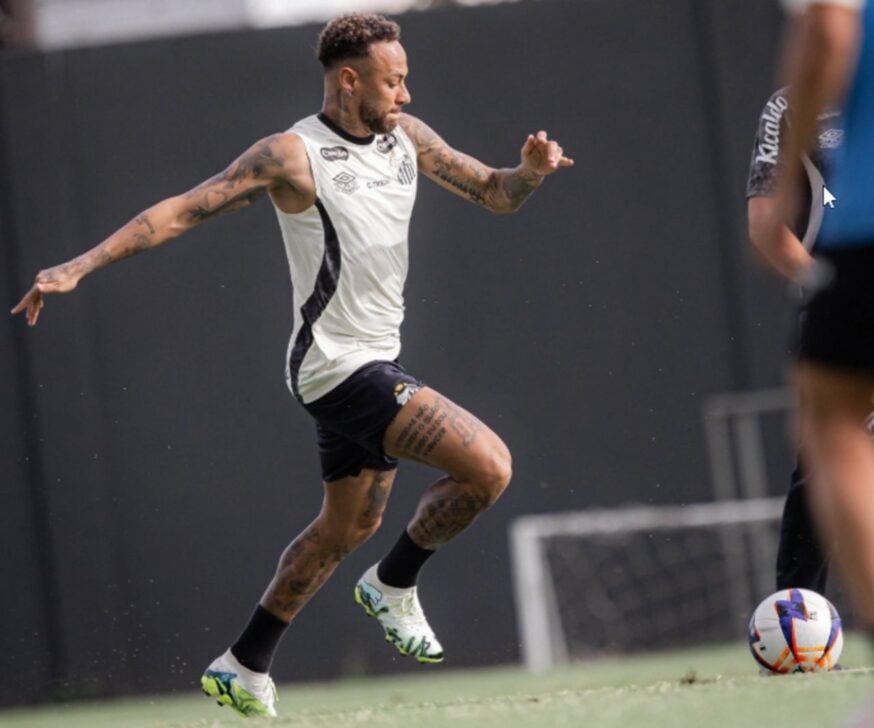
The Brazilian striker began a rigorous routine of activities at Centro of Treinamento Rei Pelé, located at Baixada Santista, with the main objective of reaching the peak of his physical form. The move occurs in a strategic period that precedes the official call-up of the national team’s technical committee for the global tournament. The player uses the facilities of the club that revealed him to carry out specific muscle strengthening and aerobic resistance work, aiming to support the high load of competition games.
Choosing the location involves familiarity with the infrastructure offered and the availability of high-tech equipment aimed at the recovery and improvement of high-performance athletes. Profissionais experts follow each step of the process, monitoring daily performance metrics to adjust workloads. The privacy of the sports complex also contributes to total concentration on the established goals.
The training sessions are divided into fundamental steps to ensure continuous and safe evolution:
– Avaliação detailed biomechanics to prevent joint and muscle injuries.
More on this story: Neymar announces retirement from the Brazilian team: My story is over
– Exercícios explosion and speed in a reduced field to improve reaction time.
– Simulações of game situations to improve ball timing and technical precision.
– Physiological Recuperação in hyperbaric chambers and thermal contrast pools.
All planning was structured so that the athlete reaches the levels required by the team’s medical and physical team, eliminating any lag in relation to other competitors who play in European football. The focus is to ensure that the transition to full group training occurs without the risk of overload.
Learn more: Main player of the Brazilian team guarantees ideal conditioning for the World Cup and dispels rumors
Cutting-edge structure on the coast of São Paulo
The Santos sports complex offers advanced resources that meet the rigorous demands of modern football. The official sized fields have grass identical to that used in the main international arenas, allowing precise adaptation to the tournament standards. Daily floor maintenance ensures that the ball rolls at the appropriate speed for passing and finishing exercises.
In addition to the impeccable lawns, the medical and physiology department has isokinetic equipment and state-of-the-art GPS tracking systems. Esses equipment provides real-time data on the workload supported by the player, adjusting the intensity of the exercises according to the body’s immediate response. Technology acts as an ally in mitigating physical risks.
The integration between the athlete’s private physical trainers and the club’s professionals guarantees a constant and detailed flow of information. Essa synergy is essential to avoid excessive wear and tear and promote a gain in lean mass adequate to withstand physical confrontations against opposing defenders during world competition.
Full coverage: News (EN)
Strategic planning for preparatory friendlies
The national team’s calendar includes a series of friendly matches before the definitive trip to the tournament headquarters. Esses games serve as a practical laboratory for the technical committee to test formations, tactical variations and evaluate the playing rhythm of the squad against teams from different football schools.
The attacker’s presence in these clashes is considered vital for the integration of the offensive sector and for the consolidation of the tactical scheme. Therefore, the goal established in the current planning is for him to be able to play during the ninety minutes without showing a sudden drop in performance in the second stage of the matches, maintaining intensity in the transitions.
On the same topic: Neymar Jr ends his career with the Brazilian team after 80 goals and four World Cups
Training with the ball has already begun to be intensified on the coast of São Paulo, focusing on medium-range shots, free kicks and movement without possession of the ball. Technical precision is combined with aerobic conditioning so that the player can execute dribbles and sprints with the same efficiency and explosiveness as in previous years.
The national technical committee receives weekly reports detailing the evolution of the athlete’s physical and physiological indices. Essa transparência na comunicação assegura que o treinador tenha total segurança e embasamento científico no momento de fechar a lista final de inscritos para a competição, evitando surpresas de última hora.
Physical demands of contemporary football
The level of intensity of international competitions has increased considerably in the last decade, requiring athletes to cover greater distances at high speed and with less recovery time. Current preparation focuses on the ability to perform repeated sprints with short rest intervals, an essential characteristic for breaking compact defensive lines and organizing devastating counterattacks. Strength work focuses on the core and lower limbs, providing the stability necessary to withstand shocks, protect possession and maintain balance during tougher ball disputes in midfield and attack.
Nutrition and rest form the basis of this intensive preparation, indispensably complementing the effort made on the pitch and in the gym. Dietas hyperproteic and controlled supplementation are adjusted daily based on the caloric expenditure recorded by the performance monitors attached to the athlete’s body. Sleep is also strictly controlled by experts, since cell regeneration and recovery of muscle fibers occur predominantly during the night’s rest period, a determining factor in the prevention of chronic muscle fatigue and physical stress.
More on this story: Preparation for the sixth World Cup: Cristiano Ronaldo invests US$ 1 million annually in discipline and physical care
Preparation history at club facilities
The use of Brazilian club training centers by players who play abroad or who seek intensive physical rehabilitation is a recurring practice that historically tends to generate highly positive results. The controlled environment, far from the immediate pressure of the international press and the constant harassment of European fans, offers the psychological tranquility necessary for a total focus on rehabilitation and individual technical improvement. In the specific case of the facilities at Baixada Santista, the partial isolation and complete hotel structure within the sports complex itself avoid exhausting daily commutes in urban traffic. Essa optimized logistics allows the athlete to carry out activities in two different periods of the day in complete comfort, interspersing field sessions in the morning with strength, proprioception and physiotherapy work in the afternoon. The immediate proximity to the local medical department also makes it easier to carry out preventive imaging exams at any time, ensuring that any micro-injury or muscle discomfort is detected and treated before it evolves into a more serious clinical problem that compromises participation in the world tournament and harms the national team’s planning.
Tactical alignment and technical leadership
Ideal physical condition is the absolute prerequisite for the player to fully perform his tactical role within the scheme designed by the national team coach for the tournament. The capacity for quick defensive recovery and coordinated pressure when the opponent’s ball is released depend directly on the physical vigor and aerobic resistance achieved in this phase of specific training.
As one of the squad’s main technical and leadership references, the striker’s presence in his best form serves as an immeasurable motivational factor for his other teammates. The search for a sixth world title necessarily depends on the collective ability to maintain an intense, supportive and aggressive pattern of play from the first match of the group stage to the decisive clashes of the knockout stages.
Final evaluation stage
In the coming weeks, the preparation schedule foresees the complete transition to more complex collective activities, simulating the real intensity and physical contact of an official high-level match. The quantitative and qualitative results of these practical tests will define the final clearance of the medical and physical department, definitively attesting to the athlete’s readiness to join the group that will seek to win the global championship with maximum strength.