

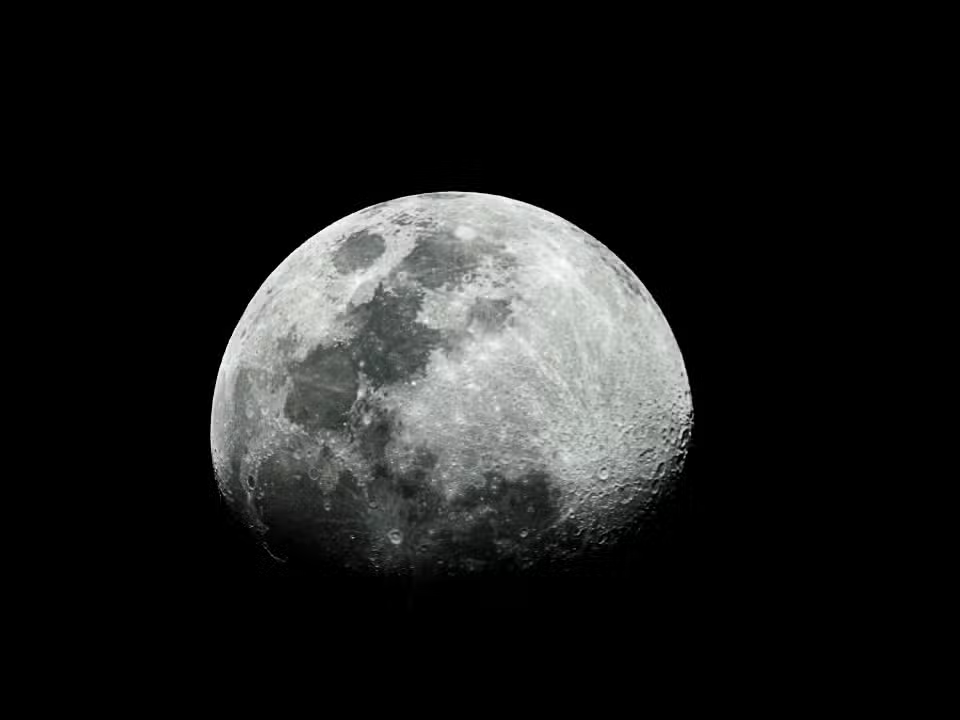
The North American space agency released a set of visual records captured by the spacecraft Orion during its crossing of the non-visible side of the natural satellite Terra. The material documents the exact moment in which the blue planet appears on the horizon full of craters, an astronomical event known technically as the sunset of Terra.
The four astronauts aboard the capsule also witnessed a total solar eclipse from a vantage point in deep space. The direct observation of the solar corona lasted almost an hour, providing unprecedented data on the interaction of light with the space vacuum.
The operation took place autonomously while the spacecraft crossed a forty-minute radio silence zone. The high definition equipment integrated into the navigation system ensured that images were captured without intervention from the ground control base.
Visual details of the lunar surface and dynamics of the astronomical event
The most prominent image features crater Ohm in the foreground, revealing complex geological formations generated by asteroid impacts. The structure’s central peak demonstrates how the surface was liquefied and rapidly cooled in the past.
In the background of this arid landscape, planet Terra appears illuminated, displaying cloud formations above Oceania and Austrália. The contrast between Earth’s dayside and the darkness of deep space offers a unique perspective on the fragility of the globe. The recording was made at exactly eighteen hours and forty-one minutes East Coast time, marking the greatest distance ever reached by a human crew on an exploration mission.
The crew used specific equipment to document the astronomical event with technical precision:
– Câmeras high resolution attached to the capsule’s polycarbonate windows.
– Sensores light calibrated to withstand extreme light transition.
– Gravadores audio to capture the astronauts’ immediate sensory descriptions.
The direct visibility of these structures allows scientists to analyze soil composition and mineral distribution without the immediate need for physical samples. The crossing of audio reports with high-definition photographs will result in three-dimensional maps essential for defining the landing zones for the next stages of the space program, ensuring greater safety for future crews that will descend on the lunar south pole.
Extended Solar Eclipse Observation in Deep Space
The spacecraft’s orbital speed Orion allowed the total solar eclipse to be observed for fifty-four continuous minutes. Essa duration is physically impossible for any observer positioned on the Earth’s surface, due to the planet’s rotation.
The cosmic alignment revealed the solar corona as a vibrant white halo around the dark silhouette of Lua. The gray light phenomenon, characterized by the glow of Terra reflecting off the lunar surface, became visible shortly after the light of Sol was completely blocked.
Autonomous data capture and processing technology
The capsule’s state-of-the-art digital sensors operated under extreme temperature conditions to prevent pixel saturation from intense light. The onboard artificial intelligence automatically selected the best photographic exposures during the communication isolation period.
The internal storage capacity ensured that no data was lost while radio transmission was unavailable. The reinforced structure of the quartz windows was essential to maintain the clarity of the images captured by the crew.
Crew reports and sensory analysis of the cislunar environment
The recovered audio files contain detailed descriptions of the color variations and intensity of sunlight in a vacuum. The mission pilot reported how quickly the lighting reflected by the globe altered the perception of shadows in neighboring craters.
These direct human observations provide nuances that space weather instruments cannot record with the same sensitivity. The integration between the human eye and the precision of machines optimizes equipment calibration for future trips.
The identity of the photographer responsible for each click remains under the administrative confidentiality of the space agency. Todos team members actively participated in data collection while managing the ship’s life support systems.
Advances over historic exploration missions
The level of detail achieved in this operation far surpasses the records made by film cameras from the Apollo era. Technological developments in recent decades have made it possible to capture textures of the lunar soil with a clarity unprecedented in the history of astronomy.
The quality of the colors facilitates the preliminary identification of natural resources available on the satellite’s surface. Esse Advancement accelerates the geological research process, reducing the time required for laboratory studies based solely on automatic probes.
The success of visual capture proves the effectiveness of new protection systems against cosmic radiation. Image stabilization in a microgravity environment worked perfectly during maximum approach maneuvers to the celestial body.
The visual data collected will serve as the basis for developing new spacesuits and surface exploration vehicles. Accurately understanding the illumination at the lunar south pole will dictate the timing of future extravehicular activities.
Preparing for the return and recovery of physical files
The flight control team rigorously monitors the spacecraft’s return trajectory toward Earth’s atmosphere. The capsule’s heat shield will face extreme temperatures during aerodynamic friction in the reentry phase, testing the limits of composite materials developed to ensure the physical integrity of astronauts and onboard storage equipment. The accuracy of the orbital calculations is vital to ensure that the landing takes place in the designated zone in the ocean, where rescue teams wait to recover the crew module.
The researchers’ expectations focus on extracting the internal hard drives, which contain terabytes of videos and photographs in raw format that could not be transmitted in real time. The limited bandwidth of deep space communication networks restricts the sending of large files, making physical data recovery a critical mission step. Cada megabytes of stored information will be processed on supercomputers to reveal additional details about lunar topography and the behavior of solar radiation.
Expansion of human presence in the solar system
Mastery of autonomous operations on the non-visible side of Lua represents a key milestone for planning long-duration interplanetary travel, especially missions aimed at planet Marte. The ability for a spacecraft to make critical navigation and scientific documentation decisions without direct intervention from ground control resolves one of the biggest hurdles in deep exploration, where radio communication delay can exceed the twenty-minute mark. The impeccable functioning of the capsule’s life support systems and artificial intelligence during the period of absolute silence validates the technological architecture chosen to sustain a permanent human presence outside the low orbit of Terra. The establishment of a fixed lunar base, fueled by locally extracted resources and operated by international crews, will directly depend on the reliability of the equipment tested in this pioneering orbital crossing.
Scientific dissemination and global engagement
The space agency will make the complete visual collection available on public access platforms to foster independent academic research. The photographic material will be part of educational programs aimed at training a new generation of engineers and specialists in planetary sciences around the world.