

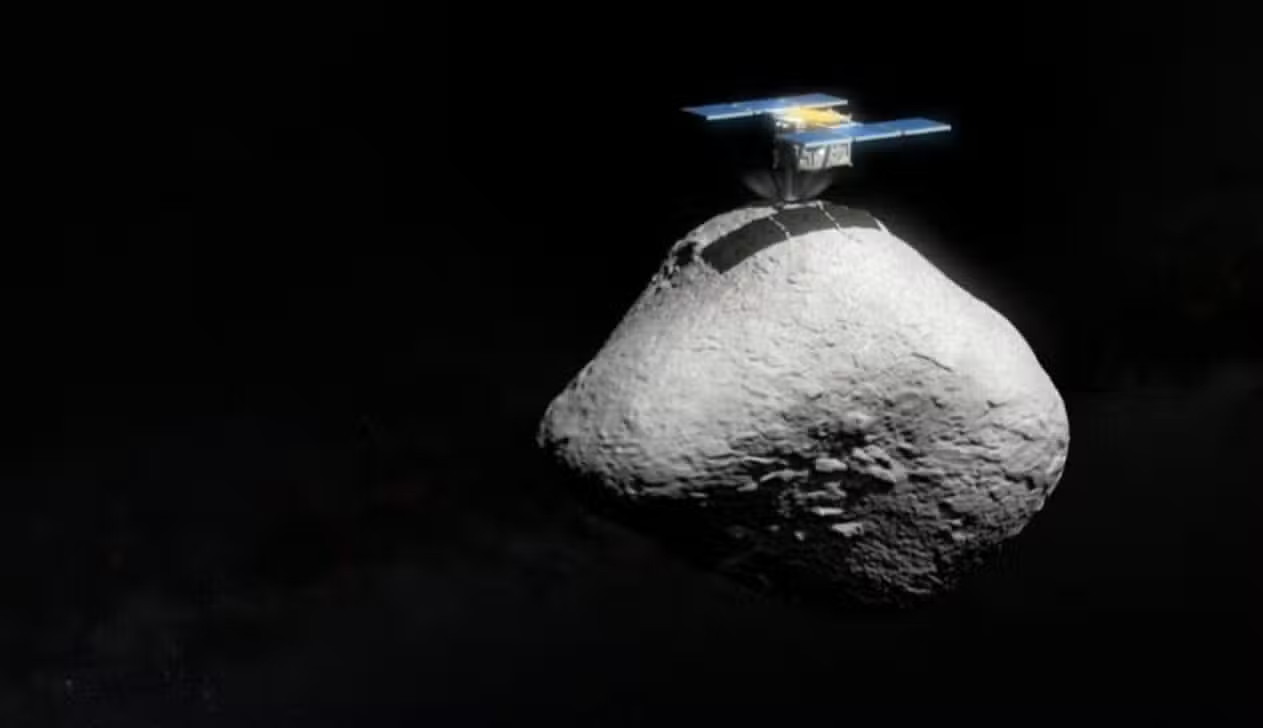
Avi Loeb and collaborators presented evidence that links the object 1998 KY26, classified as a dark comet, to the Soviet probe Phobos 1. The Universidade Harvard astrophysicist published an analysis that considers the possibility that the celestial body is a remnant of a Russian mission lost in 1988. Agência Japonesa from Exploração Aeroespacial intends to make the first encounter of a probe with an object measuring around 10 meters in July 2031.
Object 1998 KY26 measures approximately 11 meters in diameter. Ele exhibits a high albedo of 0.52, which indicates a very reflective surface. The rotation period is 5.3516 minutes, which suggests a resistant monolithic structure. A pile-of-rubble asteroid would disintegrate under centrifugal forces generated by this speed.
Estudo analyzes compatibility between orbits
Pesquisadores calculated two speed pulses combined at 1.9 km/s. The first would have occurred shortly after the loss of Phobos 1. The second would have occurred in May 1996. Essas corrections would allow the trajectories of the two bodies to be aligned. The analysis considers uncertainties in the orbit of 1998 KY26, which has more than 230 observations.
- Phobos 1 and 1998 KY26 have statistically compatible orbits.
- Diferença orbital falls within the thrust envelope available to the Soviet probe.
- Registro history indicates possible propulsive thrust shortly after mission failure.
- Missão was lost early, which preserved large ΔV capacity.
- Propriedades observed physics favors robust object over pile of rubble.
- Variações’s magnitude suggests an elongated shape, compatible with the design of Phobos 1.
The Phobos 1 probe was launched in July 1988 towards Marte. Contato was lost on September 2 of that year. Técnico sent command with missing hyphen on August 28th. Isso has disabled attitude thrusters. The probe lost orientation to the solar panels and ran out of batteries.
Hayabusa2 mission will test hypothesis
Hayabusa2 completed the main phase by returning samples from the asteroid Ryugu in 2020. With remaining fuel, the probe continues on an extended mission. The encounter with 1998 KY26 is scheduled for 2031. Astrônomos hope that the landing will reveal details about the possible release of gases from the object classified as a dark comet.
1998 KY26 was observed by ground-based telescopes to prepare for the approach. Resultados came out in an article published in Nature Communications in 2025. Dados show a smaller and faster object than previous estimates. The Japanese mission will mark the first visit to a rapidly rotating decameter-scale body.
Características physics support idea of artificial origin
The high albedo contrasts with expectations for typical dark comets. Reduced Tamanho and fast rotation require cohesive structure. Estimated cohesive Força is below 20 Pa. Isso allows both monolithic structure and pile of rubble with certain strength. Mudanças in apparent magnitude indicates stretching. Tal format matches the design of probes such as the Phobos 1.
Avi Loeb had already proposed similar classification for other objects. In a previous publication, he related 2005 VL1 to Venera 2. The case of 2020 SO, identified as a rocket stage, reinforces that artificial objects can exhibit non-gravitational acceleration without a visible tail. Pressão of solar radiation explains the phenomenon in known cases.
Rotating Período challenges common asteroid model
Rotação of just over five minutes generates forces that would destroy fragile structures. Observações combines radar data from Goldstone with light curves from telescopes. Modelos convex and non-convex points point retrograde. Equipe international participated in the measurements that reduced the estimated diameter to 11 meters.
The object received increasing attention after being included in the category of dark comets. Esses bodies show non-gravitational acceleration with no signs of visible outgassing. The Loeb hypothesis suggests that at least some of them may have human origins. The Hayabusa2 mission is expected to provide definitive data on the true nature of 1998 KY26.
Contexto mission history Phobos
Soviet Programa Phobos provided two probes. Phobos 2 even operated close to Marte before failing. Phobos 1 never completed the trip. Single command Falha stopped communication. Análise from the new team considers that residual impulses could have altered the trajectory over the years.
The possibility of reuniting with lost technology opens up debate about cataloging objects close to Terra. Base data from human launches since 1957 could be incorporated into astronomical models. Scientific Hipóteses are tested by evidence. The 2031 encounter should clarify whether 1998 KY26 is a natural asteroid or a space artifact.