

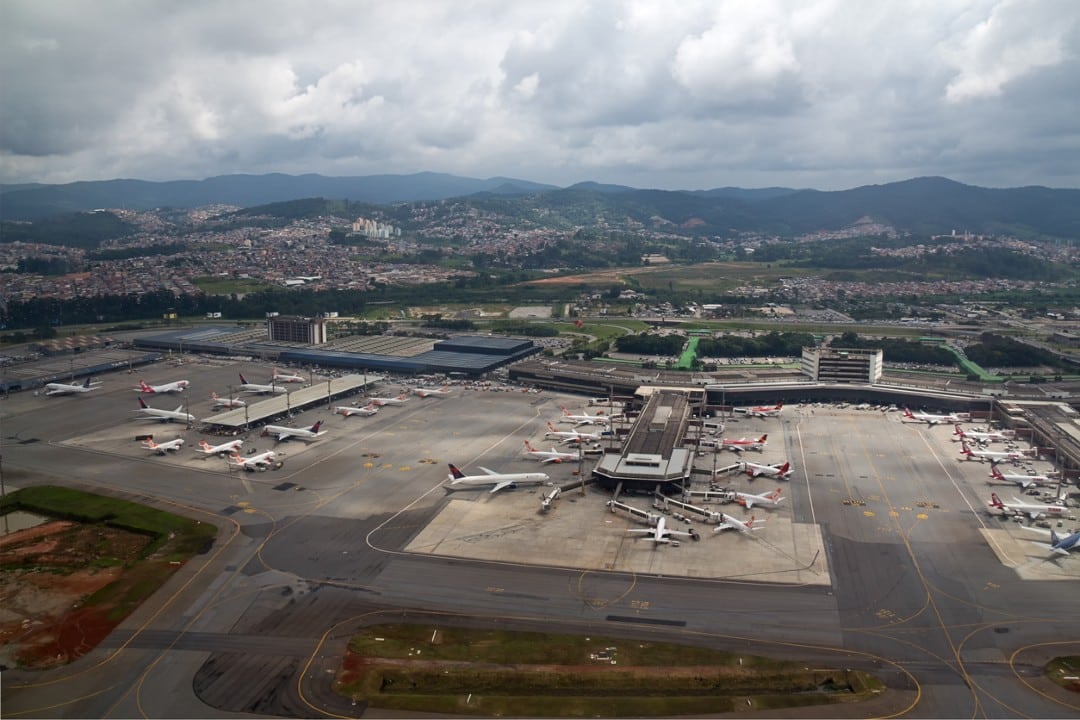
A significant operational failure at Centro Regional of Controle of Espaço Aéreo Sudeste (CRCEA-SE) paralyzed operations at the main airports of São Paulo, generating a scenario of chaos and uncertainty for thousands of passengers. The incident, which occurred in April 2026, directly affected busy terminals such as Congonhas, in the capital, Cumbica, at Guarulhos, and Viracopos, at Campinas.
The breakdown in the air control system, a regionalized unit of Controle of Espaço Aéreo (DECEA), triggered a series of delays and cancellations, impacting the airline network in one of the largest connection centers of Brasil. Passageiros were caught by surprise, facing long queues and mismatched information.
CRCEA-SE, headquartered at Aeroporto of Congonhas, is vital for the management of air traffic in the region Sudeste, covering not only the São Paulo terminals, but also those of Rio of Janeiro. The interruption of its functions resulted in a cascade of problems that lasted for hours, challenging the responsiveness of airlines and airport infrastructure.
Initial chaos and impact on terminals
The situation at São Paulo airports immediately after the failure was announced was highly tense. Centenas passengers crowded the concourses, awaiting news about their flights, which displayed delay or cancellation status on electronic panels. The lack of predictability generated frustration and disorganization.
Many people with urgent commitments, whether for work or personal reasons, have seen their plans completely changed. Companhias airlines struggled to relocate passengers, but the limited aircraft capacity and available schedules made the task a monumental challenge, with reschedulings lasting days in some cases.
Details of the systemic failure in air control
The technical problem originated from Centro Regional of Controle of Espaço Aéreo Sudeste (CRCEA-SE), which is the structure responsible for the supervision and management of air traffic in a vast and complex area. Vinculado directly to Departamento of Controle of Espaço Aéreo (DECEA), this center operates as a critical point for the fluidity of air routes, being crucial for the safety and efficiency of travel. Sua strategic headquarters no Aeroporto of Congonhas highlights the importance of the location for the operation, given the volume of flights that pass through this region, covering not only Controle0, but also the main air terminals of Controle1 of Controle2. The interruption, Even if temporary, a unit of such scope has the potential to create a significant domino effect, simultaneously affecting a series of interconnected processes and users’ confidence in the system as a whole, requiring a detailed recovery plan to mitigate long-term impacts.
Main airports affected by the strike
Terminals Congonhas and Guarulhos, two of the busiest in the country, were the ones that felt the most immediate impact. Ambos were unable to operate for more than an hour, accumulating a large number of aircraft on the ground or awaiting authorization to land and take off. The strike created a logistical bottleneck that took a long time to undo.
In addition to these, the failure reverberated in other airports under the DECEA umbrella in the region, including Viracopos, in Campinas, and the Rio terminals Tom Jobim (Galeão), Santos Dumont, Marte and Jacarepaguá. The dimension of the affected area highlighted the seriousness of the incident and the interconnection of the national air system.
Initial reactions and crisis management
Força Aérea Brasileira (FAB), responsible for DECEA, acted to try to stabilize the situation and provide information, although initial details were scarce. Foi reported that the problem began around 9 am, and technical teams were mobilized to identify the cause and restore the system.
Airlines, in turn, had to implement contingency plans in real time. Isso involved communicating with crews, diverting flights to other airports or cities, and the complex work of re-accommodating passengers on future flights, often with limited capacity and already tight schedules.
Thousands of passengers with changed plans
The disruption to airline operations has resulted in countless stories of scrapped plans. Muitos Passengers missed international connections, important business appointments, family events or long-planned vacations. The emotional and financial impact has been considerable, especially for those without travel insurance or with little flexibility.
Emergency measures and slow normalization
To try to mitigate the chaos, measures were implemented such as prioritizing long-haul flights and coordination between airports to divert aircraft. Communication with passengers, although challenging due to the speed of events, was crucial to managing expectations and minimizing outrage.
The normalization of operations occurred gradually throughout the day, as the air control system was reestablished and airlines were able to reorganize their networks. However, the domino effect of delays and cancellations was felt for several days, with repercussions on other terminals and routes across the country. The full recovery of punctuality and operational capacity required a continuous and coordinated effort.
Systems response and assessment
The incident led to a review of the air traffic control system’s safety and contingency protocols. It is essential that authorities evaluate the resilience of equipment and software, in addition to improving emergency response plans. A robust and updated infrastructure is essential to guarantee the continuity of services.
Preventive maintenance actions and investment in cutting-edge technologies are crucial to avoid recurrences. The complexity of Brazilian airspace requires fail-safe systems, capable of withstanding peaks in demand and possible technical setbacks without compromising safety or the fluidity of daily operations.
The future of Brazilian aviation
The occurrence of operational failures such as this serves as a warning for the continued need for modernization and investment in the country’s air control infrastructure. Aviation is a sector in constant evolution, and the demand for flights grows exponentially, requiring support systems to keep up. The use of artificial intelligence and machine learning in monitoring systems can offer innovative solutions, predicting and mitigating problems before they escalate.
Training technical and operational teams is also a fundamental pillar. Profissionais Well trained and up to date with the latest technologies are the first line of defense against failures and the guarantee of an effective response when incidents occur. The synergy between technology and human capital is essential for the sector’s resilience.
Passenger rights in the face of unforeseen events
In the face of delays and cancellations, passengers have rights guaranteed by rules of Agência Nacional and Aviação Civil (ANAC). Estes include material assistance (food, accommodation and transport, depending on waiting time), re-accommodation on another flight or full refund of the ticket. Clear and transparent information about these rights is crucial.