

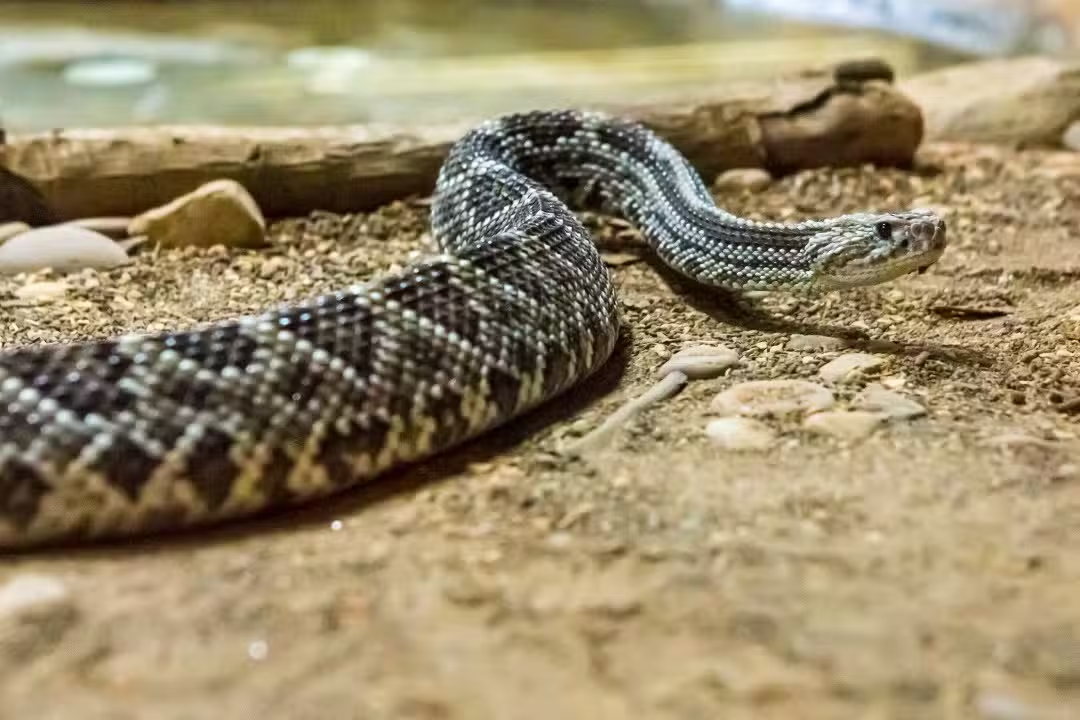
A well-preserved fossil of an ancient snake with hind legs was found at Argentina. The specimen belongs to the species Najash rionegrina and lived almost 100 million years ago. The material includes skull details that help understand changes in the snakes’ bodies over time.
Pesquisadores of Universidade of Alberta and Argentine institutions analyzed the fossil. Eles used high-resolution computed tomography to examine internal structures without damaging the part. The results indicate that primitive snakes maintained hind limbs for a long period before the emergence of current species, most of which are legless.
Preserved Crânio shows missing bone in modern snakes
The zygomatic, or jugal, bone was still present in the Najash rionegrin’s skull. Essa structure has practically disappeared in today’s snakes. Scientists have reconstructed nerve pathways and blood vessels within the rock.
Essa evidence corrects 160-year-old interpretations of lizard and snake anatomy. The fossil came from the northern region of Patagônia and belongs to an ancient lineage linked to the continents of Gondwana.
- The specimen preserved functional hind legs attached to the spine.
- The mouth was wide, different from the shape expected in small excavators.
- The body suggested larger predators in terrestrial environments.
- The analysis confirmed retention of limbs for tens of millions of years.
- Detalhes of the skull clarifies the sequence of bone loss in snakes.
Evidências points to terrestrial and predatory ancestors
Rionegrin Najash lived in terrestrial sediments of Formação Candeleros. Diferente of some fossil sea snakes with reduced limbs, this species had legs that protruded outside the rib cage. The hip bone was firmly connected to the spine.
Fernando Garberoglio, lead author of the 2019 study, highlighted that the ancestors of modern snakes had large bodies and mouths. Michael Caldwell, from Universidade from Alberta, reinforced that the research uses direct evidence rather than assumptions.
The material came from a paleontological area rich in La Buitrera. The fossils include partial skeletons and three-dimensional skulls. Essa preservation allowed observations that the previous fossil record did not provide clarity.
Descoberta challenges idea of origin as small diggers
Durante decades, a common hypothesis suggested that snakes arose as small animals that dug burrows. The Najash fossils indicate the opposite. The first snakes would have been larger terrestrial predators.
Later Estudoss, such as a 2020 one about a large blind snake from Brasil and a 2023 one about fossil brains, have added layers to the debate. A 2025 work on a squamate of Jurássico in Escócia showed initial anatomical experimentation in the group. Mesmo thus, Najash remains a clear reference for a transition phase.
Researchers link the group to a few unusual modern snakes. The southern lineage inhabited parts of América of Sul and other continents of the Gondwana supercontinent.
Tomografia reveals hidden details of the fossil
The team applied micro-CT to visualize the interior of the skull. Imagens showed buried bones, nerve pathways and vascular structures. Essa technique prevented damage to material nearly 100 million years old.
The results appeared in the journal Science Advances. The paper describes new skulls and skeletons of the Cretáceo legged snake. The 2019 publication remains the basis for discussions about the body plan of current snakes.
Contexto geological and importance for paleontology
Argentine Patagônia offers one of the richest vertebrate records of Cretáceo. Formação Candeleros preserves ancient plains and dunes environments. The fossil of Najash rionegrina was discovered in this sedimentary unit.
Argentine Paleontólogos collaborated with Canadian experts. The work integrates efforts to reconstruct the history of squamates, a group that includes lizards and snakes. The discovery reinforces that the loss of limbs occurred gradually and not linearly.
Universidade by Alberta highlights the role of research in advancing knowledge about evolution. The fossil captures snakes at a time of transition, with mixed characteristics of modern lizards and snakes.