

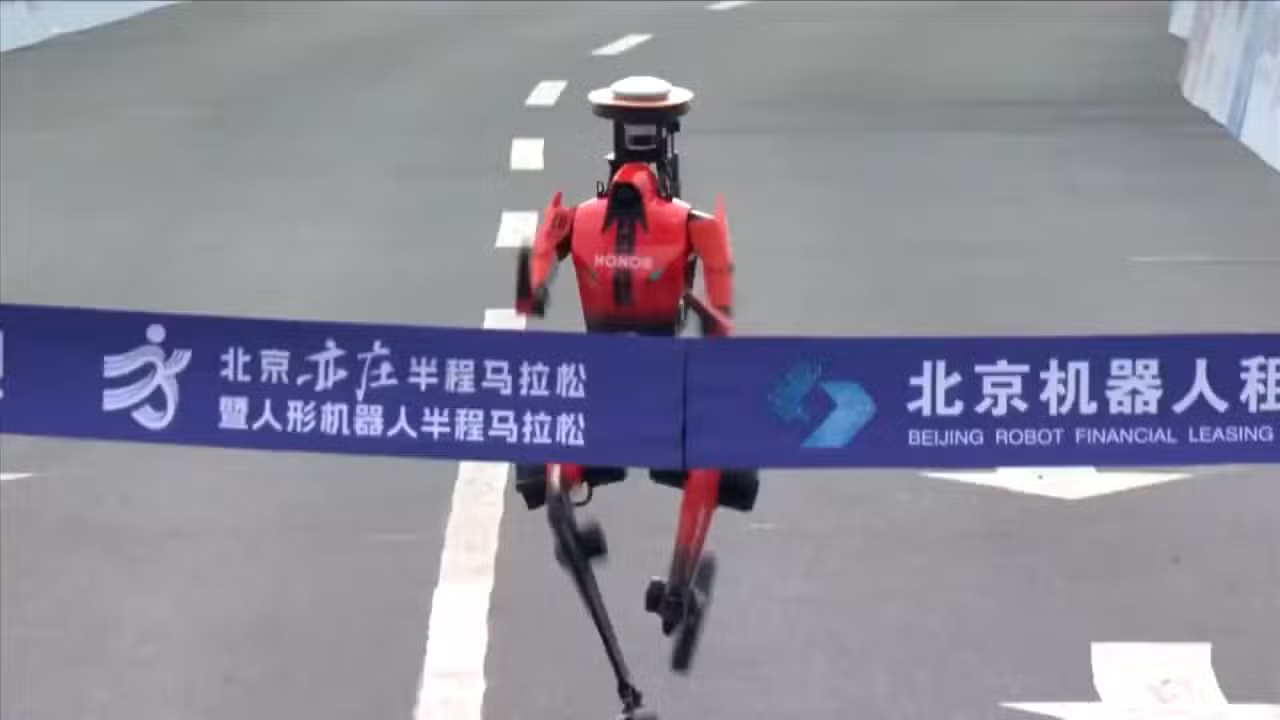
A humanoid robot won the race dedicated to machines in the second edition of the Pequim half marathon. The model developed by Honor completed the 21 kilometers in 50 minutes and 26 seconds this Sunday, April 19th. The time was below the men’s world record for the distance, which is 57 minutes and 20 seconds.
The competition took place in the economic and technological development area known as Beijing E-Town, on the southern outskirts of the Chinese capital. The robots ran on separate tracks from the approximately 12,000 human athletes who participated in the traditional race on the same day. Organizado for the second time, the event brought together more than 100 teams and registered significant progress compared to the previous edition.
Robô Lightning by Honor leads with autonomous navigation
The winner was a robot called Lightning, produced by Honor, a Chinese company known for smartphones. Ele ran completely autonomously, without remote control, and crossed the finish line with superior performance than all competitors. Dois other models from the same manufacturer occupied second and third place, also independently.
The test had different categories. One allowed remote operation, in which an Honor robot clocked 48 minutes and 19 seconds. However, the regulations rewarded the best time in autonomous mode. Quase half of the participants operated without direct human intervention, which represented a leap compared to last year, when few robots were able to maintain stability for long stretches.
- The winning robot maintained an average speed of close to 25 km/h throughout much of the route.
- Engenheiros highlighted improvements to the legs with biomimetic design and a cooling system adapted from cell phone technologies.
- Autonomy allowed the machine to adjust to the terrain and correct deviations without external assistance most of the time.
- Outros models based on platforms such as Unitree H1 also participated, but did not reach the podium.
The progress was remarkable. In the first edition, in 2025, the fastest robot took 2 hours, 40 minutes and 42 seconds to complete the same distance.
https://twitter.com/astronomiaum/status/2046017435317272649?ref_src=twsrc%5Etfw
Chinese Empresas focuses efforts on the humanoid robotics sector
Honor wasn’t the only one to be present. Empresas like Unitree, UBTech and Tiangong have submitted prototypes or platforms to independent teams. The event served as a practical test for components such as batteries, motors and navigation algorithms in a real environment.
Especialistas note that the results do not yet mean immediate application on an industrial scale. Robôs humanoids still face limitations in tasks that require fine precision or complex interaction with varied objects. Mesmo thus, running performance showed gains in endurance and movement stability.
The race took place in parallel to the human half marathon. Corredores humans completed the journey in much longer times, with the fastest among them clocking just over an hour and seven minutes. The separation of the lanes avoided any risk of collision between machines and people.
Technological Avanço reflects national goal of leadership in robotics
China invests heavily in the development of humanoid robots. The event at Pequim brought together more than 300 models of different sizes and configurations. Alguns measured less than one meter, while others reached two meters in height.
Melhorias in hardware allowed machines to sustain prolonged effort. The cooling system prevented overheating, and the sensors helped adapt to the asphalt and small irregularities on the route. Nem everything went without incident: some robots stumbled, stopped for adjustments or needed assistance at the end.
The prize for the winner was 5 thousand yuan, equivalent to around R$3,600. Mais than the cash value, the highlight serves as a showcase for participating companies. Fabricantes seek to attract investments and partnerships with performance demonstrated in real conditions.
Próximos challenges include tasks beyond speed
Apesar’s milestone, engineers recognize that the race represents just one aspect of development. Future Aplicações may involve logistics, manufacturing or assistance in controlled environments. The ability to deal with uneven terrain and maintain balance has already evolved, but fine motor skills still require refinement.
The event attracted international attention. Imagens of the moving robots circulated on networks and media outlets. Analistas see the test as an indicator of the rapid pace of Chinese advances in the field of robotics.
The second edition of the humanoid half marathon consolidated the format as a reference for evaluating technical progress. Organizadores did not disclose a date for 2027, but interest from companies suggests continuity.