

The mobile device industry had been showing conservative behavior in the development of photographic hardware in recent global launches. The focus of major manufacturers has gradually migrated from the raw increase of technical specifications to the refinement of software and image post-processing. Essa stability trend has just been interrupted by an announcement that revives the technical aggressiveness of past generations.
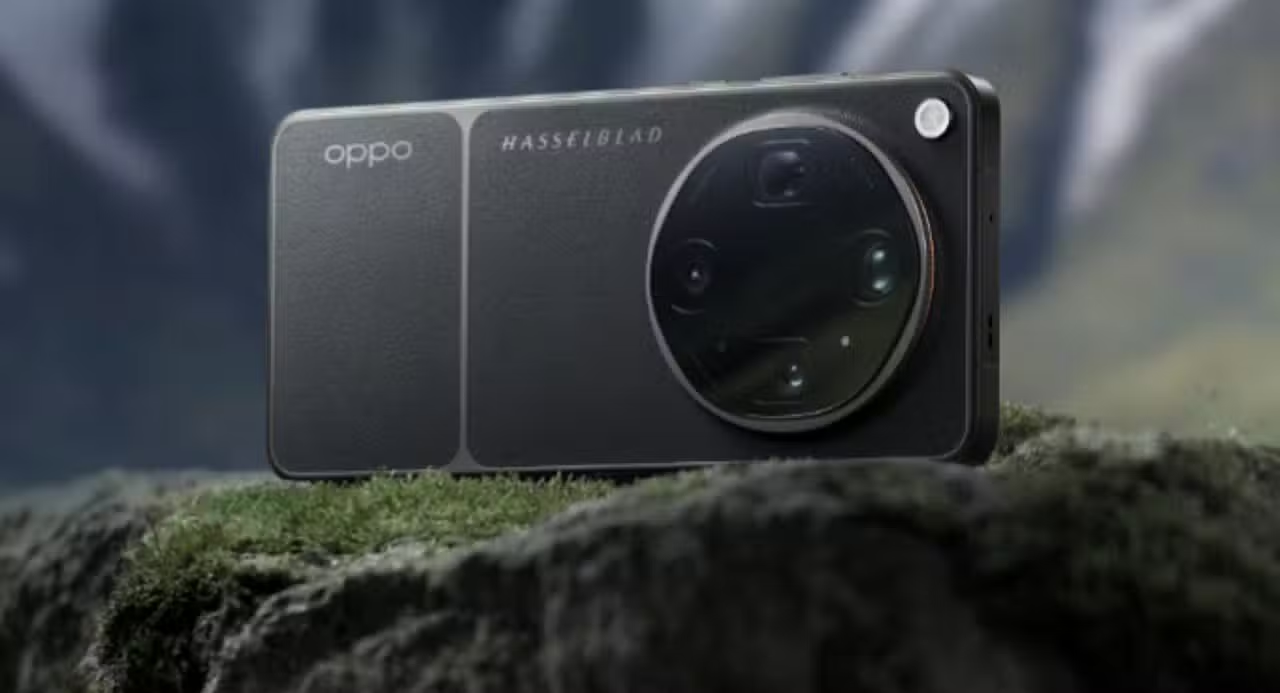
The Oppo Find X9 Ultra appears as a hardware proposal considered excessive by analysts in the technology sector. The device interrupts the cycle of incremental updates by presenting an optical set that combines very high-resolution sensors with approximation capabilities that had been left aside by direct competitors. The strategy puts the brand on a collision course with the top-of-the-line models of the Samsung and Apple, which maintain more cautious approaches to their sensors.
Optical Conjunto features dual 200-megapixel sensors
The device’s great innovation lies in the simultaneous use of two sensors with a resolution of 200 megapixels. Enquanto Most brands only use a high-density main sensor, the Chinese manufacturer decided to apply the technology to the short-range telephoto lens as well. Essa choice allows the user to capture deep details even in three times zoom photos, ensuring sharpness that is often lost on smaller sensors.
The project was developed in partnership with Hasselblad, a renowned Swedish camera manufacturer. The Find X9 Ultra’s complete rear camera system is made up of four distinct lenses:
- Main Câmera with state-of-the-art 200 MP sensor.
- Lente 200MP telephoto with 3x optical zoom for portraits and close-up subjects.
- Lente 50MP periscope with true 10x optical zoom for long distances.
- Lente 50 MP ultrawide for capturing landscapes and wide angles.
Retorno from ten times optical zoom to the flagship market
The launch marks the return of a technical specification that had disappeared from the most recent premium models. Desde o Samsung Galaxy S23 Ultra, launched in 2023, no major global manufacturer had maintained a native ten times optical zoom in their flagship devices. The market trend was to replace it with five-fold lenses with digital cuts to simulate greater ranges.
Essa technical change is significant for mobile photographers seeking versatility without image degradation. By maintaining a dedicated lens for the 10x range, the Find X9 Ultra can deliver photos of distant objects with preserved texture and colors. The design of the camera module on the rear panel reinforces this identity, taking up considerable space to accommodate the physical parts necessary for the movement of the periscopic lenses.

Hardware Estratégia challenges conservatism of Apple and Samsung
The current scenario of mobile technology showed signs of exhaustion in the race for superlative numbers. Apple and Samsung currently focus on integrating artificial intelligence to improve night photos and automatic color corrections. Oppo’s move is seen as an act of commercial rebellion in a market that has become predictable.
Excitement about new releases is often an expensive resource for companies, given the maturity of current products. By offering the most advanced in terms of physical components, the brand tries to attract an enthusiastic audience that is not satisfied with algorithmic improvements alone. The production cost of a system with two 200 MP sensors is high, which should reflect on the product’s price positioning on international shelves.
Integração technological and impact on the consumption of visual content
The processing capacity required to handle files generated by sensors of this magnitude requires a powerful chipset. The Find Essa agility is essential so that the device is not just a technical demonstration, but a functional tool in everyday life.
The device also enhances high-resolution video recording by utilizing optical stabilization of the zoom lens to prevent shake at close-ups. The content creation market for social networks is the main target of this technology. With larger sensors, light input improves drastically, resulting in images with less digital noise even indoors or in poor lighting.