

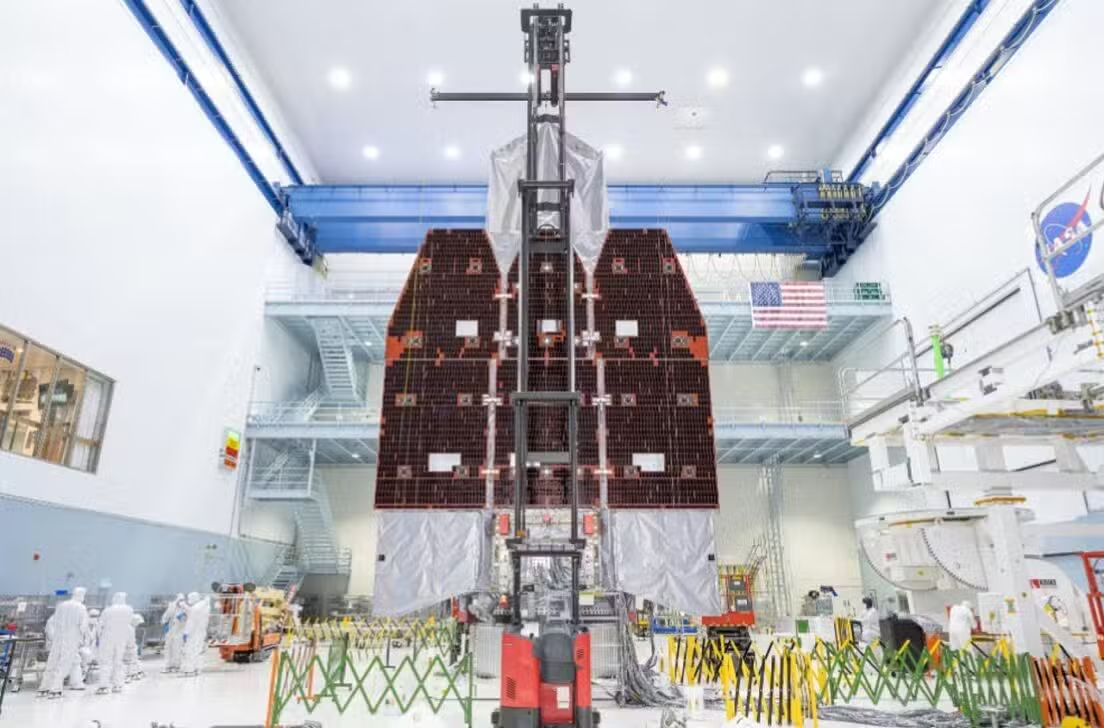
The American space agency has set September 2026 for sending Telescópio Espacial Nancy Grace Roman into space. The billion-dollar equipment has the mission of recording hundreds of millions of galaxies. The original goal predicted takeoff only in May 2027. Advancement of the schedule depends on the success of the final integration tests. Engineers work with a safety margin for any minor unforeseen events.
The observatory cost public coffers around 4 billion dollars. The structure has already been assembled in Centro of Voos Espaciais Goddard, located in the state of Maryland. Transport to the launch site, in Cabo Canaveral, in Flórida, must take place by the month of June of the year of the mission. The rocket will launch from Complexo 39A, at Kennedy Space Center. The base has a long history of large scientific missions.
https://twitter.com/NASAAdmin/status/2046595795583955209?ref_src=twsrc%5Etfw
Capacidade visual capture outperforms equipment in operation
The new astronomical instrument has a field of view considered wide by scientists. A single photograph captured by the system covers an area one hundred times larger than the Hubble telescope can frame at the same instant. Essa feature allows rapid mapping of the cosmos. In just thirty days of operation, the machinery will collect the volume of information that Hubble would take a century to gather. Efficiency changes the dynamics of astronomical research.
High performance results from the combination of a wide-angle camera with infrared light detectors. The system will generate approximately 1.4 terabytes of digital files every twenty-four hours. Project director Julie McEnery calculated the visual aspect ratio of these captures. The researcher explained that displaying a single complete image would require more than half a million televisions with 4K resolution lined up. The visual detail impresses the researchers involved.
The massive volume of records will require the creation of new data processing tools. Researchers will need advanced systems to analyze daily photographs. The total number of files generated during the equipment’s lifetime will easily exceed the 172 terabytes accumulated by the Hubble in three decades of service. Centros research teams around the world are already preparing servers to receive the material.
Metas scientific studies involve expansion of the universe and new worlds
The observatory’s design prioritizes speed in scanning the night sky. Telescopes of previous generations tended to focus on tiny regions of space with extreme resolution. The new model combines the breadth of the image with the depth of the visual range. The equipment will record light from distant objects that traveled through space for billions of years before reaching the lens.
The mission has specific objectives defined by the astrophysics team. The central focus is on understanding the invisible forces that act in the universe.
- The system will monitor the light emitted by thousands of supernovae to measure cosmic distances.
- The sensors must identify more than 100,000 exoplanets using the gravitational microlensing technique.
- The mapping will record the movement of billions of galaxies throughout the history of the universe.
- The main activity time is scheduled for five years, with technical feasibility for extension.
Scientific director Nicky Fox highlighted the scale of the expected discoveries. The statistical survey will help answer questions about the distribution of dark matter. The study of the accelerated expansion of the universe gains a tool capable of observing large portions of visible space in multiple bands of infrared light. The sweep will cover large areas in a period of just two years.
Posicionamento orbital and networking with other observatories
The flight path will place the machinery at a distance of 1.6 million kilometers from the Earth’s surface. The chosen location guarantees a stable observation environment free from interference caused by the planet’s atmosphere. The strategic position makes it easier to maintain the ideal temperature for the infrared sensors to operate without thermal noise. Thermal insulation represents a critical factor for image clarity.
The work will not happen in isolation in deep space. The observatory will integrate a research network alongside two other major agency instruments. Hubble remains in a low orbit around Terra, while James Webb occupies a distant position known as the Lagrange L2 point. Joint action allows the crossing of information captured in different light wavelengths.
Combining data from the three telescopes provides a three-dimensional, multi-frequency view of space phenomena. Astronomers plan to direct equipment at the same targets at specific times. The strategy expands the ability to understand the processes of formation and evolution of galactic structures since the beginnings of the cosmos. The complementarity of the missions strengthens the international astronomy database.
Homenagem to the pioneer of American space astronomy
The telescope’s nomenclature carries the memory of the first woman to hold the position of chief astronomer at the Estados Unidos space agency. Nancy Grace Roman passed away in 2018 and left a history of defending the use of satellites to observe the universe. The scientist led the planning of projects that laid the foundations of modern astronomy outside the Earth’s atmosphere. The name of the equipment recognizes this historical contribution.
Public recognition highlights the importance of the planning work carried out in previous decades. The researcher faced resistance in academia when she proposed the construction of large orbital observatories. The new instrument materializes the scientist’s vision with the application of cutting-edge technologies developed in recent years. The astronomer’s legacy remains active in the agency’s daily operations.
Engineering teams hold weekly follow-up meetings to ensure the current schedule is maintained. The commissioning phase will begin shortly after arrival at the final orbital point. The first scientific data packets should reach ground-based computers a few months after liftoff on Flórida. The global academic community is already developing research proposals to utilize the available observation time.