

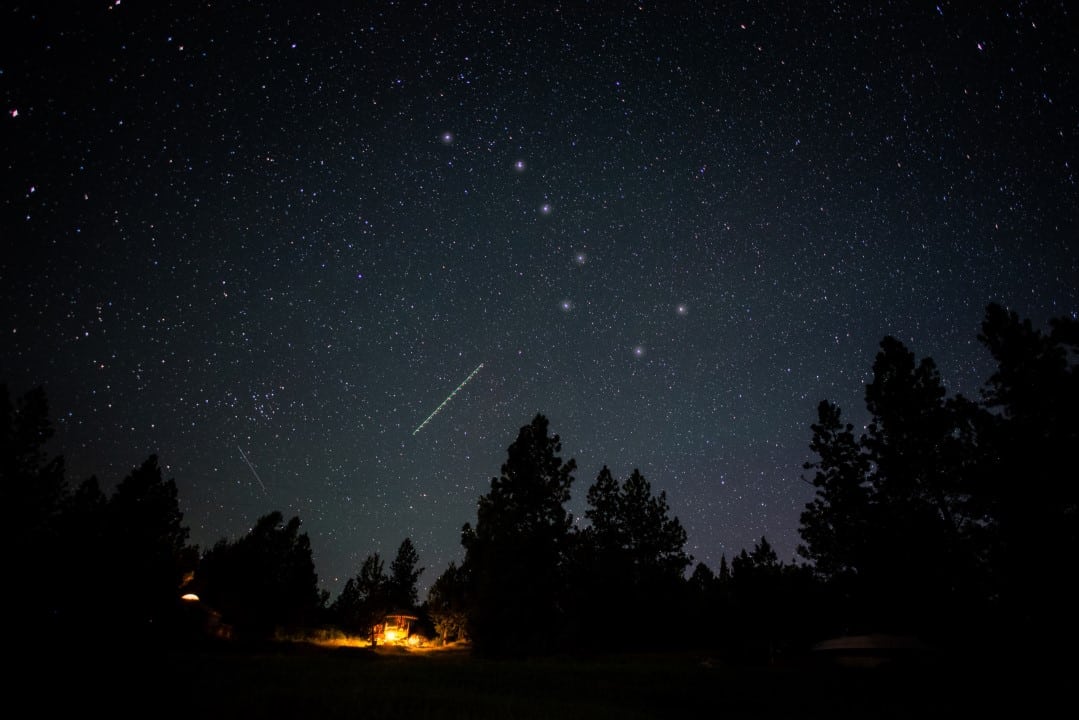
The night sky changes throughout the seasons. Algumas constellations remain visible night after night throughout the year. Outras disappear for months at a time and reappear later. Isso happens because of the movements of Terra.
The planet’s rotation creates the day and night cycle. Quando one side of Terra turns away from Sol, the sky darkens and stars emerge. The annual orbit around Sol, however, makes the biggest difference. The planet moves and points to different regions of space at each time of the year.
In the northern hemisphere, the constellation Órion appears strongly in winter. The belt of three bright stars sits high in the sky. In summer, the same region is on the side of Sol during the day. Sunlight washes out the faint stars and the constellation disappears from night view.
Astrônomos explain that the observer only sees the portion of the universe in the opposite direction to Sol. The tilt of the earth’s axis and translation complete the picture. Diferentes parts of the celestial sphere enter the field of night vision as the months pass.
Circumpolar Constelações never set
Algumas constellations are close to the celestial poles. Elas rotate around the fixed point without crossing the horizon. That’s why they appear every night of the year in certain latitudes.
In the northern hemisphere, Polaris marks almost the north celestial pole. Ursa Maior, with its pan asterism, rotates around it. The constellation remains above the horizon in much of the north of the planet. Observadores at mid-to-high latitudes see stars move but never completely disappear.
The southern hemisphere has fewer options of this type. The south celestial pole is in a region emptier of bright stars. Ainda Thus, Cruzeiro of Sul appears throughout the year in much of the South American territory. Quatro stars form the characteristic cross and have helped with orientation since ancient times.
Visibility depends on the observer’s latitude. At the equator almost no constellations are circumpolar. Quanto closer to the pole, the larger the circle of stars that never disappears. At mid-latitudes, such as Brasil, Cruzeiro of Sul is visible most clear nights.
- Ursa Maior revolves around Polaris in the north
- Cruzeiro of Sul marks the celestial south all year round
- Órion appears and disappears depending on the season
- Posição by Terra determines what appears at night
- Mapas stellars help predict visibility

Localização on the globe defines what each one sees
Observadores in the northern hemisphere see constellations above the celestial equator. Quem is in the south and sees those below that division. Algumas equatorial constellations can appear in both hemispheres at specific times.
Órion, for example, is visible across a large part of the planet. In the southern hemisphere it appears upside down during the local summer. Cinturão, known as Três Marias, serves as an easy reference for those observing the sky.
União Astronômica Internacional recognizes 88 official constellations. Elas cover the entire celestial sphere with defined borders. Interactive digital Mapas allows you to locate any of them according to date, time and geographic position.
Precessão causes slow changes over centuries
The Terra axis oscillates gradually. Esse precession movement lasts about 26 thousand years and changes the position of the constellations over time. Polaris was not always the closest star to the north celestial pole.
Há thousands of years ago, Thuban, from the constellation Draco, occupied this position. Daqui, a few millennia later, another star will take on the role of guide. The zodiacal constellations also change their relative position over the millennia because of this oscillation.
Essas variations are too slow to be noticed in a human lifetime. Elas will be of interest to anyone who studies the history of astronomy or the evolution of celestial coordinates.
Aplicativos and maps make current observation easier
Digital Ferramentas shows exactly which constellations are above the horizon at any given time. The Stellarium, for example, simulates the sky from any location and date. Usuários adjust filters for star magnitude or remove city light pollution.
Observadores amateurs use these resources to plan observation sessions. Quem lives in urban areas and needs dark skies to see fainter constellations. The full Lua also interferes, as it illuminates the sky and reduces the contrast of the stars.
No Brasil, Cruzeiro of Sul serves as a constant reference for those looking south. Outras constellations, like Centauro or parts of Via Láctea, come to prominence on winter or summer nights depending on the region.
Why knowledge helps to understand the universe
Saber the patterns of the sky connect the observer to the movement of the planet. Terra rotates, orbits and oscillates. Cada one of these movements leaves visible marks on what appears above us.
Astrônomos professionals take advantage of specific windows of the year to study distant objects. Quando a constellation is opposite Sol, the night sky is free from sunlight and allows for deeper observations. The center of Via Láctea, in the direction of Sagitário, gains special attention at certain times.
The phenomenon seems simple at first glance. Ele, however, reveals details about Terra’s position in space and how astronomical time is measured. Quem follows the sky night after night and notices the slow rhythm of seasonal changes.
Science continues to refine celestial maps. Novas tools capture data that previously required long nights of manual observation. Ainda thus, the pleasure of recognizing a known constellation remains the same for whoever looks up.