

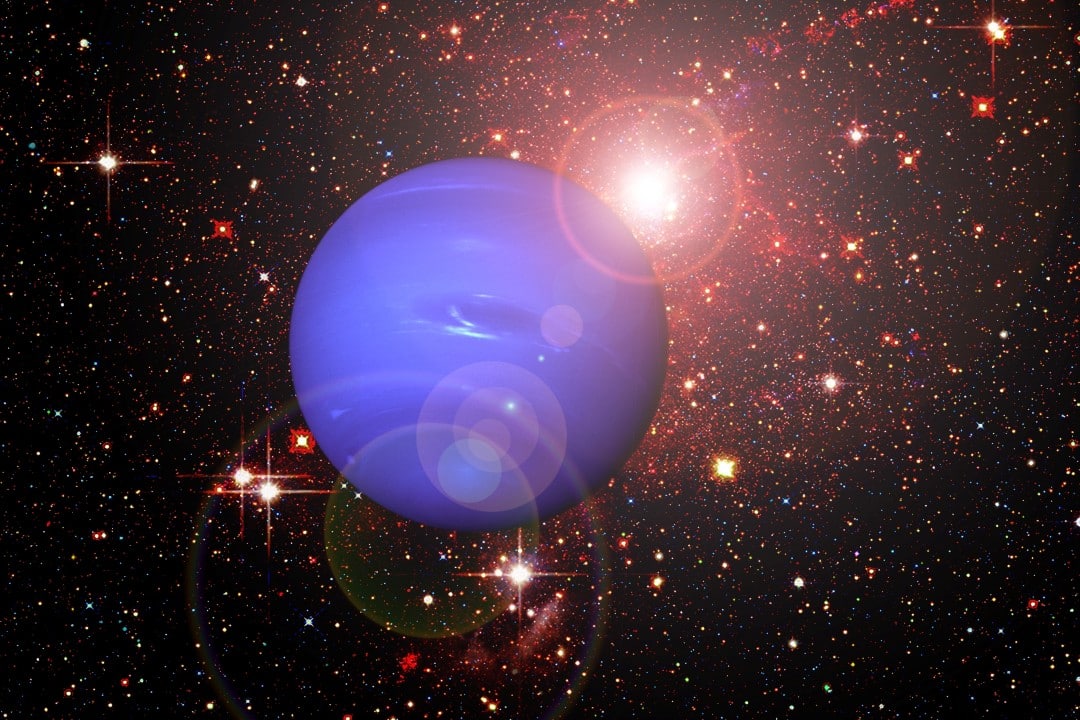
There is evidence that, at the depths of Neptune and Uranus, immense pressure thousands of kilometers deep pulverizes methane, compressing carbon into streams of solid diamond. In 2017, researchers managed to reproduce this exact reaction in a controlled laboratory environment.
Humans have visited Neptune only once, in 1989, during the brief passage of the Voyager 2 spacecraft. Therefore, almost all information about the planet’s interior comes from theoretical physics rather than visual observations. This science points to a scenario that seems straight out of a jeweler’s fantasy: an underground layer where carbon crystallizes and precipitates like pure diamond.
The theory about the existence of these diamonds has been discussed for decades. What marked a recent turning point was the ability of scientists to replicate a small fraction of Neptune’s internal conditions in the laboratory, enabling direct observation of the process.
Why experts were suspicious of the presence of diamonds in ice giants
Neptune and Uranus are classified by astronomers as ice giants, although the term can be a bit misleading. They are not composed of ice as we know it on Earth. Below their hydrogen and helium atmospheres, there is a deep, extremely hot and dense layer made up of water, ammonia and methane. These elements are in states of matter that are not found on our planet.
Methane represents the most abundant component on these planets. Each of its molecules has a carbon atom connected to four hydrogen atoms, and it is precisely methane that gives the blue-green color to both celestial bodies, through the absorption of red light.
As you advance towards the center of the planet, the pressure reaches millions of atmospheres and the temperature rises to thousands of degrees Celsius. In the 1970s and 1980s, theorists such as physicist Marvin Ross of Lawrence Livermore National Laboratory proposed that under such extreme conditions, methane would disintegrate. The released carbon would bond with itself and, at sufficient depths, form diamond crystals. Because diamonds are denser, they would sink, descending toward the core like a type of mineral “snow.”
This was an elegant and well-founded hypothesis. However, for a long time, its experimental verification remained almost unattainable.
Difficulties in simulating the internal conditions of a distant planet
Exploring the interior of Neptune with a sensor is an unfeasible task. The pressures necessary to form a diamond shower exist beneath thousands of kilometers of atmosphere, conditions that would destroy any spacecraft before it even reaches the desired depth. Thus, for decades, the idea of diamond precipitation existed only in computer simulations and academic debates. Although it was a respectable idea, it lacked empirical proof.
The great advance occurred when it was possible to create the relevant conditions in the laboratory and maintain them long enough to record the result, even if for a brief moment.
In 2017, a team of scientists led by physicist Dominik Kraus used the powerful X-ray laser at the SLAC National Accelerator Laboratory in California. The objective was to reproduce the chemical reaction and observe it in action. The results were later published in the prestigious journal Nature Astronomy.

The construction of a “rain” of diamonds in a controlled environment
Interestingly, the research team chose not to use methane directly in the experiment. Instead, they employed a thin layer of regular polystyrene, the plastic found in disposable cups and packaging. The choice was made because polystyrene is composed of hydrogen and carbon, the same crucial elements present in ice giants.
Then, the plastic was hit by a powerful optical laser, generating two shock waves: one fast and one slow. They were synchronized to overlap. At the meeting point, the material was subjected, for a short period, to levels of pressure and heat similar to those found thousands of kilometers inside Neptune.
At that exact moment, the scientists activated the laboratory’s free electron X-ray laser, known as the Linac Coherent Light Source, to pass through the sample. The X-rays worked like an ultrafast camera, recording the arrangement of atoms in the fraction of a second before all the material disintegrated.
The X-ray records were decisive. In the area of overlap, the carbon atoms dissociated from the hydrogen and organized themselves into the characteristic crystalline structure of diamond. As reported by SLAC, almost all of the carbon in the sample was coalesced into tiny diamond structures, some just a few nanometers in diameter, formed in less time than it takes for light to cross a room.
What the experiment confirmed and what still remains in theory
It is essential to be clear about the results, as the popular interpretation of the discovery often simplifies what the experiment actually demonstrated.
The laboratory was unable to observe diamonds falling into the interior of Neptune; This has never been directly witnessed. What the study proved is that the specific chemical step, fundamental to the theory — the decomposition of hydrocarbons under the pressure of an ice giant and the subsequent crystallization of carbon into diamond — actually occurs efficiently in conditions that replicate the environment of these planets. This elevated the idea of ”diamond rain” from a plausible model to a confirmed process within the relevant regime.
The statement that “it rains diamonds on Neptune” is a reasonable deduction based on evidence, but not a direct measurement of the phenomenon. The interiors of these planets are still understood through models, gravitational data and magnetic field readings. There is legitimate scientific debate about the exact temperatures and depth at which this layer of diamonds would form. The experiment considerably reinforced the hypothesis, but did not result in the physical obtaining of a planetary diamond.
Maintaining this distinction is crucial, as it illustrates the difference between reporting a discovery accurately and simply romanticizing it.
Importance of diamonds, even in small sizes
A persistent question lies in whether these were actually diamonds or just small grains. Laboratory-produced diamonds were nanometric in size. Some models suggest that on a real planet, with time and matter in abundance, falling diamonds could clump together, reaching much larger proportions and possibly millions of carats. However, this is a prediction that is still in the field of modeling, without observational proof.
The most fascinating consequence of this hypothesis is in the energetic aspect. As denser diamonds sink toward the planetary core, they release gravitational energy in the form of heat, similar to a stone stirring up water when thrown into a lake. The SLAC team noted that this precipitation could be an additional source of internal heat, one of the mysteries about how ice giants manage to keep their internal temperatures high. The magnitude of this contribution, however, remains a matter of modeling, not direct measurement.
The planets that remain unexplored by humanity
What really stands out in the “diamond rain” narrative is not the diamonds themselves, but rather the limited knowledge we still have about these worlds.
Neptune and Uranus are the only planets in the solar system that have never been orbited by a spacecraft. All of our understanding was compiled from two quick passes of the Voyager probes in the late 1980s, as well as telescopic observations and a vast body of theory. Although the most recent U.S. decadal planetary science survey indicated an orbital probe to Uranus as the priority mission, extensive travel times mean such a probe would not arrive until more than a decade after its launch.
For now, the most concrete information we have about Neptune’s interior was obtained from a fragment of plastic cup, a pair of shock waves and an X-ray pulse, all carried out in a laboratory in California. The diamonds generated in this experiment existed for a very short time before the sample disintegrated. Somewhere beyond our orbit, immersed in darkness and pressure, the same reaction may have been occurring silently for billions of years, without us having witnessed it.