

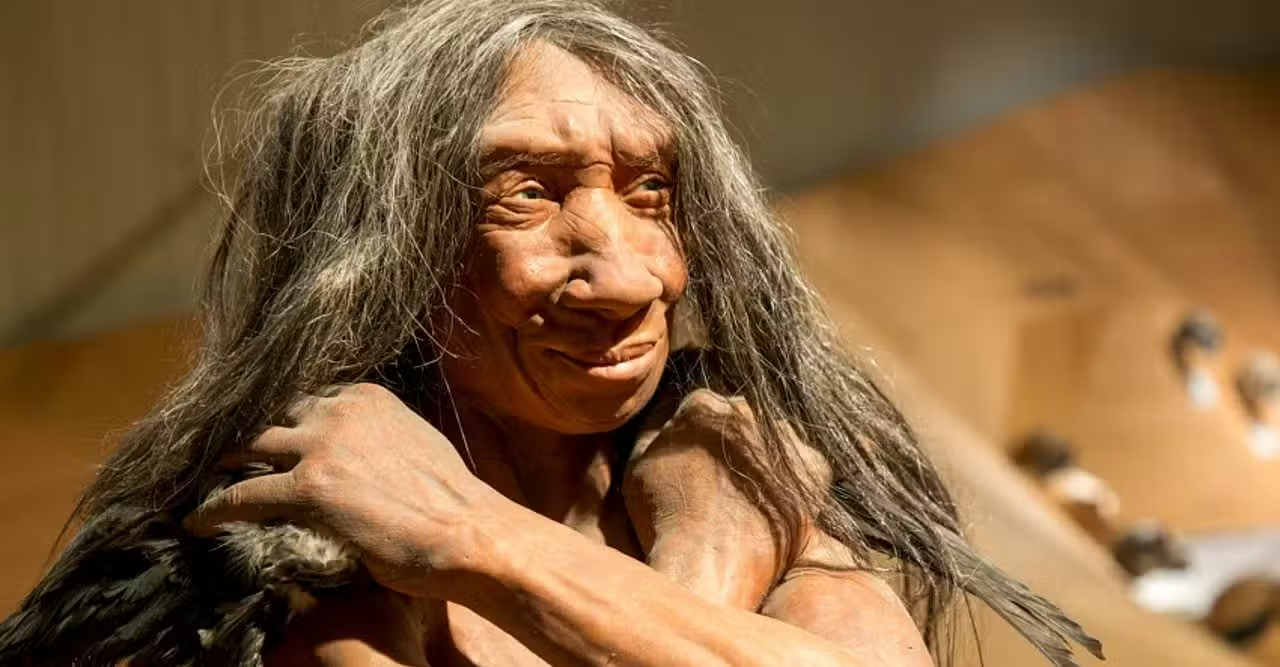
A team of researchers analyzed the most complete skeleton of a Neanderthal baby ever found. The material, from around 51,000 to 56,000 years ago, indicates accelerated physical development in the first months of life. The finding opens new perspectives on how this species adapted to hostile environments during Era from Gelo.
The skeleton, known as Amud 7, came from a cave in the north of Israel, close to the sea of Galileia. Arqueólogos recovered 111 bones in 1992. Só now a detailed 3D reconstruction allowed to accurately estimate age and growth stage.
Caverna of Amud keeps rare record of Neanderthal childhood
Amud’s cave has already yielded other important fossils of the species. Desta instead, the focus fell on a very young individual. The bones include skull fragments, teeth, ribs, arms and legs. Preservation allowed direct comparisons with current human babies.
The researchers measured the length of long bones and cranial volume. Eles also examined growth lines in tooth enamel. The material came from a sedimentary context that helped date the period between 51,000 and 56,000 years ago.
Dentes indicate six months, but body suggests older age
Analysis of the teeth points to an age of around five and a half to six months at the time of death. Apenas two lower incisors had begun to erupt. Esse dental data is considered reliable for estimating age in primates.
On the other hand, the size of the bones in the arms and legs corresponds to that of a modern human child aged 12 to 14 months. The estimated body length is between 70 and 78 centimeters. Brain volume reaches around 880 cubic centimeters, also in line with more advanced development.
- Ossos long, more robust and thicker than expected for dental age
- Crânio large and chinless, typical Neanderthal feature already present
- Clavícula curve and scapula with upward tilt
- Tíbia relatively short, characteristic of the species
Essas marks appear consistently on the skeleton. Elas confirm Neanderthal affinities from the first months.

Crescimento accelerated as a strategy to survive the cold
Scientists propose that the rapid pace of development helped build a larger, more robust body early. Larger Corpos retain heat more efficiently, an advantage in cold climates of Europa and Ásia over Pleistoceno. Energy demand would also be high in the early years.
Comparações with two other Neanderthal infant fossils, one from Síria and one from França, show the same pattern. Accelerated growth appears to be a characteristic of the species in the first years of life. Depois, development curves most closely approximate those of modern humans around the age of seven.
Reconstrução 3D provides unprecedented insight into Neanderthal biology
The team used advanced imaging techniques to virtually assemble the skeleton. Ella Been, of Ono Academic College, in Israel, led the work. Ela highlighted traits such as robust bones, large endocranium and absence of chin, all visible since childhood.
The study, published in the journal Current Biology, reinforces that Neanderthals and modern humans followed distinct evolutionary paths after separating from a common ancestor around 600,000 years ago. Differences appear already in the early stages of development.
Implicações for understanding human evolution
Pesquisadores from several institutions participated in the analysis. The material does not reveal the baby’s sex. Ele also does not indicate the cause of death. The focus was restricted to aspects of growth and morphology.
The find contributes to debates about diet, parental care and energy requirements in prehistory. Bebês Neanderthals probably needed more nutrients from an early age to sustain their growth rate.
A scientific team suggests that Neanderthal babies grew much faster than human babies. The trait likely evolved to survive in hostile environments. The discovery, based on the most comprehensive analysis of an infant Neanderthal skeleton, reinforces profound biological differences between the two lineages.