

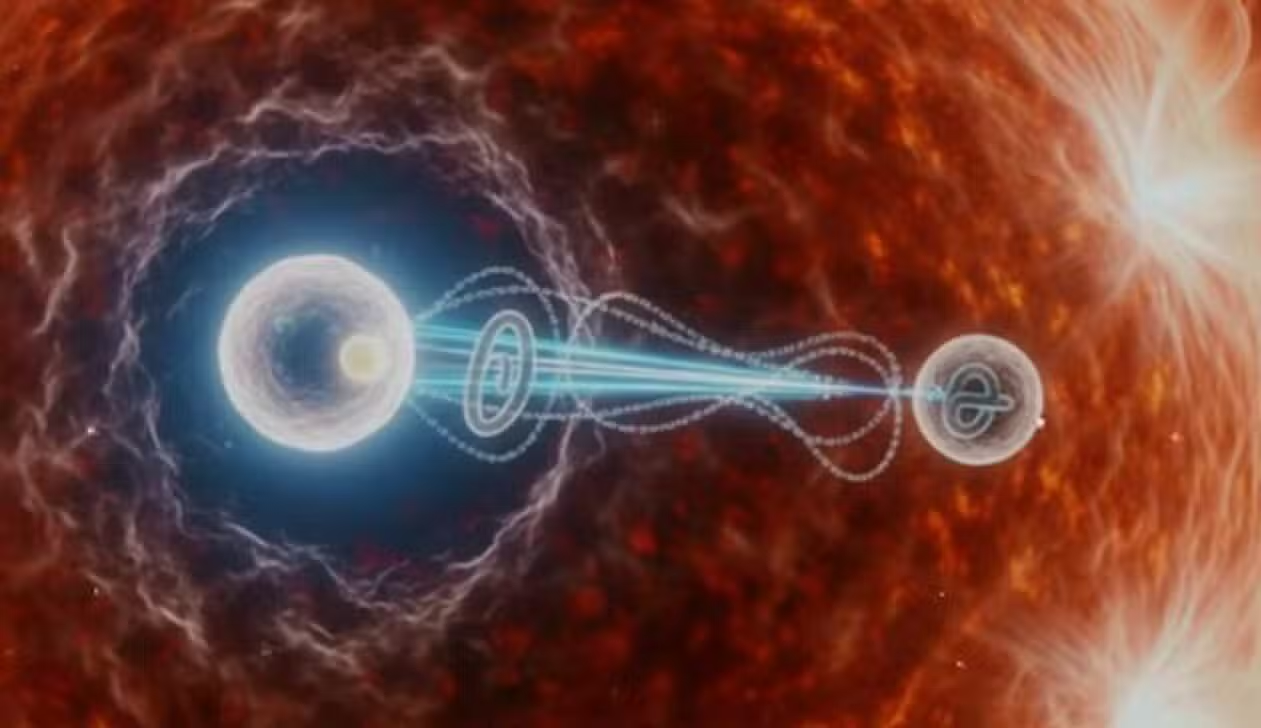
The CMS detector, at CERN’s Grande Colisor, analyzed proton collisions and found no evidence of internal structure in the quarks. The research used data from the LHC’s second phase of operation and tested scales up to 10⁻²⁰ meters. The results reinforce the current model of particle physics.
Quarks form protons and neutrons, which in turn make up ordinary matter. The theory describes them as point particles, with no smaller parts. Previous Experimentoss have already confirmed this view, but the search for deeper layers continues. The new study advances the observation limit.
Rutherford guided current investigation method
The experiment follows the principle used by Ernest Rutherford in 1911. Ele bombarded gold foil with alpha particles and observed scattering angles. Most went straight through, but some ricocheted. Isso revealed the atomic nucleus concentrated in the center.
At the LHC, proton collisions break these protons into quarks. The quarks come out as jets of particles. The CMS measures the distribution of angles between these jets. If quarks had internal structure, the shape of the jets would change at certain energies. The data collected does not show this significant deviation.
The team examined more than a million events. The angle distributions match Modelo Padrão predictions for point particles. Pequenas differences appear in high mass ranges, but fall within statistical and systematic uncertainties.
Análise uses 138 fb⁻¹ of data at 13 TeV
The study is based on collisions at 13 teraelectronvolts. The integrated brightness reaches 138 fb⁻¹. The researchers corrected for detector effects and compared them with perturbative QCD calculations in NNLO order, plus electroweak NLO corrections.
- Distribuições normalized angular angles in various di-jet mass ranges
- Direct Comparação with compound quark scenarios
- Limites in contact interactions between quarks
- Restrições to extra dimensions, quantum black holes and dark matter mediators
The strictest limits so far exclude compound quarks above certain energy scales. In the reference model with left-handed quarks, the limit reaches 37 TeV for constructive interference.
Quarks remain as fundamental blocks
Physics has already gone through several revolutions. Átomos were indivisible until the discovery of the nucleus. Prótons and neutrons appeared elementary until quarks were confirmed in 1968 at SLAC. Agora, the CMS pushes the test to distances a thousand times smaller than the size of the proton.
Mesmo with no sign of substructure, scientists do not rule out possibilities on even smaller scales. The current experiment limits structures larger than 10⁻²⁰ m. Isso is equivalent to about one hundred-thousandth the diameter of a proton.
The result also constrains other phenomena beyond Modelo Padrão. Acoplamentos anomalous gluons, axion-like particles, and dark matter mediators are given tighter limits. The analysis covers several theoretical models in a single publication.
LHC’s Futuro will bring more precision
The third phase of LHC operation is already collecting new data. The HiLumi LHC upgrade, scheduled for 2030, will dramatically increase the collision rate. With more statistics, researchers will reduce uncertainties in measuring the scattering angle.
More accurate Medições could reveal subtle deviations or further confirm the point behavior of quarks. CMS plans to continue the search for signs of new physics in jet distributions.
The ordinary matter around us depends on these particles. Qualquer’s discovery about its composition would affect the understanding of the universe, including issues such as dark matter and unification of forces. For now, quarks maintain their position as elementary particles.
Scientists emphasize that the absence of evidence does not prove definitive absence. Experimentos futures with higher energies or different techniques could explore even smaller distances. The LHC remains the main tool for this frontier.