

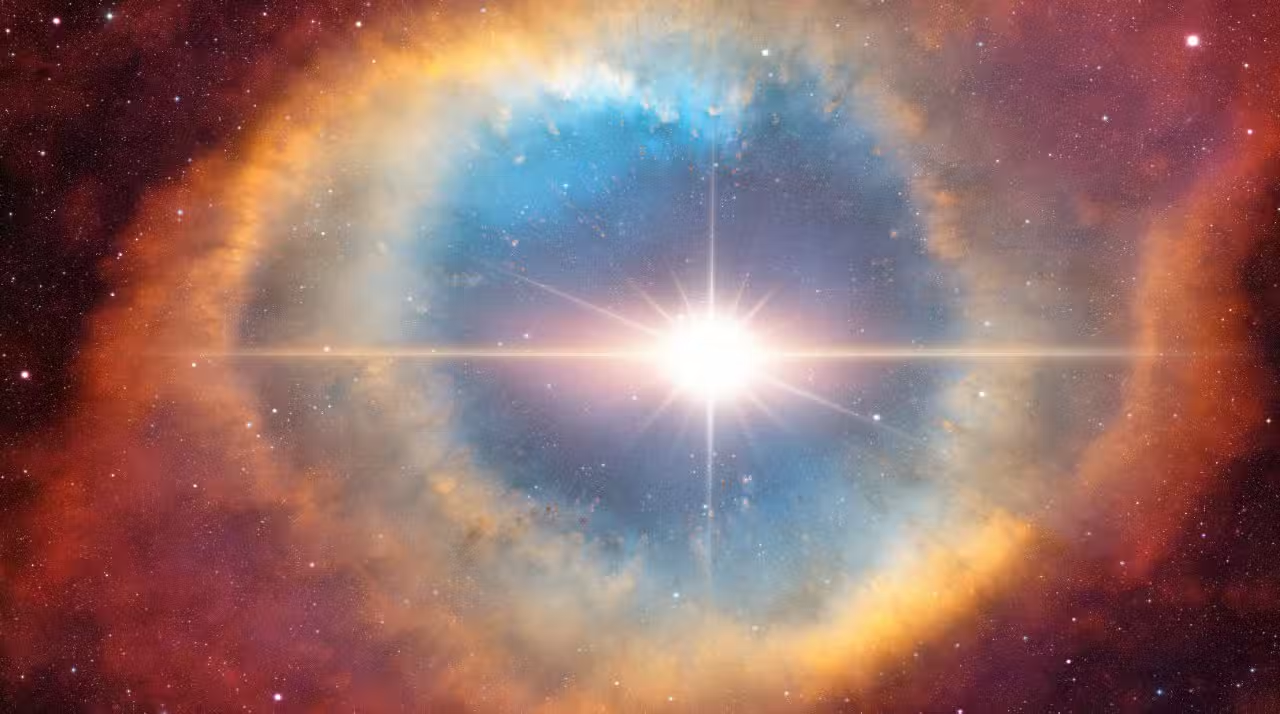
A Japanese amateur astronomer has identified a supernova in the galaxy NGC 5907, located in the constellation Dragão. The celestial object, named SN 2026kid, was detected on April 22, 2026, at 2:24 pm (Tóquio time). The discovery was confirmed as a type II supernova, a classification that indicates the collapse of a massive star and its dense core.
Após subsequent observations, astronomers confirmed the explosive nature of the phenomenon. The supernova reached its estimated maximum brightness between April 24 and 25. Pesquisadores closely monitor the luminosity changes characteristic of this type of cosmic event, which offer valuable data on stellar physics.
Descoberta by experienced observer on Hokkaido
Yasuo Sano, resident of Hokkaido, recorded the object as magnitude 16.6 in his observations. The detection occurred through the Nayoro telescope, a facility dedicated to amateur astronomy. Sano has decades of experience monitoring variables, novae and supernovae in the night sky.
Esta marks the fourth supernova discovered by Sano in its observational career. The previous discovery dates back to October 2005. The astronomer maintains a systematic program of scanning the sky, using professional quality equipment adapted for amateur observations.
- Initial Magnitude recorded at 16.6 on the night of discovery.
- Designação official SN 2026kid assigned by temporary nameserver.
- Espectroscopia performed by the ZTF group confirmed type II features.
- Tipo II indicates core collapse of massive star.
- Curva of light shows typical evolution for this type of stellar explosion.
NGC 5907 as a stage for cosmic events
The galaxy NGC 5907, seen in profile, is located in the constellation Dragão. Astrônomos is known as galaxy Knife-Edge or Splinter Galaxy. The estimated distance is approximately 50 million light years from Terra.
The supernova is visible in the galactic disk region. The images reveal a bright spot close to known structures in the galaxy, helping observers confirm the precise location. The galaxy has a history of explosive stellar events.
NGC 5907 previously recorded the supernova SN 1940A, detected in February 1940. Current records reinforce that the galaxy has the potential to generate recurring explosive events. Essa feature makes it a prime target for continuous monitoring by professional and amateur astronomers.
Confirmação by international observatories
Zwicky Transient Facility provided spectroscopy that confirmed the characteristics of a type II supernova. Outros research groups contributed supplementary data. The light curve reveals a typical pattern of development of the phenomenon.
Astrônomos continues to track the object. Supernovas type II exhibit predictable variations in brightness over time. Rigorous Monitoramento allows us to refine starburst models and validate theories on the evolution of massive stars. Dados collected by multiple observatories accelerates international scientific analysis.
Outras active supernovae in the Dragão constellation
In the same constellation, SN 2026fvx remains visible. The object appeared in the galaxy NGC 4205, classified as type Ia. Seu current brightness lies between magnitude 13 and 14.
Essa supernova type Ia was discovered on March 17, 2026. Observadores was detected quickly after emergence. Astrônomos report ease of observation with medium-sized amateur telescopes. The simultaneous presence of two events in the constellation facilitates comparisons between different types. Tipo Ia originates from binary systems where a white dwarf accumulates companion star material, differing fundamentally from the type II mechanism.
Contribuição essential from amateur watchers
Sano exemplifies the vital role of amateur astronomers in detecting cosmic transients. Muitas supernovae are primarily identified by observers equipped with accessible instruments. Programas and Transient Name Server validate and catalog amateur discoveries. Essa framework accelerates professional confirmation and scientific dissemination.
The discovery reinforces the value of systematic sky observation. Dados of amateurs complement large professional observatories. Colaboração international intensifies scientific analysis. Imagens shared by Sano and colleagues circulates in the global astronomical community, detailing the object against the galactic background. Esses records help disseminate events and education in astronomy.