
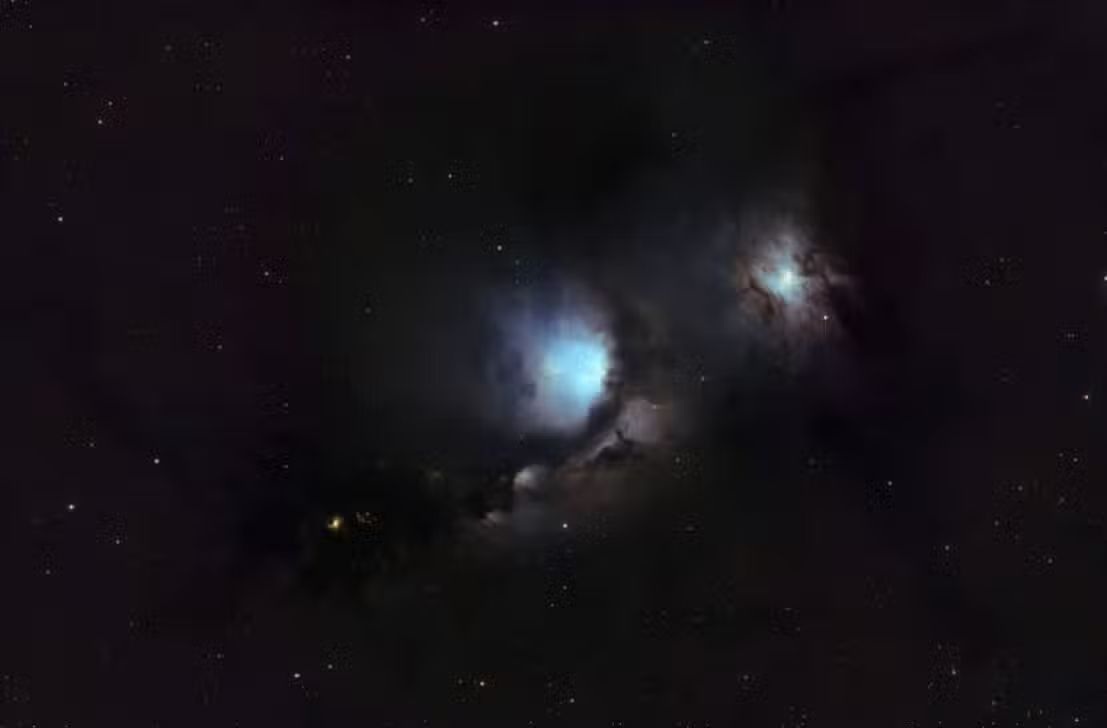
Astronomer Avi Loeb, former director of the Universidade astronomy department of Harvard, has presented an ambitious proposal for the next decade: intercept and collide with interstellar comets detected by Observatório Rubin. The idea is similar to the DART mission that reached the asteroid Dimorphos in 2022, but with much greater scope and potential to reveal the origin of these cosmic visitors.
The proposal arose in the context of recent discoveries. Observatório Rubin, located at Chile and funded by Fundação Nacional of Ciências (NSF) and Departamento of Energia from the USA, is expected to identify dozens of new interstellar objects over the next decade. Esses bodies travel at speeds exceeding 42.1 kilometers per second, enough to escape Sol’s gravitational pull. The 3I/ATLAS object, which passed through Sistema Solar in 2025, reached around 60 kilometers per second — a speed that surpasses that of humanity’s fastest rockets.
The Mysterious Origin of Cosmic Visitors
The detected interstellar objects represent a profound scientific mystery. Conforme The calculations presented by Loeb, progenitor stellar populations generate a new object detectable at less than 5 astronomical units (AU) every two years. Isso implies the existence of approximately ten trillion such bodies in current Sistema Solar, extending as far as Nuvem from Oort, 100 thousand AU away.
The dough involved is equally impressive. 3I/ATLAS carried an estimated minimum mass of 0.1 billion tons. If this proportion is maintained among the trillions of objects, the total mass ejected into interstellar space corresponds to approximately one-sixth of the Earth’s mass per star. Esse’s phenomenal volume of material suggests an origin in planetary formation processes, where icebergs are expelled during gravitational dispersal caused by massive planets or the rupture of bodies by tidal forces.

The unexplained alignment that raises questions
Porém, a detail defies conventional explanations. 3I/ATLAS arrived on a precisely aligned trajectory with just 4.89 degrees of inclination relative to Terra’s orbital plane. Esse alignment is surprising because the ecliptic plane is tilted 60.3 degrees relative to Via Láctea’s stellar disk. If future interstellar objects maintain this preference for ecliptic orientation, the scientific community will need to consider the possibility that these trajectories were not randomly plotted, but rather technologically engineered.
Loeb compares this scenario to the natural pattern of bees clustering around flowers. If interstellar visitors were purposely sent toward Sistema Solar, their abundance near Terra could be much higher than the average observed in the rest of the universe. The implication of this hypothesis is profound: it would be evidence of cosmic intelligence.
Além Furthermore, any superficial analysis would not allow us to distinguish between a natural iceberg and a possible “Interstellar Troia Horse with a technological interior”, in Loeb’s words. The collision would offer the solution.
The interception through impact strategy
The proposed strategy is straightforward: collide with the surface of an interstellar comet. A close-up photograph captured just before impact would reveal details of the object’s nature. Instrumentos aboard the interceptor could analyze the composition of the plume of gas or dust surrounding the body before the collision. Mesmo the object is a natural iceberg, specialized equipment would check for biological signatures or basic components of life, such as organic molecules.
Essa approach opens a completely new avenue for astrobiology in the search for life beyond Terra. Diferente than other space exploration strategies would not require journeys of billions of years, the interstellar objects themselves have already invested that time to get here.
The speed of a current-technology rocket-powered interceptor, approximately 10 kilometers per second, could reach objects on a collision course. 3I/ATLAS was detected 3.5 AU from Terra on July 1, 2025, and reached its closest point at 1.8 AU on December 19, nearly six months later. If 4I/Rubin is detected at 10 AU and takes a year to reach 2 AU, a ground launch at reasonable speed could intercept its trajectory.
The technical and financial challenges of the mission
The project is not simple. Colidir with the rigid surface of a possible alien spacecraft would pose completely different challenges than those faced by the DART mission. Meticulous Planejamento, fast response time and early detection capability would be critical.
Loeb estimates that the total cost of the mission would be around one billion dollars. Para context, the DART mission, less ambitious than this proposal, cost a third of that amount. Apesar of the robust investment required, the scientific potential would justify the commitment.
Agência Espacial Europeia (ESA) is already investigating similar approaches. Sua mission “Comet Interceptor”, scheduled to launch in 2029, will position a spacecraft at the second point of Lagrange Terra-Sol (L2). The spacecraft will wait up to three years for a long-period comet or interstellar object to pass by. Contudo, this approach has limitations. The spacecraft will only be able to maneuver at speeds of up to 1 kilometer per second, the equivalent of traveling 1 AU in about 5 years. Sem extraordinary luck for a visitor to pass extremely close, the time available between detection and encounter would be insufficient.
The Call for NASA and Space Entrepreneurs
Loeb considers that NASA could achieve better results with greater investment and planning. Sua proposal is not just aimed at traditional government agencies. The astronomer specifically mentions Jared Isaacman, an entrepreneur and space exploration enthusiast known for financing and personally participating in private space missions.
Isaacman has already demonstrated a willingness to invest in ambitious cosmic adventures. An interstellar comet interception mission would align with its previous interests in expanding human exploration capabilities beyond Terra’s low orbits.
The next decade will be decisive. Observatório Rubin will begin detecting interstellar visitors. Cada discovery will represent a small but real time window for action. The necessary rockets and technologies already exist. What is missing is political will, private capital and international coordination to turn this proposal into reality.
If executed successfully, an interception mission would reveal whether the universe is sending us ambassadors of nature or something radically different.