

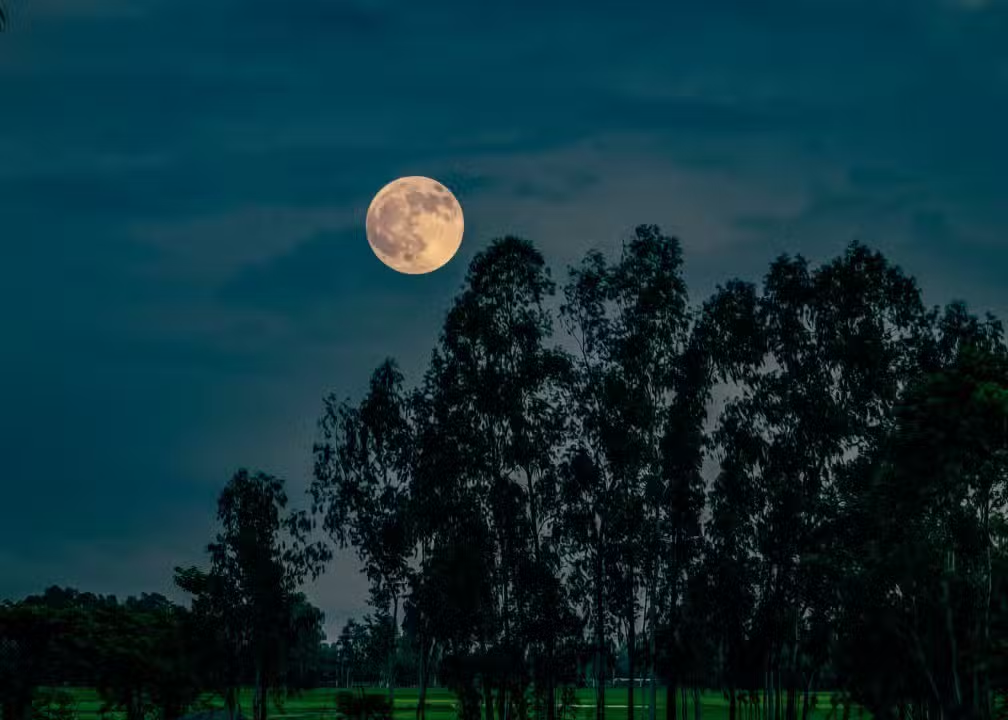
A celestial spectacle marks the next few days. Lua of Flores, the traditional name for the full moon in May, shines with particularly high intensity and displays a notable orange color. The phenomenon results from the lunar position in relation to Terra and Sol, creating specific optical conditions that intensify warm tones on the natural satellite.
The orange hue occurs when sunlight passes through the Earth’s atmosphere before reaching Lua. Esse effect, known as Rayleigh dispersion, filters out blue wavelengths and allows reddish and orange tones to predominate. The intensity depends on factors such as the observer’s altitude, local atmospheric conditions and light pollution.

Melhor observation period
Optimal viewing occurs within a few hours of sunset or before sunrise. Nestes moments, the satellite is closer to the horizon, where the Earth’s atmosphere is thicker. Não special equipment is required to appreciate the phenomenon, naked eye observation provides satisfactory experience.
Habitantes from regions with less light pollution, such as rural and mountain areas, will enjoy superior visibility. Large Cidades tend to present reduced visual quality due to excessive artificial lighting and suspended particles. Ainda so, even in urban centers, the event remains visible on clear nights.
Constelação from Ursa Maior highlighted
Simultaneamente to the brightness of Lua of Flores, the constellation of Ursa Maior reaches high position in the night sky during this period. The setup offers a unique opportunity for novice observers to locate celestial landmarks. Ursa Maior works as a natural astronomical compass, its seven main stars form a recognizable pattern and direct the gaze towards Estrela Polar.
Ursa Maior remains visible for most of the year in the Northern Hemisphere. Seu peak visibility occurs when it reaches maximum height above the horizon. Durante May, this elevation coincides with the best post-spring nighttime dark conditions in the Northern Hemisphere. Observadores from the southern hemisphere experience lower angular altitude, but can still be seen depending on latitude.
Fenômenos complementary lunars
Outras features accompany Lua from Flores this week. The satellite’s brightness significantly reduces the visibility of smaller celestial bodies, a phenomenon called lunar extinction. Astrônomos Amateurs who observe galaxies, nebulae, and star clusters generally avoid periods of full moon for this reason.
The distance between Terra and Lua varies approximately 50 thousand kilometers throughout their elliptical orbit. Quando to Lua reaches the closest point, the so-called supermoon occurs. The Lua of this year’s Flores is close to its average distance, providing moderate apparent size. Mesmo thus, the absolute brightness remains impressive.
Contexto historical and cultural
Antigas civilizations named each full moon after natural events in the corresponding month. The name “Lua das Flores” refers to the intense spring blooming in the northern hemisphere during May. Povos Native Americans used this naming system to mark periods of planting, harvesting, and subsistence activities.
The tradition persists in contemporary astronomical communities and among enthusiasts of celestial phenomena. Cada name carries meaning linked to the seasonal cycle or biological characteristics of the period. Outras full moons of the year are given names such as Lua from Lobo (January), Lua from Mel (June), and Lua from Caçador (October).
Dicas practices for observers
- ideal Localização: move away from big cities and seek natural elevations
- Timing: observe between 9 and 11 pm or between 5 and 7 am
- Equipamento: binoculars increase detail, but naked eye provides comprehensive view
- Fotografia: Smartphone cameras capture hue with manual exposure adjustment
- Acompanhantes: astronomical applications on cell phones identify constellations and stars
Próximos astronomical events
Outras celestial occurrences are predicted for the coming months. The astronomical calendar includes eclipses, meteor showers and planetary alignments. Observadores that accompany Lua of Flores often develop interest in amateur astronomers as an ongoing hobby.
Local weather conditions directly influence the quality of the observation. Verificar forecasts of cloudiness and air humidity in advance increases the chances of success. Muitas regions face cloudy periods during this time of year, planning is essential to make the most of the opportunity.