

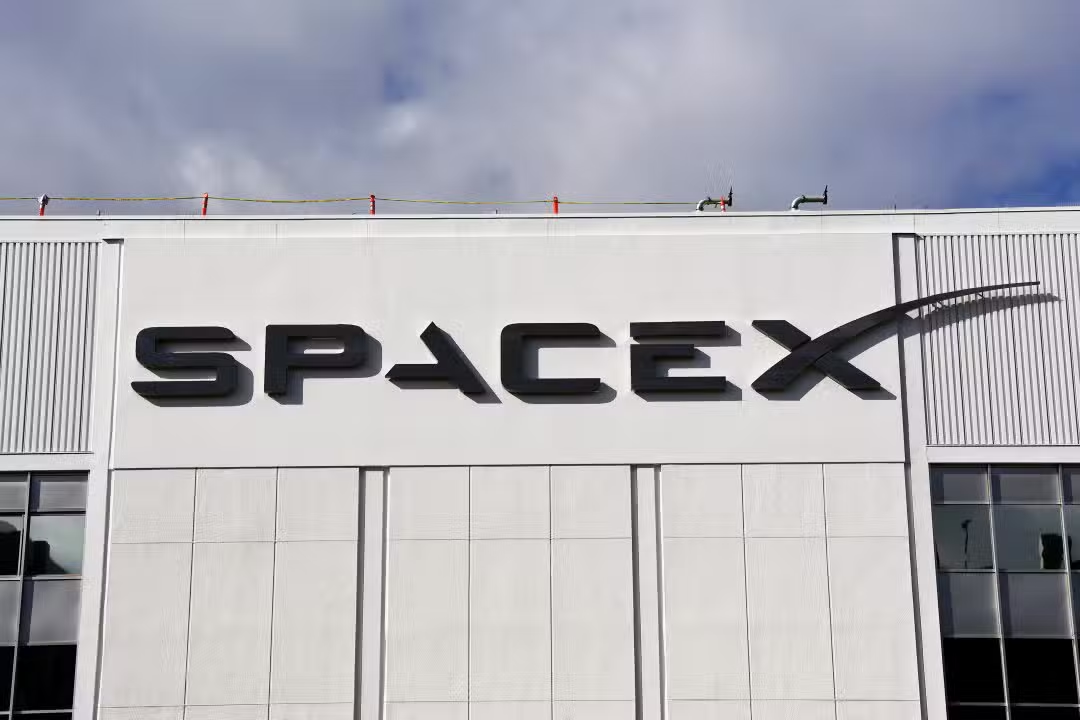
The public offering of shares by SpaceX, Elon Musk’s space exploration company, could cause a significant change in the technology investment scenario. The estimated valuation reaches US$1.75 trillion, equivalent to approximately R$8.78 billion, making this the largest IPO in history. Para Tesla, the risk is considerable: investors who were waiting for their projects to come to fruition may migrate to more tangible and stable alternatives.
The situation reflects a structural problem faced by Tesla. The company anticipates that new businesses in artificial intelligence and robotics will contribute significantly to its profits in the future, but traditional businesses are slowing down. Investidores who believed in Musk now consider SpaceX as a more concrete opportunity with less uncertainty, in contrast to the automaker’s yet-to-be-fulfilled promises.

SpaceX as a more attractive alternative
Sob under the leadership of CEO Gwynne Shotwell, SpaceX operates in a stable and predictable manner. The company has consolidated its position as an essential provider of space services, with few direct competitors in the market. Este’s operating performance contrasts sharply with Tesla, which faces uncertainty about its future results as reported in its quarterly releases.
Garry Kasparov, CEO and investor in both companies, made his position on the topic clear. Segundo he, many Tesla investors consider SpaceX a superior investment option for varying reasons. With more than $40 billion in capital under management, Kasparov stated that “a number of Tesla investors believe SpaceX represents a better opportunity.” The interpretation is that the sale of Tesla shares may occur to finance stakes in SpaceX, a company with real growth prospects and tangible benefits.
- SpaceX already generates proven revenue through its satellite launch and Estação Espacial Internacional fueling services.
- Tesla faces challenges in consolidating its AI and robotics businesses, which have yet to generate significant profits.
- Investidores look for companies with established business models that are less dependent on future promises.
Tesla faces pressure in the electric vehicle segment
Tesla’s balance sheet for the first quarter of 2025 highlights the challenges the automaker faces. Net revenue reached US$4.77 billion, representing growth of 16% compared to the previous year. Contudo, this performance was significantly below the previous quarter. In the period from October to December 2024, the company had reported profits of US$8.44 billion.
Gross revenue fell to US$2.24 billion, also representing a drop in relation to previous periods. The battery division, which performed well last year, shrank 12% in the first and fourth quarters. Estes numbers clearly illustrate the difficulty faced. Tesla has built its reputation and valuation on selling electric vehicles, a business that now faces global pressure. Esta transformation is not optional, but necessary for the company’s survival.
Negócios futures still lack profitability
Tesla’s two main projects do not contribute significantly to current profits. The autonomous taxi service mainly operates on Texas on a small scale and does not yet generate reported revenue. Da Likewise, the humanoid robot “Optimus”, announced as an important source of future earnings, remains far from profitability.
The company plans to invest at least US$250 billion, equivalent to R$1.25 trillion, in artificial intelligence and robotics. Este amount reflects the ambition of the projects. Porém, for investors, represents a future commitment and not a present return. Tesla dedicates significant resources to technologies that can take years to generate profits, while demanding patience from shareholders. Neste waiting context, SpaceX offers a different proposal: already proven results and prospects for immediate growth.
Stock Desempenho reflects market uncertainty
The market is already showing concern. Tesla shares fell 3.6% on April 23, 2025, closing at $373.72. Accumulated losses this year reach 17%. Esta’s trajectory contrasts with the frequently touted optimistic outlook. Tesla works to justify its current valuation, while SpaceX is seen as having significant growth potential.
Future competition is not necessarily the main problem. Chinese electric vehicle Fabricantes and growing global demand for EVs present real but manageable challenges. The real risk for Tesla lies in its own portfolio: investors may choose SpaceX as an alternative within Musk’s portfolio. Para the company, the challenge is to demonstrate that its investments in AI and robotics will generate substantial returns before capital is redirected to more immediate opportunities.
Enterprise Transition Contexto
Tesla has always been a company in transition. Começou as a luxury car manufacturer and has evolved into a smart mobility business focusing on autonomous technology. Este process requires time. Porém, the market does not offer unlimited patience. Investidores need clear signs of progress and tangible milestones of value.
SpaceX presents a different narrative. The company already generates profits, operates on a commercial scale and continually expands its market. The SpaceX IPO offers investors a method to participate in the future growth of an already established business. Para many, this represents a more attractive option than waiting for Tesla robots to finally hit the market.