

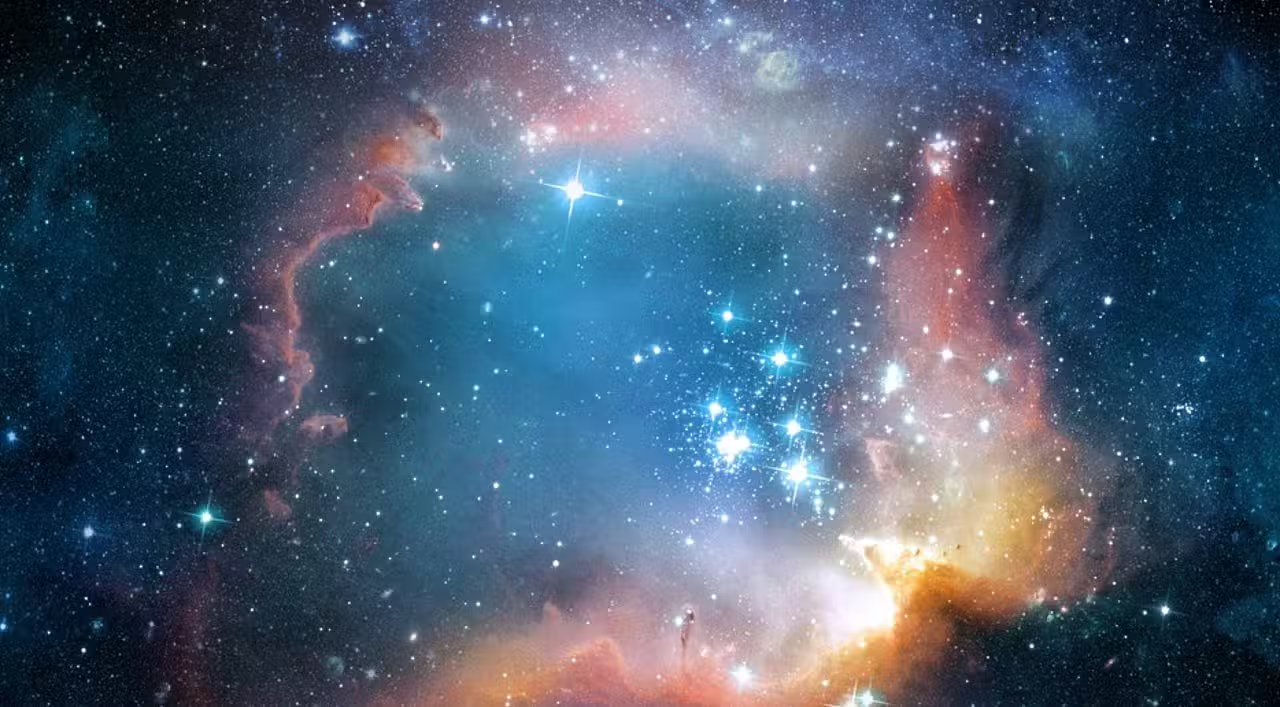
Astrônomos used a specialized telescope to detect galaxies located tens of billions of light years away, offering a unique window into the early universe. Essas observations allow scientists to understand how the cosmos formed in its early stages, revealing structures that remained invisible to conventional instruments. Segundo estimates, the observable universe contains more than a billion galaxies, but most of them remain beyond the reach of current technology.
The detection of distant cosmic objects
Para captures light from galaxies so remote, researchers don’t rely solely on optical visibility. It is necessary to analyze the electromagnetic spectrum at its multiple wave frequencies, combining data of different lengths to reconstruct a complete picture. Essa multidisciplinary approach allows us to identify structures that a single instrument would never be able to reveal in isolation.
The universe emits radiation at different wavelengths. Very high-energy regions tend to produce ultraviolet radiation and X-rays, while colder structures, such as gas and dust, manifest their presence through infrared radiation and radio waves. Essa spectral diversity is essential for astronomers specialized in different areas to be able to completely map a distant celestial object.
Como scientists identify early galaxies
Observar the universe at different wavelengths is essential for locating structures that would otherwise remain hidden. Conventional Instrumentos often fail to detect extremely old objects because their light is redshifted, a phenomenon caused by the expansion of the universe. Conforme the cosmos expands, the light emitted billions of years ago undergoes lengthening in its waveform, moving to redder frequencies of the visible spectrum.
- Radio Ondas reveals the energetic structure of early galaxies
- Infrared Radiação detects objects with lower temperatures and older compositions
- Raios X maps the most active and violent regions of the distant universe
- Microondas allows you to study the cosmic radiation background and the thermal history of the cosmos
- Análise spectroscopic identifies chemical elements and precise distances
Spectroscopy as a cosmic investigation tool
Quando astronomers analyze the light captured by telescopes, using spectroscopy techniques to reveal the characteristics of distant galaxies. Esse method breaks down radiation into its fundamental components, allowing you to identify the exact chemical composition and accurately estimate the distance to the observed object. The technique works because each chemical element absorbs and emits light at specific wavelengths, creating a unique identifiable pattern.
Quando scientists analyze the spectrum of a remote galaxy and are able to determine which chemical elements are present in it. The position of spectral lines in the infrared or visible spectrum reveals information about the composition of the galaxy, while the displacement of these lines indicates how long it took the light to reach us. Esse red shift allows you to accurately calculate the distance between Terra and that galaxy, transforming optical observations into precise cosmological measurements.
Why studying the early universe matters for science
The ability to observe extremely old galaxies offers astronomers a unique perspective on cosmic history. Quando If we observe objects billions of light years away, we are actually seeing the universe as it was billions of years ago, because light takes time to travel through space. Essa physical reality transforms every astronomical observation into a trip to the past.
The closest star to our solar system, Alfa Centauri, is located approximately 4.37 light years away, which means that its light takes 4.37 years to reach here. Quando we observe this star, we see what it was like 4.37 years ago. Astrônomos that point telescopes at galaxies tens of billions of light-years away are, in effect, observing the universe as it existed tens of billions of years in the past, capturing a visual record of the cosmos in its first billion years of existence.
Galáxias observed from a hundred billion light years away reveals structures of the early universe, showing how the first cosmic structures formed and evolved. Essas observations allow scientists to reconstruct the complete history of cosmic evolution, from the birth of the universe to the present, offering an unparalleled historical record of the formation and development of galactic structures over time.