

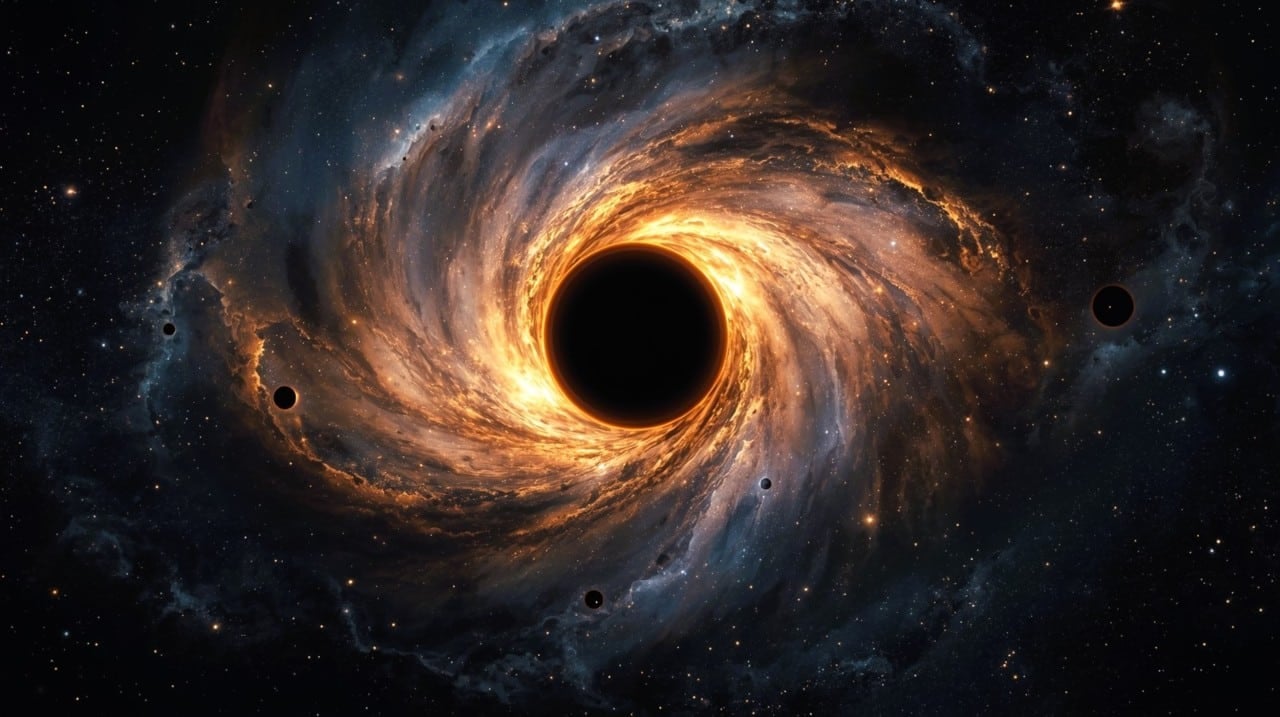
A new scientific hypothesis suggests that a form of energy associated with dark matter could have accelerated the emergence of the universe’s first black holes. The model offers a solution to one of the biggest puzzles in modern cosmology: how such massive structures formed so quickly after Big Bang, at a time when there was little cosmic time available for their development.
Pesquisadores point out that supermassive black holes detected in distant galaxies have existed since very ancient periods of the cosmos. Essa’s finding contradicts the predictions of conventional formation models, which indicate much slower growth through continuous accretion of matter. The central question remained: how did these objects reach masses billions of times greater than that of Sol in less than a billion years after the origin of the universe?

Invisible Mecanismo and its interaction with gravitational collapses
Invisible energy derived from dark matter would act as a catalyst in the early stages of the universe, changing the conditions necessary for gas clouds to collapse into compact structures. Diferentemente of ordinary matter, which interacts through electromagnetic forces and collisions, this energy would remain practically indivisible, acting gravitationally in primordial environments.
The proposed mechanism involves a redistribution of density in specific regions of the early cosmos. Computações numerical figures indicate that small initial fluctuations, amplified by the presence of this energetic form, could generate concentrations of mass sufficient to trigger gravitational collapses. Esses events would occur on a much shorter time scale than that required in scenarios without this additional component.
The speed of formation would increase significantly because dark energy would have reduced the resistance offered by radiation pressure, allowing primordial clouds to condense more efficiently. Dados observations from infrared telescopes and radio telescopes show clusters of black holes at times where conventional theory could not explain them.
Observações of ancient black holes and their implications
Detectores spacecraft have identified black holes with masses between one million and ten billion times that of Sol at redshifts greater than seven, corresponding to less than 700 million years after Big Bang. Essas findings, confirmed by multiple observation campaigns, find no satisfactory explanation in models that rely only on massive star collapse and subsequent merger.
Observações carried out over the last two decades revealed that virtually every massive galaxy harbors a supermassive black hole at its core. The correlation between the mass of the central black hole and the velocity dispersion of the host stars suggests a fundamental connection between the formation of these objects and the evolution of galaxies.
Levantamentos spectrographics indicate that many of these ancient black holes grow through mergers of smaller objects and continuous accretion. Porém, the time available would be insufficient to explain the masses observed through these isolated processes.
Previsões testable and future observations
- Detecção of gravitational signatures of intermediate-mass black holes in globular clusters
- Mapeamento of dark matter distribution around primordial black holes
- Análise of radiation spectra in ultraviolet bands of early galaxies
- Confirmação of elevated merger rates between black holes in the first billion cosmic years
- Observações of relativistic jets in active cores of distant galaxies
The next generation of telescopes, including high spatial resolution infrared, will provide more precise data on the density and distribution of matter in extremely remote cosmological epochs. Simulações computational supercomputers are being refined to incorporate different models of dark energy and test their observational consequences.
Consenso scientific and open challenges
The scientific community recognizes that alternative models deserve rigorous investigation. Enquanto Some research institutions prioritize modifications in the theory of gravity on cosmological scales, others explore scenarios where yet unidentified components of dark matter play determining roles.
Colaborações international astronomy experts expand observation networks to systematically map black holes in different cosmic epochs. Instituições in América of Norte, Europa and Ásia focus efforts on analyzing data obtained by satellites and ground-based telescopes.
Validation of the hypothesis will depend on consistency between theoretical predictions and increasingly refined observations. Estudos statistics on populations of primordial black holes will offer direct tests of the energetic hypothesis. Paralelamente, precise measurements of gravitational fields in regions of primordial formation can provide indirect evidence about the nature of this invisible component.