

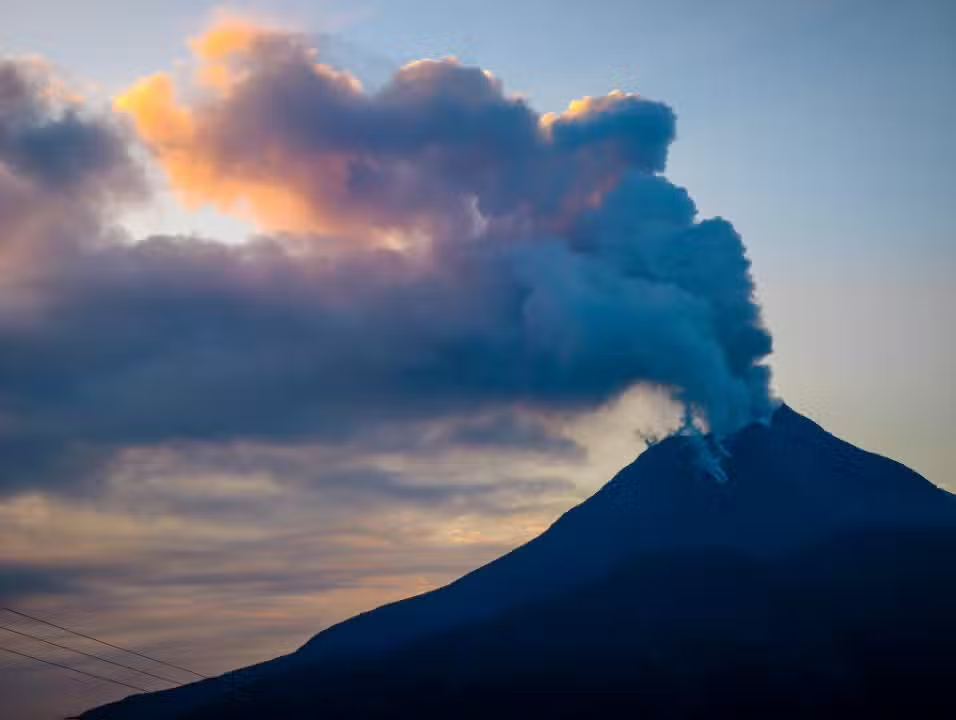
The Monte Mayon volcano, located in the province of Albay, in Filipinas, began an eruption process this Monday morning. The volcanic activity sent columns of ash and smoke hundreds of meters high into the atmosphere. Local Autoridades raised the alert level and ordered the displacement of communities living in the danger zone. The Instituto Filipino of Vulcanologia and Sismologia monitors the emission of pyroclastic flows. Rescue Equipes works to ensure that no one stays in government-defined exclusion zones.
Atividade seismic and lava emission at Monte Mayon
Technical monitoring identified a sudden increase in earthquakes in the vicinity of the main crater before the first leak of incandescent material. Especialistas explain that Monte Mayon is known for its perfect cone shape and for being one of the most active volcanoes in the Philippine archipelago. The lava flow began to flow down the slopes, destroying undergrowth in uninhabited areas. Visibility in the region was compromised due to the dense layer of ash that spreads depending on the direction of the wind.
Diferentes security measures have been adopted by the disaster management council:
- Estabelecimento from a six-kilometer permanent danger zone.
- Immediate Suspensão of flights crossing the airspace of Albay province.
- Distribuição of respiratory protection masks for the affected population.
- Montagem of temporary shelters in schools and gyms far from the base.
- Monitoramento constant of possible volcanic mudslides, called lahars.
The authorities’ biggest concern is the possibility of a more violent explosion in the coming hours. Monte Mayon’s history records fatal flares that occurred following signals similar to those currently observed. Cientistas uses drones and ground sensors to measure soil deformation and sulfur dioxide concentration. Esses data is critical to predicting the magnitude of the event.
https://twitter.com/volcaholic1/status/2050517661969203477?ref_src=twsrc%5Etfw
Mass Evacuação hits Albay province
Milhares of families were transported in military trucks and government vehicles to safe areas outside the risk perimeter. The Philippine army assisted with logistics, prioritizing the elderly, children and pregnant women living in agricultural villages. Agriculture, the region’s economic base, suffers direct losses due to the contamination of plantations by acid ash. Muitos rural producers tried to resist leaving to protect their livestock, but were prevented by local police for security reasons.
The Philippine government declared a state of calamity in nearby cities to facilitate access to emergency funds. Recursos funds are being directed to purchasing food and drinking water for evacuation centers. The weather forecast indicates scattered rains, which increases the risk of volcanic sediments being carried into rivers. If this occurs, the province’s bridges and roads could suffer severe structural damage, isolating entire communities.
Histórico of eruptions and geological impacts on the archipelago
As Filipinas are located in the so-called Círculo of Fogo of Pacífico, an area with intense seismic and volcanic activity in the world. Monte Mayon has erupted more than 50 times in the last four centuries, the most lethal being in 1814. On Naquela, the city of Cagsawa was buried, with only the church tower remaining as a historic landmark. In more recent eruptions, such as the one in 2018, the movement of people lasted months until the volcano fully stabilized.
Especialistas in geology state that the internal structure of Mayon is under strong magmatic pressure. The accumulation of gases can generate lateral or vertical explosions without prolonged warning. The network of observatories remains on call 24 hours a day to issue bulletins regarding each change in the mountain’s behavior. Tourism, which usually attracts climbers and photographers to the region, has been completely blocked for an indefinite period.
Assistência humanitarian and federal government response
The president of Filipinas stated that the total priority is the preservation of human life and support for the homeless. Ministérios from health and social welfare coordinates the arrival of medical supplies to treat respiratory problems caused by volcanic dust. Voluntários from non-governmental organizations also help organize food queues. Cooperation between the municipal and federal spheres has been crucial to avoid chaos in Albay.
Schools suspended face-to-face classes throughout the volcano’s zone of influence. Professores were instructed to use digital platforms while school buildings serve as a refuge. The electricity system suffered preventive cuts in some districts to avoid fires caused by possible fallen poles. Full recovery of affected areas will only begin when the alert level is reduced to safe levels.