

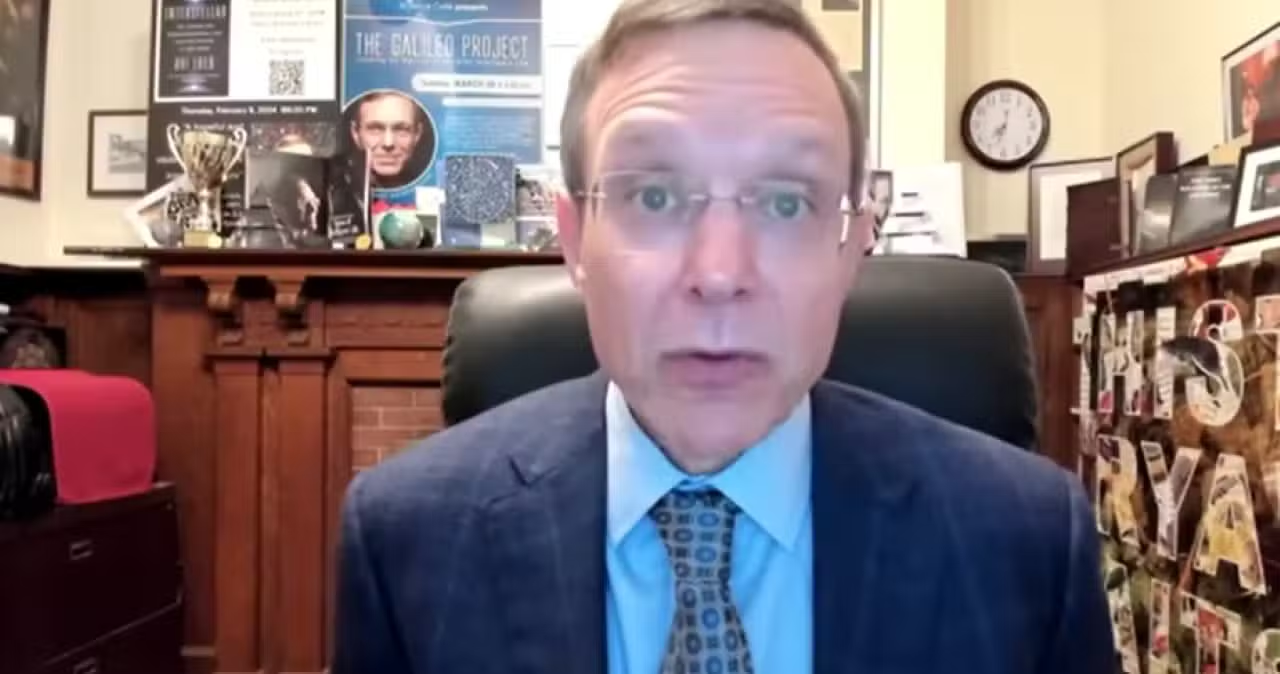
A renowned astrophysics researcher raises the possibility that the vacuum of space could be explored as a source of energy to propel ships without the need for conventional fuel. The hypothesis challenges established paradigms in classical physics and opens debate about propulsive technologies of the future. The concept, based on quantum properties of the vacuum, suggests that energy can be extracted seemingly from nothing. Essa approach repositions the understanding of resources available for space exploration. The proposal is not completely new, but it has gained renewed relevance in recent years. Pesquisadores from cutting-edge institutions investigate theoretical mechanisms that would allow vacuum energy to be converted into motion. The impact of this discovery would fundamentally transform long-range space missions.
Fundamentos Theorists and Quantum Vacuum Energy
Quantum physics has revealed that the vacuum is not truly empty. Virtual Partículas continually appear and disappear in this seemingly inert space, generating measurable energetic fluctuations. Essa Residual energy, known as zero-point energy or vacuum energy, exists at every point in the universe. Segundo theory, it would be possible to exploit these fluctuations to generate work without ejecting reaction mass. The technical challenge remains immense: extracting useful energy from these fluctuations would require technological advances that have not yet been achieved. Protótipos experiments test variations of devices that attempt to convert this energy into propulsive force. Simulações computational tests indicate theoretical feasibility, although experimental validation has not yet been conclusive on a large scale.
Implicações for space engineering
Naves equipped with vacuum propulsion would eliminate dependence on chemical or nuclear fuel. Isso would mean a drastic reduction in launch weight, significantly expanding the range of future interplanetary missions. Missões to Marte, Júpiter and beyond would become logistically viable without current mass constraints. Operating costs would drop substantially by eliminating refueling and reducing the volume of payload dedicated solely to propellant. Exploração of asteroids and space mining would gain unprecedented economic viability with this technology. Agências international space agencies are already monitoring advances in this area. Public-private Parcerias increases investment in fundamental research on exotic propulsion.
Desafios scientific and current limitations
Extrair vacuum energy remains an extraordinarily complex objective. Proposed Efeitoss operate at subatomic scales where experimentation is costly and results are often ambiguous. Críticos point out that no system has so far demonstrated practical efficiency above experimental background noise. Alguns theoretical calculations suggest that available energy per unit volume would be insufficient for practical applications. Equipamentos needed to detect and amplify these quantum fluctuations remain in early stages of development. Fatores as quantum decoherence and thermal instability compromise long observations. Replicação independent of experiments showed inconsistent results between different laboratories.
Consenso from the scientific community
The mainstream physics community remains skeptical about the commercial viability of vacuum propulsion. Entretanto, recognizes that rigorous investigation must continue given the potential importance of the discovery. Periódicos specialists accept articles on the topic for critical peer-review analysis. Conferências International dedicate sessions to exotic propulsion and fundamental space physics. Investimento of government agencies in theoretical research remains constant, although modest compared to conventional programs. Alguns advanced research institutes dedicate multidisciplinary teams to the topic. Colaboração between theoretical physicists and propulsion engineers has intensified over the past five years.
Próximos steps in experimental research
Laboratórios priorities focus on improving sensors capable of detecting minute variations in vacuum energy with nanometric precision. Projetos in progress explore different resonant cavity geometries that maximize interaction with quantum fluctuations. Equipamentos advanced cryogenics control temperatures close to absolute zero to minimize thermal interference. Refined molecular dynamics Simulações maps virtual particle behavior under extreme conditions. Financiamento emerging private fund dedicated to disruptive technologies accelerates research timeline. Instituições on Brasil, Estados Unidos, China and Europa coordinate efforts on data exchanges and methodologies. Publicações scientific research on the topic has increased by 35% in the last two years according to international bibliometric databases.
Practical application Perspectivas
If vacuum propulsion becomes technically viable, the impact would transcend space exploration. Land-based Transportes could benefit from emission-free propulsion systems, eliminating dependence on fossil fuels. Geração distributed energy would be possible anywhere on the planet without centralized infrastructure. Essa technology would represent a leap equivalent to the industrial revolution in terms of society’s transformative capacity. Cronogramas estimates for commercial viability vary widely: some researchers indicate two decades, others suggest five or more. The international Regulamentação would need to be adapted to accommodate entirely new propulsion systems. Mass Adoção would depend not only on scientific breakthrough, but also on social acceptance and adequacy of regulatory frameworks.